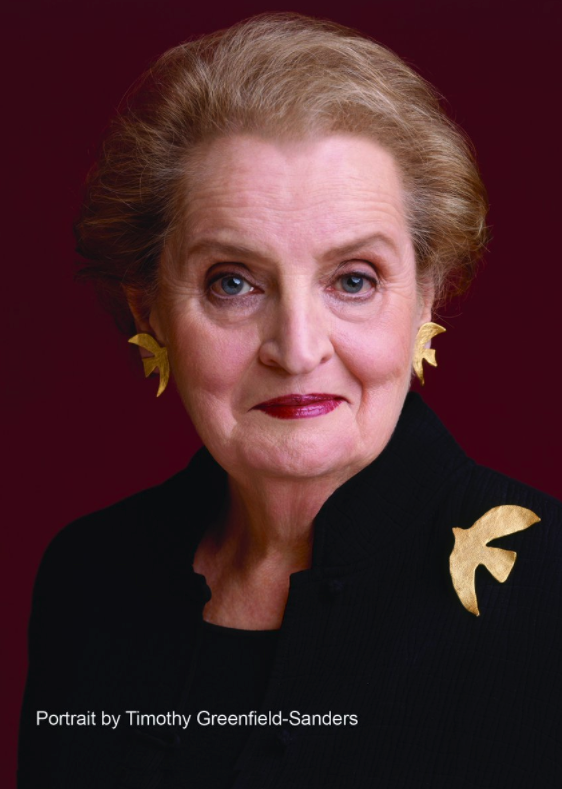
In preparing for her 2000 visit to North Korea, Madeleine Albright was told that Kim Jong-il was an avid basketball fan. “I am totally responsible for Dennis Rodman,” she said. Albright explained that to her host’s delight, she brought a Michael Jordan autographed basketball, which was the impetus for future visits by Rodman. That anecdote lightened a recent talk by Albright, where she also identified the biggest threat to American security.
Albright was named the first female Secretary of State in 1997 and became, at that time, the highest-ranking woman in the history of the U.S. government (and remains the highest ranking U.S. official to visit North Korea). Prior to her appointment, she served as the U.S. Permanent Representative to the United Nations and as a member of the President’s Cabinet.
She spoke on February 6 at the CFA Society of Boston’s annual dinner.
Albright explained that prior to her visit to North Korea, “the only other thing they told me was that Kim Jon-il was crazy and a pervert.” She paused before adding, “I discovered he wasn’t crazy.”
But her role in North Korean relations had serious consequences. Her visit established that talks with the regime were possible, although North Korea went on to violate the terms of the agreements that had been negotiated during the Clinton administration, by progressing its program to develop nuclear weapons.
I’ll review what Albright identified as America’s biggest threat, but first here are some of the more entertaining anecdotes from her talk.
Why Devin Nunes would fail her class
As a professor in diplomacy at the Georgetown University School of Foreign Service, Albright is teaching a course on national security decision making this semester.
She is on record as having stated that if Representative Devin Nunes was in her class, he would get an F. During her talk last week, she was asked to explain why the chairman of the House Permanent Select Committee on Intelligence would struggle in her classroom.
“Well, first of all he should learn to write,” she said.
“I hate to say this, but nobody in the government reads 35-page papers,” she explained. As a result, Albright said, she teaches her students how to write a memo in a clear and logical way.
“There can’t be spelling mistakes,” she added, “and you actually have to do it yourself if you’re going to take the class – you can’t have a staffer write your paper.”
“So yes, he would flunk,” Albright concluded.
She went on to argue that other members of the current administration’s leadership could benefit from her course because her syllabus includes a review of why diplomacy should be the primary tool used in matters of national security.
“What is interesting is the Defense Department understands that,” Albright explained. “Because Secretary Mattis has said, ‘If I don't have more diplomats, then I have to have more bullets.’"
“I do believe in our military,” Albright clarified, “I don't begrudge the Defense Department any of its money.”
“I've just been reading the Trump national security strategy,” she added, “and it is absolutely appropriate for the president of the United States to say that the most important thing is to protect our people, our territory and our way of life.”
But according to Albright, the current administration is undercutting U.S. power by undermining the State Department’s diplomatic efforts.
“I believe that America is safer when other countries are democracies,” she said.
Albright’s jewelry-box diplomacy
Albright took the time to reflect on her diplomatic efforts – using lighthearted anecdotes to illustrate some of the ongoing complex issues in foreign affairs.
She spoke about the difficulties in dealing with oppressive leaders from communist countries.
Before sharing a story about offending Putin, she explained one of her signature negotiation strategies.
“By the way I'm kind of known for my pins,” she said, referring to her well known practice of using wearable pins from her collection of costume jewelry as a signal during diplomatic talks.
“I can say pins got me into trouble, and they got me out of trouble,” she said before launching into a story about the former.
Albright explained that when she was Secretary of State, she joined an important meeting with Putin at the APEC summit. “He was still acting president,” she said, “he met with President Clinton and he just wanted to ingratiate himself.”
At the time, she explained, Russia was taking a “hear no evil, see no evil, speak no evil” stance towards the Chechan atrocities. To prepare for the meeting, Albright decided to find a pin with three monkeys.
When they walked into the Kremlin, she recounted, “President Putin looked at President Clinton and he said, ‘We always notice what pins Secretary Albright wears. Why are you wearing those monkeys?’”
“I cannot believe that I actually said, ‘Because I think your Chechnyan policy is evil.’"
“He got furious at me,” Albright said, “President Clinton looked at me like – ‘Are you out of your mind? You're the Chief Diplomat and you've just screwed up the summit.’"
“In those meetings, [Putin] is very smart,” she said, providing context for her approach to this diplomatic encounter.
“In meetings he did not have talking points, he took notes, and he was stiff as a board,” she said. “He was a really unpleasant person; we cannot forget that he's a KGB officer.”
Though unconventional, Albright’s approach to this specific meeting enabled her to elicit a reaction from the stern leader about a timely issue.
“That was something that got me into trouble,” she continued. “It's not totally germane, but I have to tell you when they got me out of trouble, if I may.”
Albright went on to share a story about the difficulties in responding publicly to discrimination in international affairs, a timely topic as the #MeToo movement continues around the world.
“I invented the art of diplomatic kissing,” she said, “which is much more complicated than meets the eye.” Providing examples to explain, she said, “In Latin America some kiss on the right cheek and some on the left cheek. The French kiss on both cheeks.”
“Anyways, I had just arrived home after a trip to South Korea,” she continued, “where I met the foreign minister.”
Albright said, “All of a sudden I get a call from a journalist saying, ‘Don't you think the foreign minister of South Korea should be fired because of what he said about you?’”
Having returned from what she considered a successful diplomatic trip, Albright was confused and asked the journalist what statement had been made.
The reporter responded, “He said, ‘Well, I really like it when Secretary Albright comes because we're about the same age, but I'm this tired old man. When I embrace her, she has very firm breasts.’"
The reporter then asked, “What do you have to say about that?”
"I said ‘I have to have something to put those pins on,’” Albright recounted.
America’s biggest threats
Continuing her discussion about the difficulties in diplomacy, Albright commented on the biggest national security challenges today.
According to Albright, the Trump administration is making a mistake by claiming that Russia is the biggest threat to America. She explained this by providing historical context.
According to Albright, “Putin has played a weak hand brilliantly.”
She explained that after the wall came down in 1991, national pride in Russia was dwindling. She recalled being there at the time conducting research, “I'll never forget one day outside of Moscow, this man stood up and said, ‘I'm so embarrassed. We used to be a superpower, and now we're Bangladesh with missiles.’"
“What happened is Putin plugged into that loss of national identity and pride,” she said. “He has done that despite the fact that the economy in Russia is not so good, and its oil prices are not providing what it needs.”
“He is viewed as somebody who has returned national identity,” she explained, “he wants to recreate some part of the Russian Empire.”
“He is smart. KGB agents are pretty good at propaganda,” she warned. “He has been undermining democracy all through central and eastern Europe, separating us from our allies, and doing various things in terms of fake news.”
“What bothers me at the moment,” she said, “is there's a new defense strategy of ours that has come out that says our biggest threats are China and Russia.”
“It is a gift to Putin to all of a sudden be back as America's biggest threat,” according to Albright.
According to Albright, the biggest threat to America is North Korea.
“Without going through the whole history of it,” she said, “the Korean situation is really complicated.”
“The bottom line is we want North Korea to stop being a threat to our allies, to South Koreans, and to us – it’s very hard to do that if you're not talking to them,” she said.
Albright explained that we have never had a peace treaty with North Korea. She said that the situation has become increasingly complicated since our diplomatic efforts were abruptly cut back when Clinton left office. That comment could be interpreted as self-serving, since talks comprising China, North Korea, Japan, Russia, South Korea and the U.S. began in 2003 and continued over a number of years until 2009 under President Obama. All the while, North Korea had continued its nuclear weapons program, which was well under way during the Clinton administration.
“It's very dangerous,” Albright said, commenting on recent exchanges between U.S. and North Korean Officials.
“When I think of the most dangerous places [in the world] right now,” she said, “with what’s going on, [North Korea] is right up there.”
In her closing remarks, Albright noted that, “Democracy is resilient, but it does need TLC.”
“I'm often asked if I'm an optimist or a pessimist,” she said, “I'm an optimist who worries a lot.”
Read more articles by Marianne Brunet
 In preparing for her 2000 visit to North Korea, Madeleine Albright was told that Kim Jong-il was an avid basketball fan. “I am totally responsible for Dennis Rodman,” she said. Albright explained that to her host’s delight, she brought a Michael Jordan autographed basketball, which was the impetus for future visits by Rodman. That anecdote lightened a recent talk by Albright, where she also identified the biggest threat to American security.