Advisor Perspectives welcomes guest contributions. The views presented here do not necessarily represent those of Advisor Perspectives,
“Is there anything I can do to be more transparent or communicate better?”
That’s one of several questions Dr. Frank Murtha has suggested financial advisors ask to strengthen relationships with their clients. Murtha, a psychologist and co-founder of MarketPsych, and Bob Schmidt, manager of the Brandes Institute, discussed behavioral finance during an Advisor Perspectives webinar called “Training the Investor Brain.” The duo shared more than a dozen specific questions, anecdotes, tools and tactics advisors can use today to help better manage client emotions – and in turn their clients’ money.
“The financial advisor profession is under attack today,” Murtha said. “And the attacks are coming from regulation, robo-advisors and the increasingly popular notion that people can invest successfully on their own.” While some individual investors have shown proficiency with money management, Murtha said many struggle. “And they struggle primarily because of behavioral biases. It’s very, very difficult to stay rational and disciplined over a long-term horizon. And generally people need these traits to do well.”
Murtha has worked with financial advisors and individual investors for 18 years, taking theories about behavior and providing guidance to put the theories into practice. Schmidt has managed the “thought leadership” division of investment management firm Brandes Investment Partners since the Institute’s inception in 2002.
“The lingering question I have about the growing field of behavioral finance is, ‘So what?’” Schmidt asked. “What can advisors actually do with these concepts? How can they apply them to shield investors from missteps and exploit others’ shortcomings?”
In the webinar, the team discussed specific worksheets, handouts and phrases advisors can use with clients to address popular and destructive biases such as fear, short-term thinking and extrapolation.
Among the items available free of charge to advisors[1]:
-
Bias Alert Guide – a worksheet to discuss specific traps clients may face and how to avoid them;
-
Stress Management Plan – this is designed to help limit emotion and keep clients focused on the long term;
- A dessert plate-sized handout that illustrates the dangers of checking performance too frequently called “Wheel of Investor Emotion” (See the handy user guide too.);
-
Short article – designed to counter investor preference for stocks in their “home country”; and
- A podcast titled “Behavioral Finance – So What?” featuring Schmidt and Murtha.
Murtha also stressed that advisors work not only with clients, but with their clients’ children and grandchildren to help their business flourish across generations. “The Planning Fallacy contends people don’t appreciate how much time and effort it takes to reach a goal,” he said. For example, high-profile construction projects tend to run over budget and take much longer to complete. Similarly, people often fail to see the benefits of starting their investment journey early and sticking to it. This lesson can be valuable for younger investors.
Schmidt discussed the 10-30-60 Rule. “The rule posits that sixty percent of the money people may withdraw during retirement comes from investment returns earned during retirement. Thirty percent comes from investment returns earned during the working years, and 10 percent comes from their actual retirement contributions during the working years. And the example we use assumes they earn a 7.5% annual return while working and when they stop working. I worry that if people shy away from stocks and increase their exposure to bonds or cash as they age, they may run out of money. People need to plan for getting to and through retirement.”
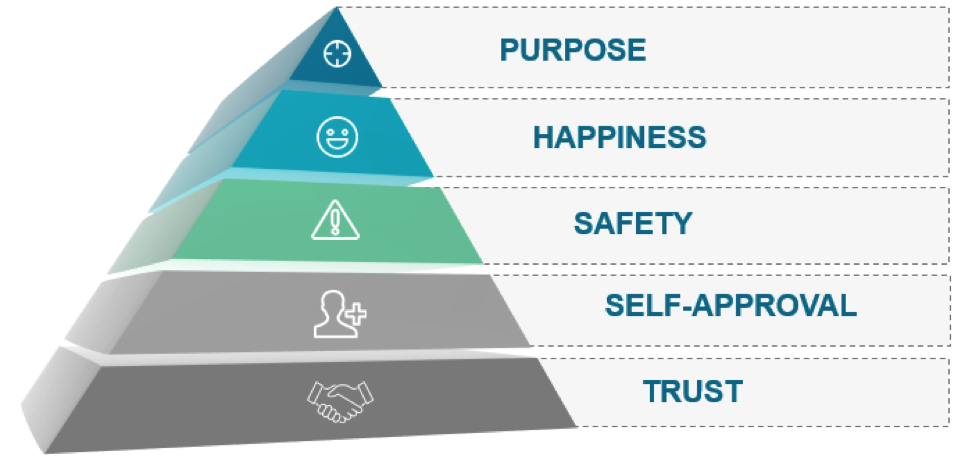
Murtha delved into the psychological foundation and higher-level emotions investors need in order to feel successful. He created an “Investor Hierarchy of Needs” modeled off Abraham Maslow’s pyramid, which puts basic needs such as food and shelter at the bottom and “self-actualization” at the top.
Murtha’s theory on investor needs was published at the Financial Advisor magazine website in September. At the foundation is trust. See Exhibit 1 below. “And right above trust is self-approval,” Murtha said. “Not safety or happiness. Clients need to feel they are doing the right things before they invest – it’s about living up to their values.” Murtha offered advisors a couple questions to trigger a meaningful conversation that could reveal client needs and bolster their self-approval: “What are the most important things you want your investing to accomplish?” And “What makes these things so important to you?”
He added that he and Schmidt have created a 2-page article that includes 10 specific questions advisors can ask to build credibility and a bond with clients designed to last a lifetime. Advisors can download the article here.
Exhibit 1: Investor Hierarchy of Needs Offers Blueprint for Enhancing Client Satisfaction

The duo stressed advisors remain their clients’ “trainers.” “It’s the reason we call this webinar ‘Training the Investor Brain.’ We really look at what advisors do as an ongoing training process,” Murtha said.
“To the degree we can be a resource in that process,” Schmidt added, “please ask us.”
For more information about Training the Investor Brain materials, contact either Bob Schmidt ([email protected]) or Dr. Frank Murtha ([email protected])
Frank Murtha, Ph.D., co-founder of MarketPsych, specializes in helping others apply behavioral finance to build relationships, increase assets and improve returns. He has consulted to dozens of leading financial institutions and trained thousands of professionals. Dr. Murtha is not affiliated with Brandes Investment Partners or the Brandes Institute. His views are his own and do not necessarily represent those of Brandes.
The information provided in this material should not be considered a recommendation to purchase or sell any particular security. It should not be assumed that any security transactions, holdings or sectors discussed were or will be profitable, or that the investment recommendations or decisions we make in the future will be profitable or will equal the investment performance discussed herein. No investment strategy can assure a profit or protect against loss. Brandes Investment Partners does not guarantee that the information supplied is accurate, complete or timely, or make any warranties with regard to the results obtained from its use. Brandes Investment Partners does not guarantee the suitability or potential value of any particular investment or information source.
Copyright © 2019 Brandes Investment Partners, L.P. ALL RIGHTS RESERVED. Brandes Investment Partners® is a registered trademark of Brandes Investment Partners, L.P. in the United States and Canada. Users agree not to copy, reproduce, distribute, publish or in any way exploit this material, except that users may make a print copy for their own personal, non-commercial use.
The foregoing reflects the thoughts and opinions of Brandes Investment Partners® exclusively and is subject to change without notice. Brandes Investment Partners® is a registered trademark of Brandes Investment Partners, L.P. in the United States and Canada.
[1] For more information on free resources for advisors, please contact Brandes’ Private Client Services department at [email protected].
Read more articles by Frank Murtha and Bob Schmidt