Why Tech Companies Want You to Believe America Has a Skills Gap
Membership required
Membership is now required to use this feature. To learn more:
View Membership BenefitsWeeks before she lost her job, Judy Konopka’s desk was already clear. Gone were the photos and plants, the vintage typewriter and illustrated calendar. The wall where she had once tacked up a print-out of an inspirational quote was bare. By the time she walked into the brisk New England winter air on her last day, exiting the building where she had worked for the better part of two decades, Konopka didn’t have so much as a box to load into her 2007 Pontiac Vibe.
Konopka’s departure from Northeast Utilities in 2014 wasn’t billed as a layoff. Her employer’s merger with a Massachusetts power company would eliminate 350 jobs “through attrition,” the chief executive officer said when the deal closed in 2012. For a while, the staff believed it. The tie-up created a $12 billion company that eventually became Eversource Energy, with about 4 million customers across New England. Management gave reassurances that there would be more than enough work to go around after the deal, Konopka recalls — there was even a flutter of anticipation about the chance to do projects on Cape Cod.
But group by group, over the course of several months, teams were being displaced. Konopka, a web designer, was one of about 200 information technology employees to be laid off. Several not only had to watch their jobs go to foreigners, but also to train their replacements.
Many new hires were H-1B visa holders — mostly young, educated guest workers hired for “specialty occupations” such as engineering or computer programming that require at least a bachelor’s degree. Created in 1990 as part of President George H.W. Bush’s plan to expand legal immigration, the program had an initial cap of 65,000 approvals each year.
Over the past three decades, however, the H-1B visa category has become a reliable mill of temporary human capital. Congress raised the limit to 195,000 in the early 2000s before bringing it back down again — though thanks to exemptions, most petitions are approved outside the latest 85,000 limit. (In 2018, for instance, more than 200,000 were approved outside the cap.) The population of H-1Bs in the U.S. has swelled to almost 600,000. They now account for about 10% of the U.S. information technology workforce.
On Monday, President Donald Trump signed an executive order that will increase scrutiny of federal contractors' use of the H-1B holders to replace U.S. workers. This follows his temporary suspension of the visa program in June. Both actions come as the president seeks to protect jobs lost during the coronavirus outbreak and as the November election looms.
Many now worry that plugging this wellspring of capable minds will hamper any economic recovery and threaten the U.S. ability to innovate. There’s no doubt that America’s dynamism will continue to depend heavily on its ability to attract the world’s smartest and most accomplished to its shores. Yet the experiences of Konopka, who worked her way up from a secretary, and thousands of other displaced workers across the country also tell another story: Americans have plenty of education, talent and experience — but an ever-ready supply of less expensive and more dependent guest workers gives companies less incentive to invest in them.
Companies have long complained of a skills gap among job seekers who aren’t keeping up with the demands of the labor market. Almost 70% of U.S. employers reported a talent shortage at the end of 2019. Businesses rank engineers and IT personnel, including cybersecurity experts, network administrators and technical support, among the top five roles that are hardest to fill, according to the Manpower Group.
Believers in the skills gap aren’t limited to board rooms and C-suites. Lawmakers on both sides of the aisle, editorial pages, think tanks, universities and other worthy institutions have fretted about America’s competitiveness. President Barack Obama warned about this generation’s “Sputnik moment,” while his advisory council blasted schools for “failing systematically” to produce enough students interested in science, technology, engineering and math.
In 2017, the administration of President Donald Trump directed the Department of Education to channel at least $200 million a year toward STEM, noting that coding skills are critical for high-paying jobs. Too few schools are providing students an adequate foundation in STEM and computer science, the president said.
It’s true that the U.S. K-12 education system has serious problems and needs sustained improvement. Average U.S. test scores are mediocre, and the U.S. can’t hope to succeed in the 21st century if its high school graduates aren’t competent in science and mathematics. But as the demographer Michael Teitelbaum, author of “Falling Behind? Boom, Bust and the Global Race for Scientific Talent,” has noted, “there is a big disconnect between this broad educational imperative and the numerically limited scope of the science and engineering workforce.” In most countries, only 5% to 10% of the labor pool ends up in occupations that require high levels of science and math, almost all of which draw upon students who were in the top-performing quartile of high-school test-takers. To determine if the U.S. educational system is failing to produce enough high-skilled workers, it’s more instructive to look at how the best students are faring.
There, the outlook is much brighter. American citizens and permanent residents have been graduating with a record number of bachelor’s degrees in computer science and engineering over the past five years. In 2018, U.S. colleges and universities awarded roughly 365,000 undergraduate STEM degrees, up 60% from a decade earlier, according to calculations based on data from the National Center for Education Statistics. Of that total, 92% went to Americans and permanent residents. Meanwhile, test scores among seniors majoring in computer science in the U.S. “substantially outperform” those in China, India and Russia, according to research published in the Proceedings of the National Academy of Sciences. “The skills advantage of the United States is not because it has a large proportion of high-scoring international students,” a group of academics and experts found.
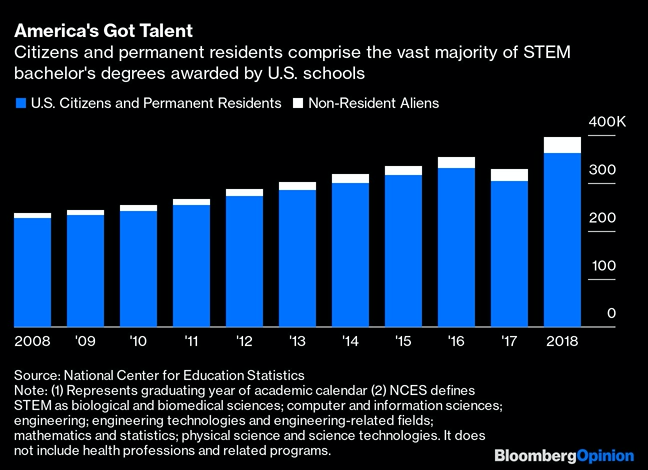
America's Got Talent
It's important to note that these areas of study — and the occupations they may lead to — tend to get jumbled in conversations about STEM. But distinctions are critical: Just as emerging markets can’t be considered a monolithic asset class, the STEM labor market is almost impossible to assess as a whole. At any given time, some fields will be doing well, and others won’t.
To assess the skills gap, then, it makes sense to look at the sector where most H-1Bs are heading: technology. In fiscal 2019, two-thirds of approved H-1B petitions were for computer-related occupations, according to U.S. Citizenship and Immigration Services. Are these guest workers filling a dire shortage?
The data suggest otherwise. In 2018, the U.S. had between 95,500 and 143,000 job openings in IT occupations that typically went to candidates with a bachelor’s degree or higher in computer science or engineering, according to Hal Salzman, a professor at Rutgers University’s Edward J. Bloustein School of Planning and Public Policy. American citizens and permanent residents earned about 100,000 degrees in computer science or related engineering fields, filling the low end of that estimate. But unlike in law or medicine, in technology you don’t need a computer science degree to work: In fact, two-thirds of new entrants in IT occupations major in other disciplines. That means most openings can be filled from a much larger pool of qualified candidates — just consider any number of the 1.8 million Americans who graduate each year.
Even if you insisted on filling these jobs only with computer science majors — an approach that neither Steve Jobs nor Bill Gates would theoretically endorse — creating another 40,000 or so to meet the top end of demand shouldn’t be difficult: According to Salzman, this field has the second-lowest STEM credit requirement of all such majors.
Set this broader pool against the inflow from abroad, which included 53,000 foreign graduates with degrees in computer science or related engineering fields, as well as 48,000 initial H-1Bs destined for computer occupations in 2018, not to mention the tens of thousands of potential applicants, if not more, from the alphabet soup of other visa categories. What we see is an industry awash with supply. “The story in Washington is that we have this STEM skills gap and U.S. students are just not capable. What the data shows you is that, in fact, U.S. students are both interested and capable of doing this kind of work,” said Ronil Hira, an associate professor of political science at Howard University who studies visa programs. “None of the evidence indicates a significant shortage.”
Even job-opening forecasts can’t always be taken at face value. As a recent report on undergraduate enrollment in computer science by the National Academy of Sciences notes: “Many estimates come primarily from sources tied to industry, which could be argued has some incentive to justify a more favorable hiring environment — to expand the pool of potential hires and create more competition, leading to more highly qualified talent and enabling them to offer lower wages.”
Indeed, any armchair economist can tell you that if laborers were truly scarce, employers would be scrawling out bigger paychecks with fat signing bonuses and generous benefits. Yet as with the rest of the economy, wages in many computer occupations have flat-lined. In two of the fastest-growing fields — software developers and information security analysts— average annualized wages grew 0.1% and 0.9% from 2014 to 2019, according to Salzman and Khudodod Khudododov, a research analyst at Rutgers. That compares with 0.9% for nurse practitioners, zero growth for accountants and auditors, and a decline of 0.4% for management analysts, which includes consultants. In short, no one is doing particularly well, and coding skills are no ticket out of that.
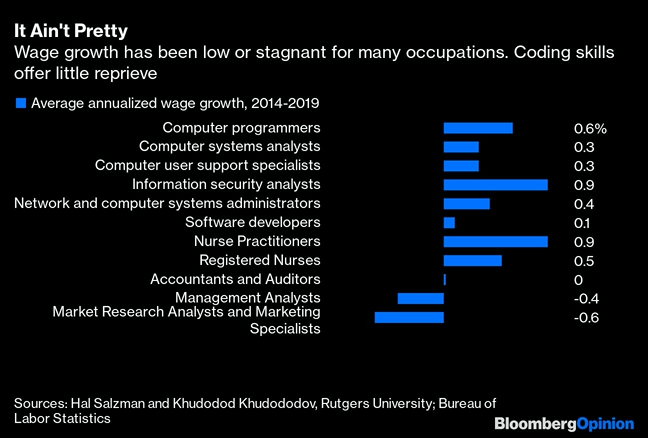
True, overall wages in the tech sector are higher than in other fields. The median annual wage for computer and IT occupations is $88,240, more than double the level for other jobs. That doesn’t mean the industry is growing. Layoffs have accelerated, with 64,166 job cuts in 2019, up 351% from a year earlier. That outpaces the number of new hires planned by three to one, according to Challenger, Gray & Christmas Inc. Salzman and Khudododov found computer programming employment sank 34% from 2014 to 2019 — a curious trend for an industry facing a shortage.
Churn and Burn
Another metric to consider is vacancies. Do these postings languish on job boards? Andrew Weaver, an assistant professor at the University of Illinois at Urbana-Champaign’s School of Labor and Employment Relations, found that persistent hiring problems are much less common than the prevailing skills gap narrative suggests: In IT, just 11% to 15% of U.S. help desks faced extended vacancies, compared with 16% to 25% for manufacturing — even though IT positions require more education and training. Typically, you’d expect just the opposite: In a tight labor market, higher-skilled positions would see more long-term openings, Weaver said.
Even those hard-to-fill positions can be a consequence of too many good applicants, according to Peter Cappelli, a professor at Wharton and author of “Why Good People Can’t Get Jobs.” Filtering software weeds out resumes that don’t meet an employer’s qualifications. “In this case, it might pay off for employers to wait for someone who is perfect for the job, not merely qualified, or even see who will do the job at a wage well below the market rate,” he wrote. “Just as there is no shortage of diamonds even though they are expensive — you can buy all you want at the market price — not being able or willing to pay the market price for talent does not constitute a shortage.”
And this is precisely what’s happening with H-1B workers and their American counterparts.
Technically, employers must pay H-1Bs a “prevailing wage,” which should match or exceed what a comparable American would make. (Contrary to popular belief, the H-1B application process does not require employers to make any effort to hire Americans first.) This wage level is to prevent undercutting U.S. workers and exploiting foreigners.
In practice, though, companies have ample discretion in setting this level, and often find loopholes, such as hiring through outsourcing firms. A recent paper by Hira and Daniel Costa for the Economic Policy Institute concludes that companies in the D.C. metro area got a 36% discount from the median wage level for the most common certified H-1B occupation (a category of software developers) in the wage bracket for entry-level positions, a difference of $41,746 per employee in fiscal 2019. The discount came to 18%, or $20,863, for the second-lowest bracket. This can amount to billions of dollars of potential savings for employers. Hira and Costa found that the Labor Department certified 60% of H-1B jobs at levels well below the local median wage for the occupation.
These visa holders are not only less expensive, they also have less bargaining power vis-à-vis their employers. For no small number of them, what begins as a promising career entry point often ends up becoming a version of “bonded labor,” says Salil Choudhary, a former H-1B holder who became an American citizen in 2010. When immigration status is tied solely to an employer, problems such as getting underpaid and overworked often go unreported, for fear of retribution. Choudhary, who studied as an engineer in India, recalls getting sucked into projects without getting paid for overtime. “If you’re working 16-hour days, you’re taking two jobs from the U.S. market... In every way you are screwing up the system,” he said. And equalizing salaries isn’t necessarily the answer if it means employees are forced to work 18- or 19-hour days — a prospect most U.S. workers wouldn’t stomach.
“You’ve created a low-cost, high retention indentured servant model,” said Bruce Morrison, an immigration lobbyist and former Democratic congressman who helped write the original H-1B statute. “That’s what Americans are competing with, and they’re too smart to compete, so they go somewhere else.”
So rather than drawing America’s sharpest minds into technology, a combination of depressed wage growth, high churn, long hours and a lack of employee development in effect encourages talented graduates to pursue more lucrative fields, such as finance. Remember, most tech employees aren’t sitting around foosball tables sipping kale smoothies on Sand Hill Road. They’re more likely to be in a back office somewhere in Jersey City or Tampa.
Such considerations were absent from Big Tech’s response to the Trump administration’s restrictions on H-1Bs. Instead, a chorus of titans blasted the White House for narrowing the path for the world’s best and brightest to come spur American innovation. Sundar Pichai, CEO of Google-owner Alphabet Inc. and an Indian immigrant himself, tweeted: “Immigration has contributed immensely to America’s economic success, making it a global leader in tech, and also Google the company it is today.”
But H-1B visa holders are not immigrants. (Nor are they as exceptional in their qualifications as other employment visa categories.) They are guest workers with a three- to six-year limit on their stay that's often extended, stuck in a “weird netherworld” of being “permanently temporary,” says the EPI’s Costa. They pay U.S. taxes but receive few of the protections that American workers enjoy — namely, unemployment insurance.
The data can be hard to parse, but a large share of H-1Bs are eventually sponsored for permanent residency by companies, and a big portion of green card applications are for people on H-1B visas. Given the backlog of applicants, though, it can take years, and decades in the case of many Indian tech workers, to get one. Meanwhile, H-1B holders with pending green cards have very little job mobility – that is, the ability to switch employers. Keep in mind, too, that companies have the option to directly sponsor workers who are still abroad, which used to be more common, according to Hira. “The green card backlogs and employer preferences have made the H-1B a principal, but not only, way station to the green card,” he wrote in an email. “Employers like the try-before-you-buy feature of this system.”
In this way, H-1Bs have become an unfortunate prop in the narrative that the U.S. has an urgent unmet economic need that its struggling educational and immigration systems can’t fill. Deep-pocketed tech companies that lobby Washington on immigration are joined by universities and research institutions seeking to expand their STEM programs and attract foreign students willing to pay top dollar tuition, in part to get into the U.S. employment pipeline. As Teitelbaum observes, what’s emerged is an elaborately successful campaign to keep labor and capital flowing.
Teitelbaum sees at least five distinct “alarm-boom-bust” talent shortage cycles, which the U.S. has repeated every 10 to 20 years since World War II. Politicians, the business community, an institutional report or the media express concerns that the U.S. lags international peers in science and engineering; the government duly boosts the supply of students and workers; a flooded market becomes prone to shocks; suddenly, a cohort of bright-eyed graduates who’ve spent years in labs and libraries find themselves in a lousy job market with few career prospects. Younger generations of students get discouraged and pursue different career paths, and so the cycle begins anew. You can trace this in endeavors from nuclear weaponry and the space race to the war on cancer, peak Cold War defense spending, and boom-busts in tech and biomedical research.
Now we might find ourselves looking at another kind of bust, with 17 million unemployed and roughly a third of those jobs possibly never coming back. The tech industry has shed more than 72,000 jobs since the coronavirus was declared a pandemic, according to one industry tracker. Then consider the other STEM labor markets that might be affected. Aeronautical engineers, for example, now face diminishing prospects with the airline industry in shambles. Airbus SE and Boeing Co. together have plans to cut more than 30,000 workers.
As we pick through the rubble of a labor market ravaged by Covid-19, a critical question will be how to get unemployed Americans from occupations that have gone bust into other fields. “A laid-off aeronautical engineer could become a very successful Silicon Valley tech worker,” said Teitelbaum. “But not if you aren’t willing to retrain him.”
For years, the steady flow of relatively cheap, ready-to-work H-1Bs has helped diminish incentives for many companies to invest in training and development. In a 2011 op-ed for the Wall Street Journal, Cappelli, the Wharton professor, wondered how businesses could complain of difficulties finding qualified candidates with unemployment hovering just below a post-recession high of 10%. He noted that blame gets passed around — schools are failing, immigration policy is insufficient and Americans are lacking skills. “But I believe that the real culprits are the employers themselves,” he wrote.
Not much has changed in the years since. Though companies in North America spent $169.4 billion on training last year, workers and managers are dissatisfied with the outcome. Government programs such as Trade Adjustment Assistance, which helps employees displaced by globalization trends, have been largely written off as ineffective.
Academics like Weaver at Illinois have proposed better coordination between employers and community colleges or universities. This approach would not only widen students’ job-search networks and help companies design roles that better suit the future workforce, it also ensures that the skills being taught match up with requirements. Often, hiring managers ratchet up specifications during a downturn to help screen out the inevitable flood of candidates. That means employers sifting through the current pool of applicants will have their pick, but they could be eliminating people with decades of experience, like Konopka, whose talents aren't easily identified by an algorithm.
Konopka ended up using her TAA assistance to finish a graphic design degree, and she works as an artist with two shops on Etsy where she sells her prints and restored photographs. She went from making $90,000 a year to $35,000. But even if the labor force has lost her IT expertise, at least she's now content. The quote she once had on her wall was, “Everything you want is on the other side of fear” — and notwithstanding a $4,000 health-insurance deductible, Konopka swears she will never go back to IT. “I’d prefer to work for myself,” she said. “That’s why I’m an artist now, because nobody can replace my art.”
Rather than shepherding exceptional talent to the U.S. and turning them into Americans, the H-1B system has given companies a steadily expanding supply of guest workers who are themselves stuck in indentured limbo. As Labor Secretary Eugene Scalia wrote recently in an opinion piece, “The H-1B program was never intended to create a pool of foreign labor that displaces Americans’ opportunities for good-paying jobs.”
Trump’s latest executive order could set some much needed H-1B reforms in motion. For one, it seeks to close a loophole that enabled companies to hire guest workers — through outsourcing firms — without attesting to the Labor Department that they could cost Americans like Konopka their jobs or hurt their wages. (Outsourcing firms themselves theoretically must be able to support these claims — but of course their employees aren’t affected, as Scalia noted at the signing.) Meanwhile, increased collaboration between the Departments of Labor and Homeland Security, announced Friday, means that the secretary of labor is more likely to initiate fraud investigations, rather than waiting for complaints to be filed. These measures are part of a broader revamp of the H-1B program the White House has initiated, with more likely to follow in the coming weeks, Bloomberg News reported. Yet some of the more substantial regulatory changes on the table never managed to get legislative traction before the coronavirus, and may not advance in a Biden administration. Absent enforcement of these proposals, Trump’s June order mostly imposes a blunt and temporary ban that has thrown thousands of lives into chaos.
If the U.S. is going to compete in the global race for talent, it needs to offer the best and the brightest workers less convoluted pathways to legal immigration, instead of false promises that lead to exploitation and decades-long waiting lists. And if the U.S. is equally committed to providing its citizens with the broadest range of opportunities, as it should be, companies must also be able to prove they have found candidates who legitimately fill needs that domestic workers can’t. A system in which Americans have to train their replacements doesn’t pass the test. Until we find a better balance between those needs, our broken labor market will remain a collection of easily replaceable parts.
Bloomberg Opinion provided this article. For more articles like this please visit bloomberg.com/opinion.
Bloomberg News provided this article. For more articles like this please visit bloomberg.com.
Membership required
Membership is now required to use this feature. To learn more:
View Membership Benefits