The list of worries hasn’t really changed: Inflation, war in Ukraine, Covid-19. But something in investors’ psyches did on Tuesday when stocks posted their best day in more than a month.
Fueling the rally has been string of unexpectedly sturdy economic data, undermining arguments that a recession is at hand. Housing starts came in better than forecast, while other recent reports have given solace to bulls. Hiring remains robust and applications for unemployment benefits are near historic lows. High-frequency data show consumers are out in droves shopping and dining again.
The S&P 500 rose 1.6%, its best day since mid-March and only its second gain in seven sessions. The Russell 2000 Index of smaller firms added 2% in its strongest performance of April. Meanwhile, S&P sectors sensitive to the economy -- including consumer discretionary and real estate -- outperformed, with only energy closing lower.
“The housing-starts numbers was the catalyst for an overdue, oversold rally, and that’s a healthy catalyst to have,” Art Hogan, chief market strategist at National Securities, said by phone. “To have your top seven sectors in the S&P 500 up all north of 1% is clearly a pretty broad advance.”
Housing starts surged in March to the highest level since 2006, suggesting strength in an area of the economy that is highly sensitive to interest-rate moves. Meanwhile, applications for U.S. state unemployment insurance have dropped off in recent weeks, and a consumer sentiment survey from the University of Michigan rose to a three-month high in early April.
High-frequency indicators became popular during the pandemic as analysts looked to get a grip on things like how consumers were moving amid lockdowns -- and right now they’re also trending higher. A back-to-work barometer has increased to its highest levels since March 2020, while a TSA-traveler throughput data and a gauge that measures reservations made via the restaurant-booking app OpenTable have also advanced.
“There are no complaints there about really any of the economic data that we’re seeing,” Brian Nick, chief investment strategist at Nuveen, said by phone.
Earnings reports from the country’s biggest banks indicate worries over consumer strength might have been misplaced: Data showed spending on their credit cards surged in the first quarter as customers began traveling and dining out again. And even with the increases in spending, borrowers kept up with their bills.
“The financials giving us the health-of-the-consumer report card I think changed a lot of people’s opinion,” said Hogan of National Securities. “It’s clearly a sign that this is a strong and confident consumer, and that clearly helps the psychology behind the market.”
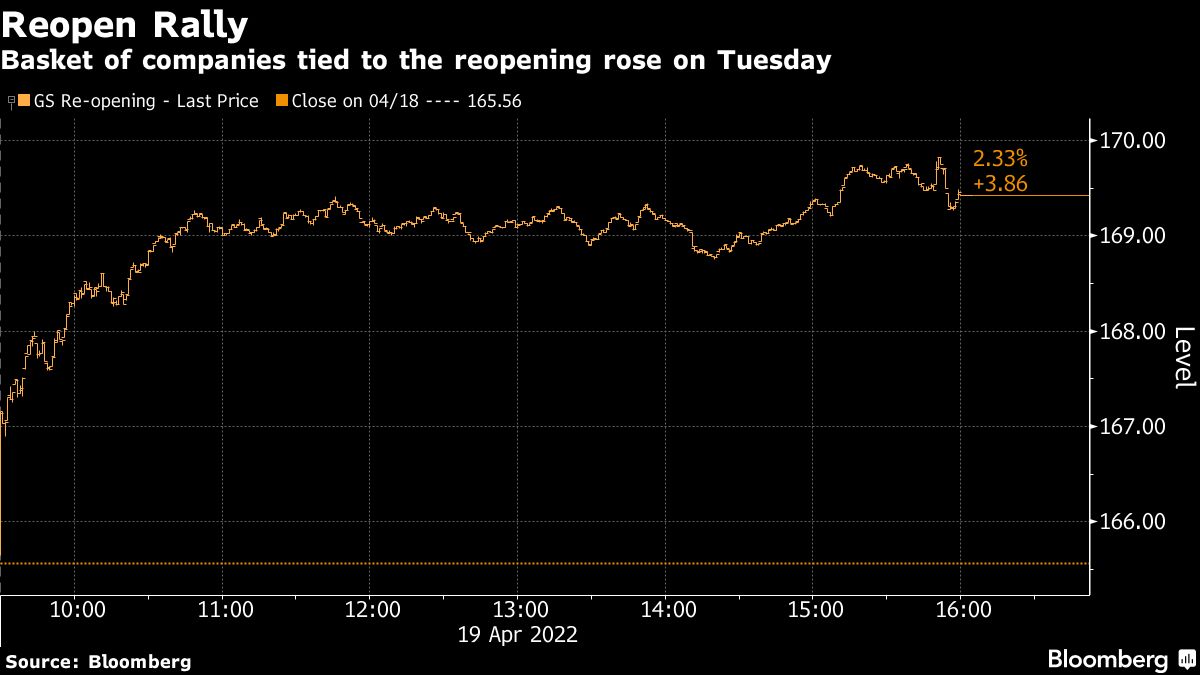
A basket of companies that benefit from economic re-openings on Tuesday outperformed one that does well when people are stuck at home. Shares of Etsy Inc. surged 4.4%, while Penn National Gaming Inc., Wynn Resorts Ltd. and CarMax Inc. each added more than 5%.
At UBS Global Wealth Management, Mark Haefele said that though risks to growth have increased, his base case is that a recession will be avoided. First-quarter earnings looks set to be positive, he said, adding that investors should look for long-term value in stocks. “Periods of heightened market volatility and uncertainty can often lead to attractive longer-term entry points in areas of structural growth,” the chief investment officer wrote. He sees sectors including 5G, automation and robotics, and smart mobility as attractive.
Elsewhere, JPMorgan Chase & Co.’s Marko Kolanovic said runaway commodity prices, diverging global central-bank policy and the recent stock-market selloff have created a unique buying opportunity for growth and value stocks. The strategist said sentiment and positioning are still too bearish.
Yet it’s hard to read too much into a one-day move, and worries about growth still pester investors and economists. And while there is merit to the argument that the buoyancy in the equity market Tuesday is reflective of an interest-rate-sensitive economic sector -- housing -- potentially signaling continued economic strength, it’s too soon to call an all-clear, said Lauren Goodwin, economist and portfolio strategist at New York Life Investments.
“If that is true, then we should expect what we’re already seeing in the market, which is a lot of volatility when economic data is released,” she said by phone. “When the path for growth, and specifically for growth and interest rates ahead, is so uncertain, the Fed and investors on a day-to-day basis become even more data-dependent than normal. So if we’re seeing a rally in equity prices today because of some positive eco data, we could move in the other direction when we get disappointments.”
Bloomberg News provided this article. For more articles like this please visit
bloomberg.com.