Advisor Perspectives welcomes guest contributions. The views presented here do not necessarily represent those of Advisor Perspectives.
This article was written with the assistance of artificial intelligence. The underlying data, financial arguments, and strategic insights were authenticated by the authors, who retain full accountability for the accuracy of the content.
As tensions simmer between the U.S., Israel, and Iran, markets once again find themselves caught between uncertainty and resilience. While the situation is fluid, it is part of a broader pattern of geopolitical friction in the Middle East.
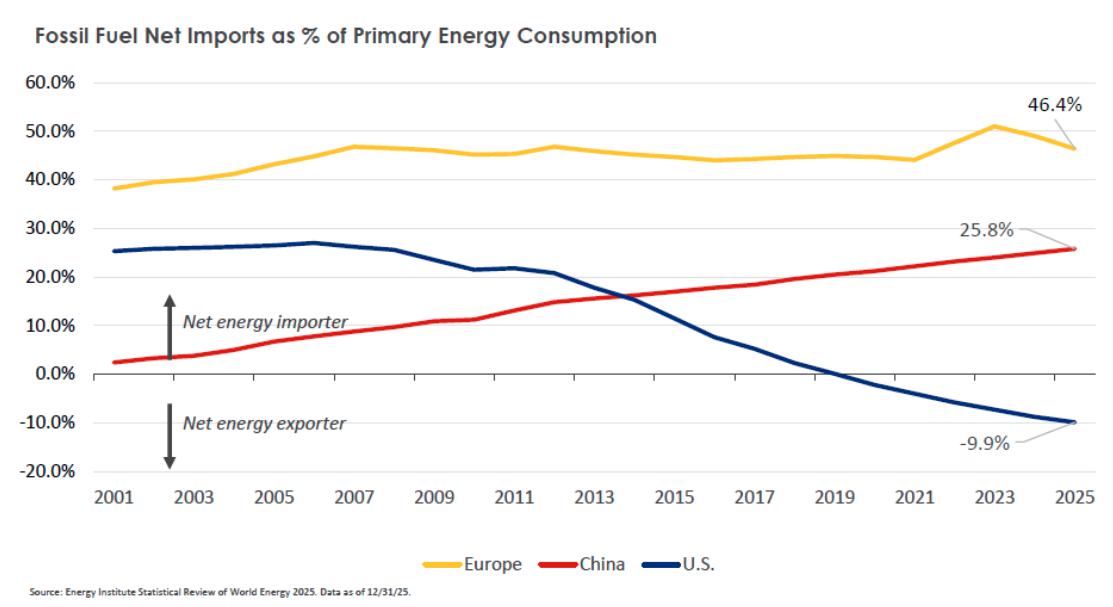
Historically, these tensions hit energy markets first and equities second, as oil prices quickly price in the risk of supply disruptions, particularly with critical chokepoints like the Strait of Hormuz. Adding China’s dependence on Iranian oil, Russia’s ongoing war in Ukraine, and elevated global tensions, macroeconomic anxiety envitably grows.
Higher energy prices could act as a tax on growth, squeezing corporate margins, increasing transportation and manufacturing costs, complicating central bank policy, and pressuring consumers worldwide. All of this is unfolding at a time when U.S. equity valuations are relatively high, leaving little room for error in the eyes of many investors.
Central Banks & Market Reactions
These dynamics put central banks like the Federal Reserve in a difficult position. The question posed is whether you support growth or remain restrictive to contain inflation. In a market priced for strong earnings and policy stability, any disruption to that balance can trigger sharp reactions. Geopolitics and energy prices are the primary drivers of volatility in this environment.
What begins as a geopolitical event can quickly evolve into an economic narrative and, ultimately, a market repricing. Geopolitical risk becomes a meaningful catalyst for volatility — not just a headline.
And yet, despite all of it, the market has been doing remarkably well. That’s the part that often feels counterintuitive. War headlines dominate the news cycle, but markets don’t operate purely on emotion. They digest information, reprice risk, and move forward.
Historical Context & Market Resilience
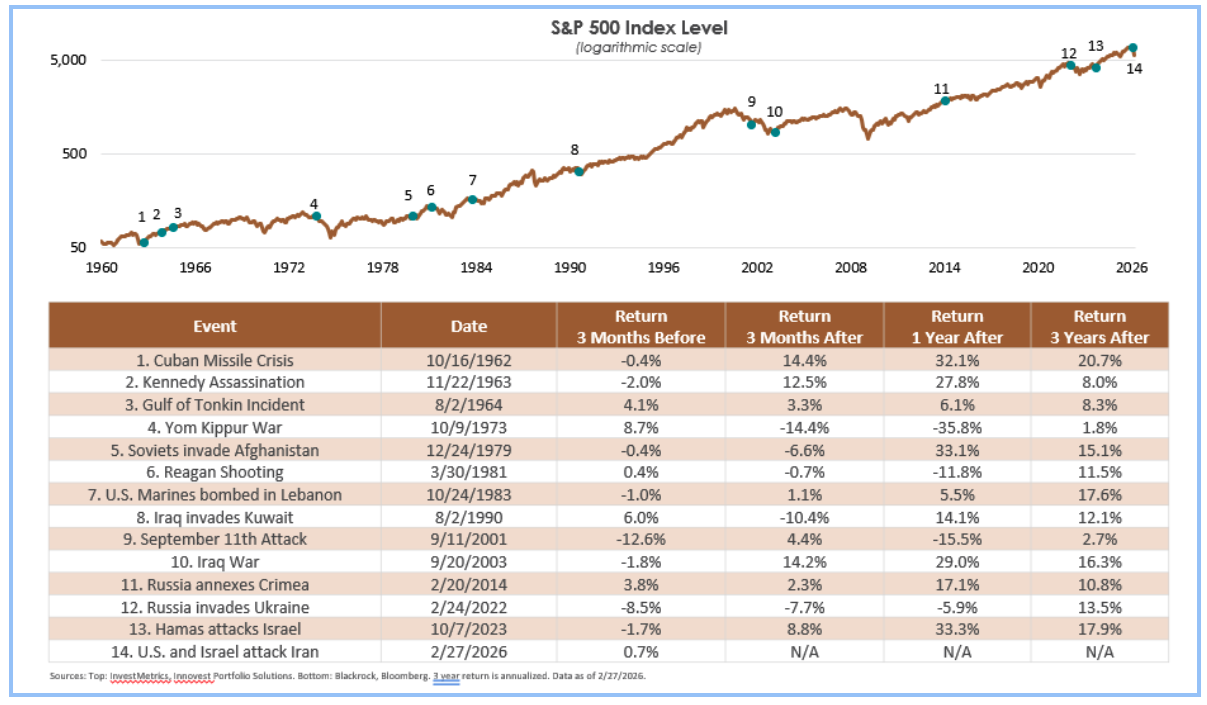
From the Cuban Missile Crisis to the Iraq War, from 9/11 to Russia’s invasion of Ukraine, the pattern is consistent. Markets may dip in the immediate aftermath — sometimes sharply — but they recover and move higher over time.
Even in the current environment, markets have demonstrated resilience. The S&P 500 has continued to reach new highs and post strong earnings growth despite ongoing geopolitical tensions tied to the Iran conflict.
The average three-year return following major geopolitical events has been over 12%, according to research from T. Rowe Price, which underscores the adaptability of global economies, the resilience of corporate earnings, and the tendency for innovation and productivity to continue even in uncertain environments. Businesses adjust supply chains, governments implement policy responses, and capital flows to areas of opportunity. Over time, these forces compound, pushing markets higher.
Winners, Losers, & Real Risks
Another often-overlooked dynamic is that geopolitical disruptions can create winners alongside losers. For example, higher energy prices can benefit U.S. energy producers and exporters, partially offsetting broader economic pressure. Energy stocks, as measured by the Energy Select Sector SPDR Fund (XLE), have outperformed the broader market by 25% year-to-date during the price surge. Markets are not static; they evolve alongside the challenges they face.
This doesn’t mean risks should be ignored. A prolonged oil supply disruption, particularly involving Iran, could have real consequences, including reviving inflation, slowing global growth, and leading to deeper or more sustained market drawdowns. Those risks are real, but volatility itself is not the exception in markets; it’s the rule.
On average, the S&P 500 experiences a drawdown of about 14% at some point every year, according to data from J.P. Morgan Asset Management, most of which occur without dramatic headlines. Yet over time, the market has continued to climb. Pullbacks of 5% happen multiple times per year on average, and corrections of 10% or more tend to occur roughly every 18 months, according to data from Fidelity Investments.
Long-Term Discipline Prevails
That’s why the most effective investment strategy remains consistent through wars, recessions, and political uncertainty: Stay diversified, maintain a long-term perspective, and rebalance along the way. Successful compounding doesn’t require perfect timing; it requires discipline and patience.
Periods like this can feel especially tense, with higher stakes and more urgent headlines. Yet over time, markets have shown they are forward-looking and resilient, absorbing uncertainty rather than freezing in it. While today’s geopolitical backdrop may feel unsettling, it fits a long history of disruptions that markets have ultimately navigated. Risk matters, but long-term perseverance consistently prevails.
Christian O'Dwyer is a Principal and Consultant at Innovest specializing in investment strategy and financial planning for families, nonprofit operating pools, endowments, foundations, and associations.
Brooklyn Seymour is an Analyst on the Research Team. Her responsibilities include monitoring investment products and strategies, creating deliverables for Innovest’s retirement plan clients, and completing quarterly performance reports.
A message from Advisor Perspectives and VettaFi: Discover something new! Click here to register for our upcoming webcasts.
More ETF Topics >
 Advisor Perspectives welcomes guest contributions. The views presented here do not necessarily represent those of Advisor Perspectives.