4 Practical Uses of TIPS in the Portfolio
Membership required
Membership is now required to use this feature. To learn more:
View Membership Benefits The views presented here do not necessarily represent those of Advisor Perspectives.
I’ve been accused of beating the drum on Treasury Inflation-Protected Securities, or TIPS, and I plead guilty as charged. I built my first TIPS ladder in late 2022 and wrote that the 4% rule just became a whole lot easier. Maybe I exaggerated a bit with the title, but in 2024, I wrote about four easy steps to build a TIPS ladder. It’s still hard to build, though the site TIPSLadder.com makes it much easier.
Recently, William Bernstein and Edward McQuarrie wrote a great conceptual piece on TIPS, noting that long-term TIPS now yield over 3% above inflation. Nathan Dutzmann also wrote about the fundamental principles of TIPS in the portfolio. I’m going to address some practical uses and even push back on the common belief that TIPS always belong in the tax-deferred part of the portfolio. I’ll start with the TIPS ladder and then note some other great uses.
Some people have asked why I suddenly became interested in TIPS at the end of 2022. The answer is easy — real rates surged. While not at an all-time high, the chart below shows that in 2020, you could lock in a real negative yield. It could guarantee underperforming inflation. As of September 22, 10-year TIPS were yielding 2.64%.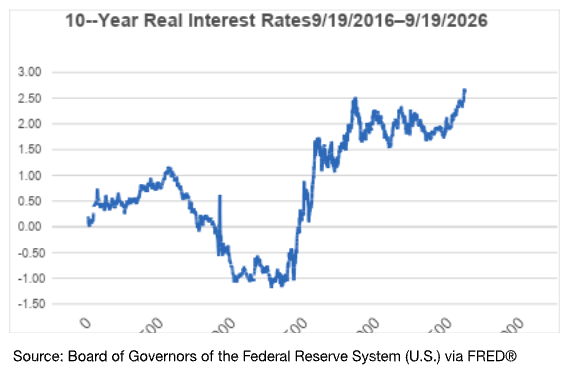
The Inflation-Adjusted Period-Certain Pension Up to 30 Years
This is also known as the TIPS ladder or up to a 30-year period-certain annuity. As of September 12, a 30-year TIPS ladder was providing a 2.93% real yield and a 4.98% annualized withdrawal rate.
This means a $1 million TIPS ladder can provide about $29,300 annually without touching the real principal, which will increase with inflation. It also means the TIPS ladder can provide just under $50,000 annually of real cash flow, so we are approaching the 5% safe withdrawal rate if one has a life expectancy of less than 30 years.
Though the economics are compelling, the real benefit is psychological. For both my clients and myself, the TIPS ladder combined with Social Security provides a spending floor that yields comfort:
- Enabling one to spend more freely from the rest of the portfolio
- Allowing peace of mind to stay the course when markets tank
While these are similar to the benefits of Social Security, the TIPS ladder does provide a survivor benefit to whoever inherits it, but has one key drawback: one could live beyond the 30 years. I’ll address this issue next.
The Inheritable Lifetime Inflation-Adjusted Pension
Obviously, people don’t die at the exact age of their life expectancy. I can attest to this by noting how thrilled I am that my own father is months away from celebrating his 100th birthday. The implication is that, say at age 70, building a 30-year TIPS ladder would not be enough. I’m not suggesting that anyone put their entire portfolio in TIPS or, for that matter, in any single asset class. But one could still build a lifetime real annuity.
Using the example of $1 million, a TIPS ladder could be built with a slightly lower payout to build longevity protection in two ways. One could use about $900,000 to build a 30-year TIPS ladder with a 4.5% real cash payout of $45,000 annually. Then one could put the remaining $100,000 in one of two vehicles.
The first would be a low-cost total stock index fund that could grow with three decades of compounding and provide funds to live on. McQuarrie, professor emeritus at the Leavey School of Business at Santa Clara University, estimates that there is a 99.1% probability the stocks would earn at least a 2% real return.
For even greater certainty, one could just put the remaining $100,000 in the TIPS maturing in 30 years. It yields about 3.08% above inflation and thus would provide about $248,400 in inflation-adjusted dollars to support that $45,000 cash flow for nearly six additional years.
Neither of these two ways of providing longevity protection is perfect, but I suspect they have a greater probability of success than an insurance company, which can default over a 30-year period
I view these solutions as better than Social Security because they can’t be adjusted downward by Congress, as is possible with Social Security. Additionally, they can be inherited by anyone, not just a spouse.
Risk-Free Equity Investing
Stocks are risky and, as McQuarrie has shown, Jeremy Siegel’s view that stocks are not risky in the long run is likely false.
For many years, I’ve written about a bond-and-stock strategy to build an annuity without the insurance company and related costs. This type of annuity is now called a fixed-indexed annuity (formerly known as an equity-indexed annuity) and provides some of the return of the stock market and a guarantee of getting back principal. A CD or Treasury bond combined with stocks would guarantee one could get back their principal. The problem, of course, is that it’s not real. Years later, that principal buys far less as inflation takes away buying power.
Using TIPS along with stocks can be risk-free in a real, inflation-adjusted way. Using the $1 million portfolio example, one could put $402,500 in the 30-year TIPS that, at a 3.083% annual real yield, would grow to $1,000,000, and put the remaining $597,500 in a low-cost stock index fund. That’s almost 60% in stocks and just over 40% in TIPS.
This solution has a small theoretical issue: The coupon paid on the 30-year TIPS would have to be reinvested in that same bond, and there is no guarantee what the yield would be each year. Also, 30 years is a long time.
Both issues can be solved with an ETF like the iShares iBonds October 2036 Term TIPS ETF (IBIM). It yields 2.54% above inflation, so $778,200 would grow to $1,000,000, with dividends reinvested. The remaining $221,800 goes into the low-cost diversified stock index fund. The longer the time period, the greater the percentage of the portfolio that can go to stocks.
A Bridge to Social Security
I think the real benefit of TIPS is long-term, since higher-than-expected inflation compounds. In other words, if inflation remains higher than the 2% target of the Federal Reserve Bank, then that compounding is devastating over time, as shown below.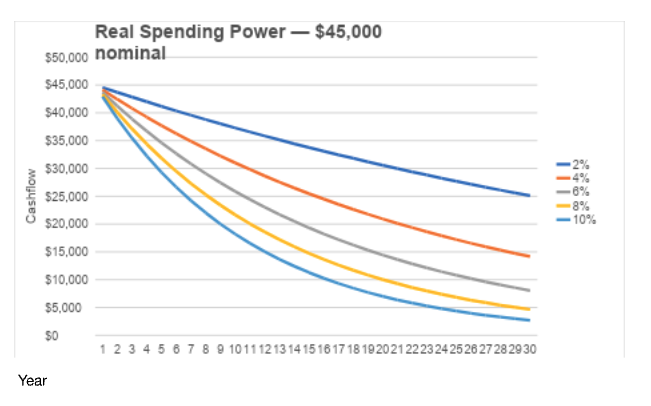
But Kevin Esler, creator of TIPSLadder.com, noted at the 2025 Bogleheads conference last year that a TIPS ladder can be used in the short term to delay Social Security to create a higher long-term benefit. If, for example, someone is 62 years old and wants to delay Social Security to age 70 in order to collect an inflation-adjusted $45,000 annually, they could bridge the eight-year gap by buying an eight-year TIPS ladder. As of September 22, that would cost about $328,000.
There are other practical uses for TIPS. In one case, a client was transferred to a foreign country for two years and wanted to buy a house when he returned. We used the iShares iBonds to invest for that two-year period knowing what the real return would be.
Where to Locate the TIPS?
Conventional wisdom dictates that TIPS be held in a tax-deferred account because they are subject to phantom income tax. Though that is only if the coupon is paid in cash, both the coupon and the CPI adjustment (not paid until maturity) are taxed.
While I wish the Treasury had designed TIPS taxation differently, it’s really no different than buying a CD and letting the interest compound. The interest is taxed every year even though it isn’t paid out by the bank. But neither the CD nor the TIPS are taxed twice. Still, I agree it's better to pay taxes later, which is a strong argument for holding in a traditional IRA.
Delaying taxes is only one argument. I strongly believe asset allocation matters more than asset location. Most of my clients and I have far more assets in a taxable wrapper and far less in the tax-deferred and tax-free Roth tax-wrappers.
Given that TIPS are state tax-exempt, this could swing the argument to hold corporate bonds in the traditional accounts and TIPS in a taxable account for a client who is in a high tax bracket living in a high-tax state such as California or New York.
As a simplified example, take a client with $9 million in a taxable account and a $1 million traditional IRA who has a target of 60% stocks and 40% bonds. The client needs $4 million in bonds and wants $1 million of that in a TIPS ladder. The client lives in California and is in the 13.3% marginal tax rate. It would be most tax efficient to locate the corporate bonds in the traditional IRA and the TIPS ladder, possibly with some munis, in the taxable account.
McQuarrie studied the issue of TIPS location and concluded that it was better to hold TIPS in the tax-deferred accounts and stocks in the taxable account. I spoke to McQuarrie, who confirmed he did not consider the case where TIPS would be in a taxable account and corporate bonds would be in a tax-deferred account. TIPS being in a taxable account means paying federal taxes sooner but avoiding state taxes altogether, unless the client lives in a state that has no income tax.
What About the National Debt?
So far, I’ve ignored the $40 trillion elephant in the room — the ever-increasing national debt. I have two huge concerns.
First, the U.S. dollar could lose its reserve status, causing inflation to run rampant. If that scenario plays out, it’s ironic that the maturity value of the TIPS would likely increase and perform better than nominal bonds. Thus, the TIPS would do their job well.
Second, the U.S. is already spending more on servicing its debt than on defense. It cannot let debt mushroom indefinitely. One scenario is that the U.S. defaults on its debt, which would include TIPS, of course. This is not an impossible scenario, and I’m not sure what the best path would be in that situation. I feel pretty confident that stocks would plunge more than they did during the Great Depression, and corporate bonds would default as well. I wouldn’t count on bitcoin or gold.
Conclusion
How much one needs for retirement is both a mathematical and emotional equation to solve. For both my clients and myself, enough is never enough because we fear a stock market plunge, inflation, or both (stagflation). But these four practical uses of TIPS provide near certainty of having enough to enjoy the rest of one’s life. Rarely do math and emotion each arrive at the same solution.
Allan Roth is the founder of Wealth Logic, LLC, a Colorado-based fee-only registered investment advisory firm. He has been working in the investment world of corporate finance for over 25 years. Allan has served as corporate finance officer of two multibillion-dollar companies and has consulted with many others while at McKinsey & Company.
A message from Advisor Perspectives and VettaFi: Discover something new! Click here to register for our upcoming webcasts.
Membership required
Membership is now required to use this feature. To learn more:
View Membership Benefits