Advisor Perspectives welcomes guest contributions. The views presented here do not necessarily represent those of Advisor Perspectives.
Was Anthropic’s Claude for Financial Advisors announcement a heavily glossed nothingburger, or a seismic shift in advisor tech?
Time will soon tell, but what’s undeniable are the significant questions (and concerns) echoed by firms across North America in response. Multiple CTOs mentioned to me their top four concerns with this arrangement: 1) the IKEA-instruction-style buildout required to actually deploy Claude for Financial Advisors; 2) unknowns about when all the announced or publicized connectors are actually active; 3) ballooning token charges; and most importantly, 4) the fact that governance guardrails for data security are largely nonexistent compared to how Model Context Protocol (MCP) is being used inside more advisor tech platforms.
The previous article in our “AI Governance” series for Advisor Perspectives mentioned the SEC’s emphasis on governance documentation for upcoming exams. For a time, AI policy adoption seemed relatively unchanged, with only 15% of RIA firms having an official AI policy. Now, a frontier model is making a splash in the advisor tech space, naming at least 12 connected partners (Addepar, BlackRock, Black Diamond, Envestnet Tamarac, iCapital, MoneyGuide, Orion Advisor Solutions, Schwab, Vanguard, Wealthbox, Wealth.com, and Zocks), which puts 16,000+ RIAs within Anthropic’s reach through Schwab alone.
Your LinkedIn feed, inbox, and likely at least one conversation with a colleague buzzed with this news. I’ll self-report to being an avid Claude user, but this announcement gave me pause. It deserves a search for substantiation, especially through the lens of data security for advisory firms.
Claude for Financial Advisors and AI Governance
After Anthropic’s announcement, I went into the advisor tech version of the basement: the GitHub repository of Claude for Financial Advisors, where everything is mostly sorted if you know where to look. As of October 10, 2026, the repo setup is a README file with a grab bag of plain-text files. Make no mistake: This is not your standard turnkey tech arrangement. This is a reference implementation, as shown at the top of the README.md file:
Advisory firms are expected to manually implement all of the connections and run “workflow skills” with a set of incomplete instructions. At best, that’s daunting for a vast majority of the 16,000+ RIAs with Schwab who lack an in-house CTO.
If you’re used to a plug-and-play setup with little to no technical prowess required, this may be an adjustment. Advisors still need to put the pieces together. However, this is time-consuming and vulnerable to data risk and inefficiencies if done improperly — and it feels like the IKEA-bunk-bed version of advisor tech.
Schwab’s press release announcing Claude for Financial Advisors included the following line: “Advisors can get more value from the tools they already use — from financial planning and CRM to portfolio accounting and custody — with audit logs for admins to review.”
Anthropic also mentioned, “We recommend Enterprise plans for registered investment advisers, because it includes the audit logs that support recordkeeping.”
Are both referencing the same audit log inside Claude? If so, who’s responsible for maintaining the audit logs? In the event of an SEC exam, how accessible are those audit logs to prove proper provenance?
Claude for Financial Advisors and Schwab Advisor Services Strike Back at Altruist
The GitHub repository launched with an interesting omission. As of October 10, 2026, Schwab’s connectivity is still marked “coming soon.”
Now, press release timelines and the announcement that “this connector is live, authenticated, and trusted with client data at your specific firm” can be several months apart. Schwab Advisor Services’ own announcement referred to a collaboration and made no mention of when exactly its connection will go live. It’s reasonable to expect Schwab’s connection to go live sooner rather than later. That alone will assuage more firms’ concerns about this opportunity.
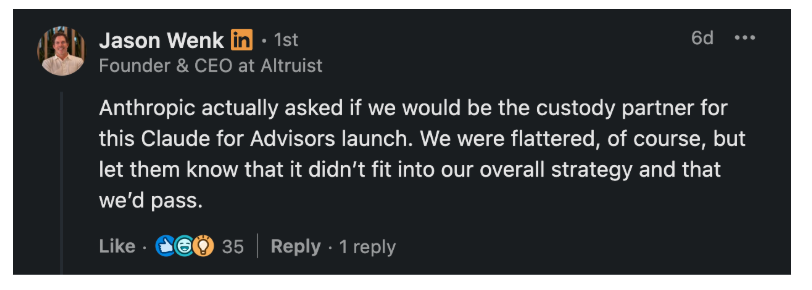
No other custodians were included in the initial connectors list. However, that doesn’t mean Anthropic’s invitation to Schwab was exclusive. Altruist was also asked to be a custody partner with Claude for Financial Advisors but declined involvement.
Link to Wenk’s comment from September 18, 2026
If viewed through the paradigm of Vanguard’s pending acquisition of Altruist, Schwab’s involvement in Anthropic’s most recent play appears as a bold countermove. What’s Anthropic’s next move, though? It’s worth noting that Vanguard is included in the connectors list, setting up a future discussion about Altruist’s involvement post-acquisition.
What’s the Real Cost to Advisory Firms for Using Claude for Financial Advisors?
There are three types of costs that seem to be unclear with this announcement: platform cost, predictability cost, and opportunity cost.
At the time of the announcement, an Anthropic Enterprise-level subscription requires a minimum of 20 seats. That doesn’t include API usage, an additional charge with few to no limits on token metering. It also doesn’t include the platform costs for each connector, which positions Claude for Financial Advisors as a potentially expensive “nice to have” for smaller firms that can more easily afford a Teams subscription.
What’s a key feature that an Enterprise plan includes compared to a Teams subscription? That would be audit logs, which aren't simply nice to have when staring down future SEC exams.
In an interview with WealthManagement.com, Peter Nolan, head of asset and wealth management at Anthropic, mentioned that “Advisors who want to use the new Claude for Financial Advisors product (a ballpark would be around $70 to $120 per user per month) will need to have Claude Co-Work and Anthropic’s Claude for Financial Advisors plug-in (the latter being free).” It’s unclear whether Nolan was adding that ballpark price for usage costs on top of the required Enterprise subscription per seat.
Token billing equates to consumption pricing rather than SaaS licensing. I don’t envy the first firm that gets a behemoth bill from usage-hungry junior advisors.
Is Your Firm’s Data Secure With Claude for Financial Advisors?
The greatest cost and risk, though, may be predictability and data security. Storing event metadata has some routine cloud logging costs, but why does gating audit logs behind a top-tier Enterprise subscription feel like a premium upgrade? The provision of audit logs should be standard fare for tech providers entering a regulated space. AI provenance can no longer be treated as a bolt-on for advisors’ operating systems.
Ideally, RIA firms in particular would be best served with tenant-isolated environments, private API endpoints, and granular control over MCP data connectors. That requires a technical lift that large-scale RIAs (read: $1B AUM/AUA) are facing while building their own operating systems. Until that standard becomes an industry-wide reality, firms face the pressure of using AI at an assumed risk. Advisor-tech-specific platforms are introducing more AI capabilities every day, whether anyone asked for those features or not.
This announcement is neither a nothingburger nor seismic in substance. What’s real is how quickly it appears to bypass some core tenets of AI governance. I trust that Anthropic will work with connectors to reinforce technical and governance standards, but until such time, verify whether making the switch is worth the work.
Jon Cook is the founder of Advisor Story, AI for advisors keynote speaker, YouTube host, and previous contributor to TheStreet, MarketWatch, Retirement Daily, and Proactive Advisor Magazine. Connect with Jon through advisorstory.com or youtube.com/@advisorstory.
A message from Advisor Perspectives and VettaFi: To learn more about this and other topics, check out some of our webcasts.
Read more articles by Jon Cook
 Advisor Perspectives welcomes guest contributions. The views presented here do not necessarily represent those of Advisor Perspectives.