Advisor Perspectives welcomes guest contributions. The views presented here do not necessarily represent those of Advisor Perspectives.
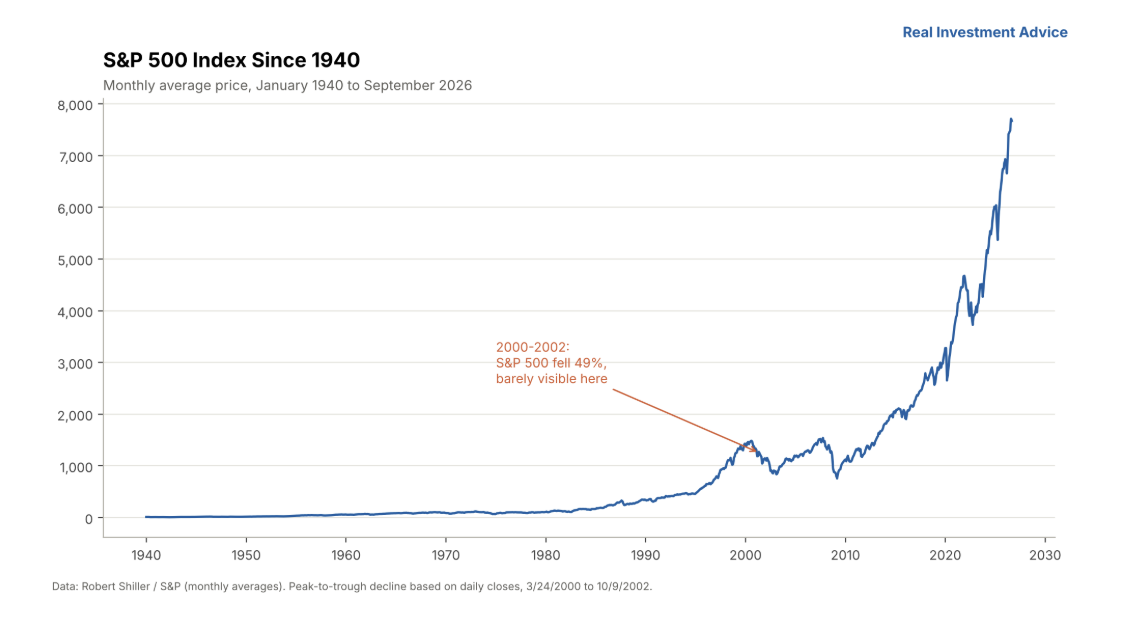
Buy an S&P 500 index fund, set up automatic contributions, and forget about it. It's one of the most common pieces of retirement advice, and the chart below makes a strong case for it.
In January 1940, the S&P 500, as reconstructed by Robert Shiller, stood at about 12. Today, it's around 7,500. World War II, regional wars, recessions, oil shocks, a pandemic, and a long list of financial crises look like minor speed bumps. For anyone saving for retirement, the answer seems obvious: Why do anything other than buy and forget?
Unfortunately, it's not that easy. The chart shows what the market did over 86 years. It doesn't show what happened to investors who depended on it during the 20 or 30 years that mattered most to them.
“The Best Laid Plans of Mice & Men Often Go Awry”
To illustrate why, consider a hypothetical example.
A hypothetical investor born in 1940 starts saving for retirement in 1965, at age 25. He begins by putting $100 a month into an S&P 500 fund and raises his contributions with inflation each year. By the late 1990s, he is putting away about $540 a month. He reinvests dividends and never sells. He is the poster child for passive retirement savings.
The saver benefited greatly from the bull markets of the 1980s and 1990s. In January 2000, at age 60, his account is worth $1.7 million. He retires and follows the well-known 4% rule. Withdraw 4% of your total investment portfolio in year one of retirement and adjust that dollar amount annually for inflation. In theory, if his portfolio gains exceed the withdrawals, he can keep the principal intact and possibly grow it.
Our new retiree withdraws about $68,000 in his first year, 2000. On paper, his plan looks successful. Later that year, the dot-com bubble burst. The S&P 500 fell 49% from its March 2000 peak to its October 2002 low. His best-laid plan went awry.
What Happened to the Saver
On the 86-year S&P 500 chart, the 2000 to 2002 bear market is noticeable but doesn't seem overly troubling. However, for the hypothetical investor, other retirees, and those near retirement who were depending on a stock portfolio for income, it was a disaster.
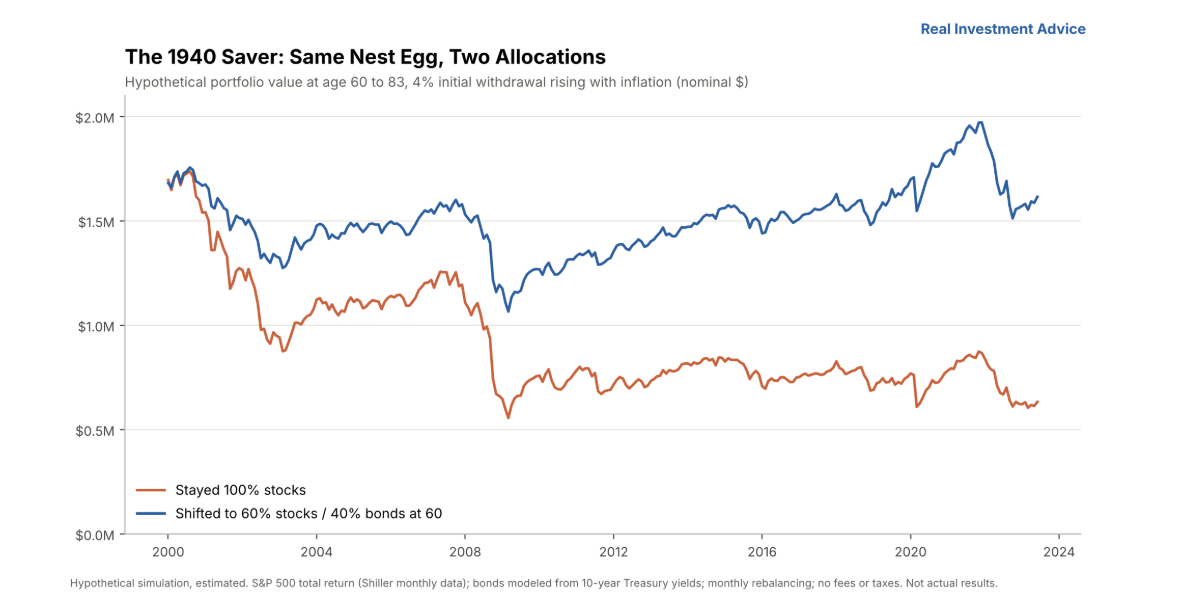
By October 2002, the hypothetical investor's $1.7 million nest egg had shrunk to about $910,000. Market losses did most of the damage, but each annual withdrawal locked in losses because he had to sell shares at depressed prices.
The market recovered, and by October 2007 his account was up to about $1.25 million. That is far below where he started in 2000, because he spent the recovery withdrawing income from a smaller base.
While $1.25 million wasn't what he had planned, he still had reasonable savings. But just as investor confidence returned, the financial crisis hit. By March 2009, at the trough of the financial crisis and at age 69, his account had fallen to $555,000.
Years later, by mid-2023, at age 83, the account was worth nearly $630,000, and his inflation-adjusted withdrawal was $123,000 per year. Assuming his portfolio value didn't change, he had only about five years of income left. Worse, a sizeable, lasting stock market drawdown could have wiped out the saver.
Active Risk Management Is an Option
Now consider another example. The circumstances were the same, but the second saver, with the same $1.7 million in savings in January 2000, shifted his portfolio to limit risk when he retired.
He reduced his 100% allocation to the S&P 500 to 60% and put the remaining 40% in 10-year Treasury bonds. By doing so, his account would have troughed at about $1.07 million in March 2009, not $555,000, as in the first example. By mid-2023, the portfolio was worth roughly $1.6 million.
He made the same withdrawals and owned the same stocks. The only difference was that he was willing to sacrifice potential gains for financial security. Simply, he managed risk.
The Math of Losses & Value of Time
Losses and gains are not symmetrical. As Lance Roberts put it in Bear Market Losses, A Dangerous Illusion: Losses hurt more than they appear because recovery isn't symmetrical.
The deeper the loss, the larger the gain needed to get back to even. Consider the following math:
- A 10% loss requires an 11% gain to recover.
- A 20% loss requires a 25% gain.
- A 30% loss requires a 43% gain.
- A 50% loss requires a 100% gain.
- The 57% decline in the S&P 500 from October 2007 to March 2009 required a gain of about 131%.
Time is another critical variable. The S&P 500 did not close sustainably above its March 2000 high until 2013. A 30-year-old can wait 13 years. A retiree drawing income from a portfolio often cannot.
Losses matter for everyone, not just retirees. But once an investor begins withdrawing from their retirement savings, the losses become permanent.
Strategic Asset Allocation Is the First Line of Defense
The most important loss management decision for most traditional portfolios is the split between stocks and bonds. In 2000 through 2002 and again in 2008, Treasury bonds effectively hedged equity portfolios.
The 10-year Treasury yield fell from about 6.7% in January 2000 to about 3.9% by October 2002, and fell again during the financial crisis. So not only did the bonds pay reliable coupons, but falling yields meant rising bond prices, so the bond allocation gained value while stocks fell.
As we have recently learned, bonds are not a guaranteed hedge. In 2022, with inflation running hot and the Fed raising rates aggressively, the S&P 500 fell by nearly 20%, and the Bloomberg U.S. Aggregate Bond Index lost about 13%.
Stocks and bonds tend to move in the same direction when inflation is the market's primary concern, and in opposite directions when economic growth or financial stress is the concern. Accordingly, a fixed stock-and-bond allocation that investors never revisit leaves them exposed.
Consider three factors when setting your stock and bond allocation:
- Timing: Funds needed in the next several years should rely more on bonds than stocks.
- Know Market Drivers: When inflation is the dominant risk, shorter-duration bonds, TIPS, or money market securities offer protection that longer-term bonds may not. When a recession or financial crisis is the dominant risk, longer-term Treasuries have historically provided the best offset to equity losses.
- Rebalance With Discipline: Stay on top of your allocation by trimming outperforming assets and adding to underperformers. Letting a fixed stock/bond allocation drift too far from your target allocation may leave you under- or overexposed to risk and reward.
Allocation Is Not Just About Age
Most financial rules of thumb tie stock and bond allocation to one's age. People often assume a young person just starting out in the workforce should own all stocks. Conversely, a retiree should have a decent allocation toward bonds.
Time until retirement certainly matters when choosing your asset allocation mix, but so do current equity valuations, bond yields, and their respective expected returns.
A 50-year-old in 1982 and a 50-year-old in 1999 had the same time horizon but faced entirely different opportunities. In mid-1982, the Shiller CAPE valuation was below 7, and the 10-year Treasury yielded nearly 14%. Both stocks and bonds were cheap. In late 1999, the CAPE was at a record 44, and the 10-year Treasury yielded about 6.3%.
Bonds are the easier asset to forecast. Over a decade, the starting yield on a 10-year Treasury has been a reliable guide to the return investors earned. Using Shiller's data back to 1900, we estimate the starting yield explained about 90% of the variation in subsequent 10-year Treasury returns, missing by an average of about 0.6 percentage points a year. Today, the 10-year Treasury yields about 5.25%, 10-year TIPS offer a real yield of about 2.8%, and Treasury bills pay about 4.1%.
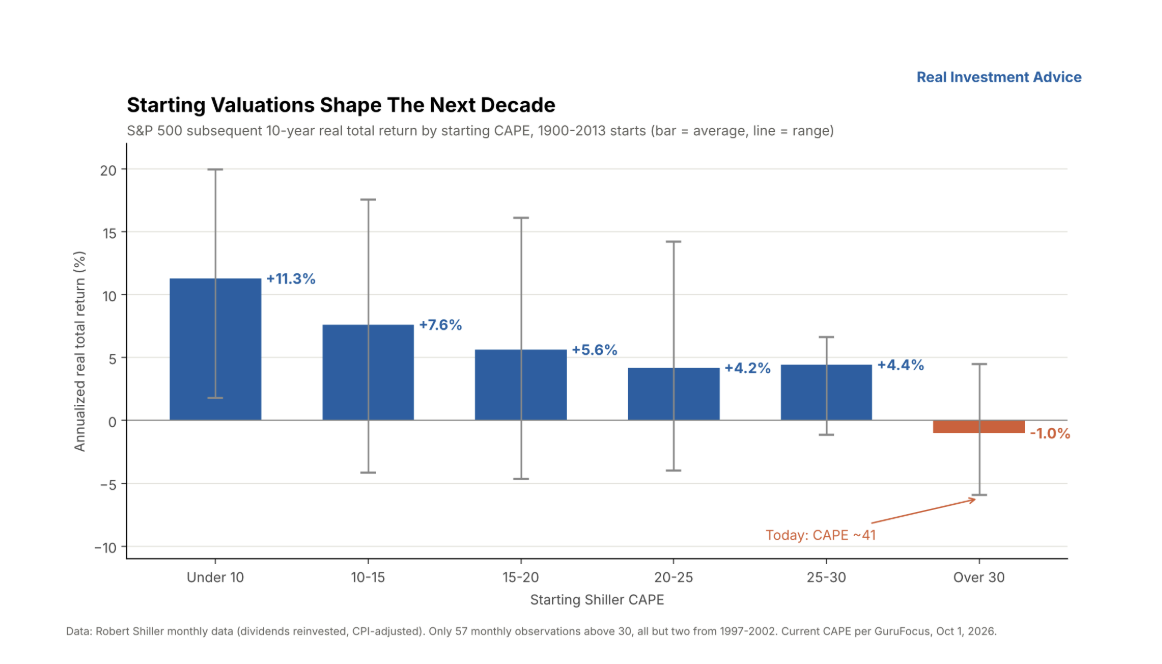
Stocks are much harder to forecast, especially over short periods; however, valuations correlate well with future returns over longer periods. The chart below shows the distribution of inflation-adjusted 10-year subsequent returns for every month since 1900, sorted by the starting CAPE valuation ratio. When the CAPE ratio started below 10, investors averaged 11.3% a year after inflation. When it started above 30, they averaged a 1.0% real annualized loss.
The CAPE is currently about 41, more than double its long-term average and not far from its 1999 record high. While concerning, two caveats must be considered.
First, nearly all of the readings above 30 in our sample come from 1997 to 2002. The CAPE has been above 30 for much of the past several years without the poor-results history it implies, at least so far.
Second, CAPE doesn't account for future growth. For example, per FactSet, the forward 12-month P/E is 19.0, slightly below its five-year and 10-year averages, because analysts expect strong earnings growth.
The inverse of the CAPE, a rough real earnings yield on stocks, is about 2.5%. That is below the 2.8% real yield on a 10-year TIPS, which carries no credit risk and offers a known real return if held to maturity. Investors are being paid little, if anything, for taking equity risk for the next 10 years.
The practical problem for equity investors is that even if we were guaranteed that the S&P 500 would be the same price in 10 years as it is today, we don't know what returns it will deliver over any span of time within those 10 years. The stock market could crash next year and deliver incredible returns over the next nine years. Conversely, a significant downturn may not occur for five years, leaving an all-bond investor with a missed opportunity.
Sector Divergences Within the Equity Allocation
Risk management is not just a stocks-versus-bonds strategy; it also depends on how the equity allocation is constructed. Owning the S&P 500 means effectively owning each stock in market-cap proportions, so the sectors and stocks that have risen the most become the largest positions and often the most overvalued.
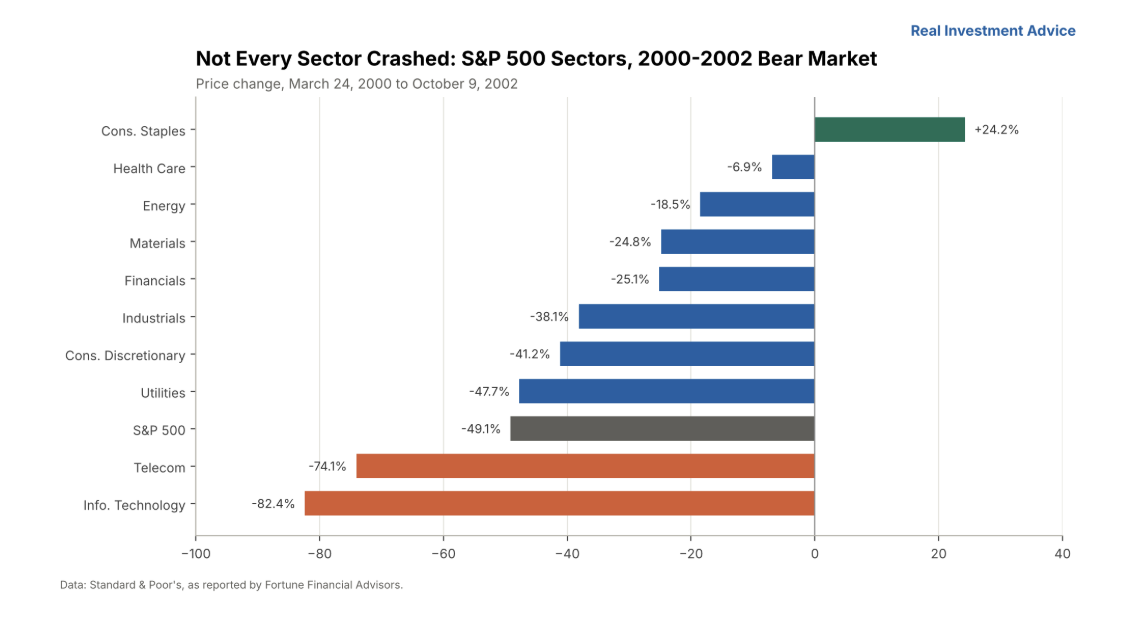
As shown below, the 2000 to 2002 bear market was not a uniform decline. Technology shares fell 82%, telecoms fell 74%, health care lost only 7%, and consumer staples gained 24%.
An investor who trimmed technology and added to staples in the late 1990s would not have avoided the bear market, but the losses would have been meaningfully smaller. When a handful of sectors or stocks dominate the index, a passive investor's risk is increasingly concentrated in those names.
Paying attention to sector divergences, trimming leaders that have become stretched, and adding to laggards with improving fundamentals can reduce drawdowns without abandoning stocks altogether.
Summary
Over the decades, stocks have greatly rewarded patient investors but not all investors. We have limited life spans and even shorter periods to accumulate and grow wealth. We only experience a slice of the graph we led with that coincides with our working years and retirement. The order in which stock returns arrive matters much more than the returns for the entire period.
Many financial professionals like to invest as the hypothetical investor did. They believe his circumstance is an anomaly and not worth managing risk for. They would likely claim that the hypothetical saver did everything right. But simple risk-management steps could have made his retirement much more successful. Managing losses through a stock-and-bond allocation that reflects valuations and yields, not just age, and a willingness to consider stock and sector divergences, as well as other asset classes, can turn a risky plan into a durable retirement.
The active, risk-based allocation shifts we discuss are just the tip of the iceberg, but they alone can help ensure a well-planned portfolio doesn't go awry.
Read more by Michael Lebowitz:
Michael Lebowitz is a portfolio manager with RIA Advisors and author for Real Investment Advice. For more information, contact him at [email protected] or 301.466.1204.
Join RIA Advisors and elevate your career within a deeply experienced team focused on innovation. Our collaborative environment is built on a foundation of advanced technology and effective investment models, designed to enhance your ability to serve clients and grow your practice. Benefit from a supportive culture that encourages professional development and fosters a forward-thinking approach. By joining our team, you’ll be part of a group dedicated to excellence and continuous improvement, empowering you to focus on building meaningful client relationships and pursuing your business ambitions. Discover the advantages of working with our accomplished advisory team by starting your conversation today.
A message from Advisor Perspectives and VettaFi: Discover something new! Click here to register for our upcoming webcasts.
Read more articles by Michael Lebowitz
 Advisor Perspectives welcomes guest contributions. The views presented here do not necessarily represent those of Advisor Perspectives.