Eurozone GDP growth was very soft in the third quarter, coming in at 0.6% for the three months to September on a seasonally adjusted annualized basis, against consensus expectations of around 1.5%. While the release is disappointing, we caution against extrapolating this weakness in quarters ahead, for a few reasons:
- Business surveys, and the Purchasing Manufacturing Index (PMI) in particular, have been pointing to somewhat healthier quarterly growth of 1.25% to 1.5% in recent months.
- There has been a clear pattern of upward revisions in eurozone GDP in expansionary phases of the business cycle. This could be the case again for the last quarter, and for previous quarters more broadly.
- There were temporary factors that weakened growth in the middle of the year – first and foremost disruptions in car production from new car emissions testing procedures (affecting German growth significantly given the importance of car production in the country, but also other countries).
- The turnaround in oil prices since the start of October, if sustained, should help household income and consumer spending ahead.
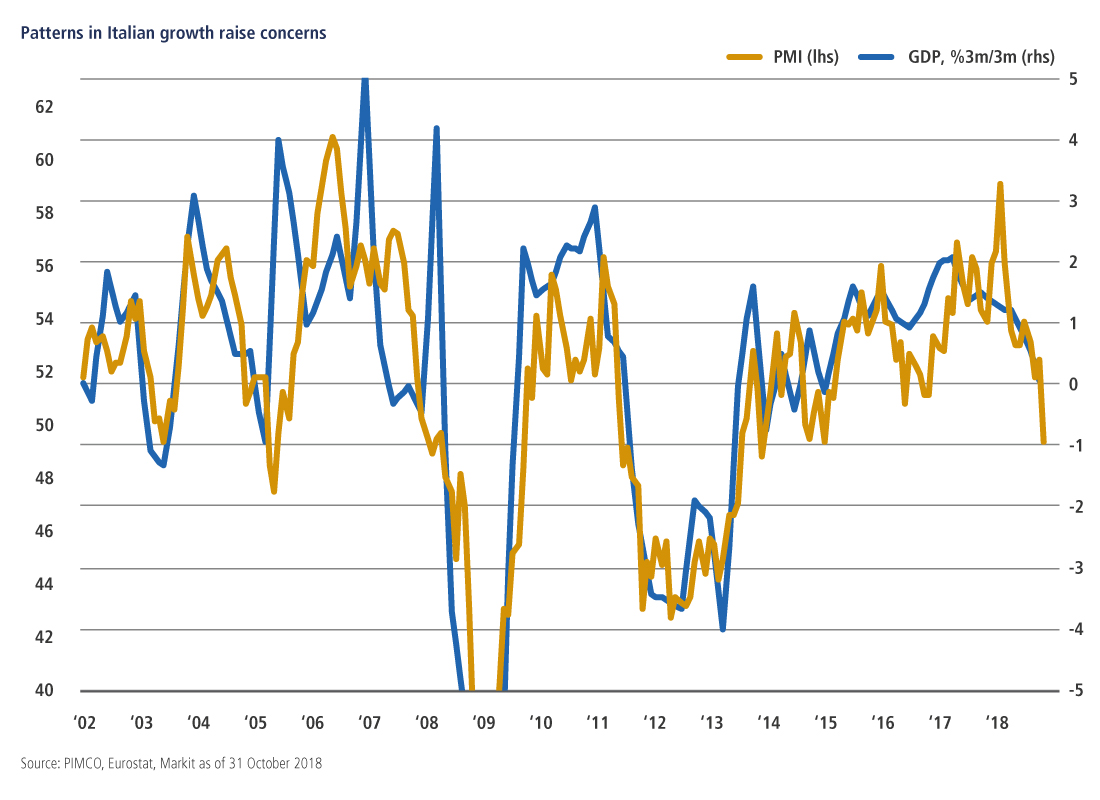
Italian growth stagnating
What’s more worrying than the GDP print itself is that the eurozone PMI took a step down in October, following the stabilization seen in previous months. And, perhaps even more importantly, the weakness in Italy looks striking. The Italian economy stagnated in Q3 according to the flash GDP release, and the PMI points to negative growth early in Q4.