Back-to-school season is normally an exciting time of year, when cooler weather signals the start of academics, fall sports, and new beginnings. But with the U.S. still in the throes of the COVID-19 pandemic, students, parents, instructors, and administrators are navigating a hodgepodge of re-opening scenarios, while investors have questions about municipal K-12 and higher-ed credits. Our view: Although health concerns may prompt sporadic backtracking and confusion, most municipals should be able to withstand these stresses.
Mode of learning should not affect credit
Generally speaking, K-12 school districts can choose how to re-open based on guidelines set by state and local public health agencies. School districts planning for in-person learning will likely see intermittent closures, as we saw in Georgia in August, when COVID-19 cases spiked, quarantines were ordered, and schools were forced to close almost immediately.
But this isn’t necessarily bad news for investors; we do not expect intermittent closures to equate to municipal credit stress. U.S. schools are funded primarily through property taxes and/or state aid appropriated for the school year, regardless of the learning model. Further, we expect to see many states provide some type of “hold-harmless” guarantee, which aims to protect the upcoming year’s school funding should enrollment decline. This is done by basing state aid on prior-year enrollment levels.
K-12: States attempting to limit funding cuts, credit selection remains crucial
The credit outlook for K-12 school districts varies across the country. Within each state, the credit quality of school district obligors depends largely on their funding status and current financial condition. We believe it is unlikely that the pandemic’s impact on K-12 will be widespread in fiscal 2021, thanks in part to federal CARES Act funding that will help offset increased expenditures related to virtual learning, as well as health and safety measures. Many states are also drawing heavily on reserves and trimming other spending in order to limit the immediate cuts to K-12 funding.
Yet, the possibility of mid-year cuts looms, should state revenue trends deteriorate and additional federal aid for state and local governments fail to materialize. In addition, K-12 still faces significant longer-term risks that carry a high degree of uncertainty. Among them: a prolonged recession that could prompt more sweeping cuts to state education funding, the impact of market volatility on pension funds, and costs associated with permanent enrollment decline and the indirect effects of learning loss.
Higher education: Pandemic likely to widen chasm between the haves, have nots
Headlines in recent months have intimated doom and gloom for higher education, with many suggesting that the pandemic will permanently alter the sector. The news is undeniably negative, with universities opting for online learning, canceling college sports, and some students choosing to withdraw for the semester.
While it is likely that the pandemic and its attendant consequences will have lasting impacts on the weakest segments of the higher education market – namely, the universities that were already struggling to attract students and deeply discounting tuition – we believe the vast majority of debt in the municipal market is tied to healthy universities with strong cash positions and sustained enrollment demand. Given their robust endowments, cash resources, and ability to borrow at exceptionally low rates, we believe most strong universities hold enough cash to buffer them through this volatile period, while swiftly responding to the crisis with spending cuts.
Still, for all but the most selective and prestigious universities, revenue recovery and a return to a somewhat normal pricing environment may take years.
Investor takeaways
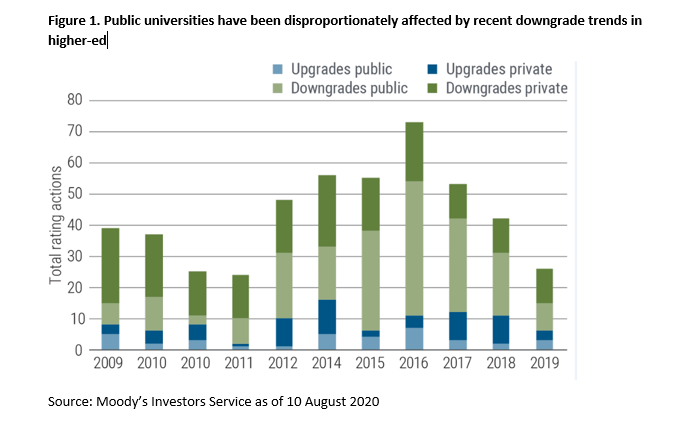
Public, private universities face different risk environments: Public universities with limited endowments and weak student demand face a number of risks, including rating agency downgrades, consolidation, closure, and possibly bankruptcy (though we view this as a remote risk). However, we believe state financial support and oversight will limit default risk and could push weak public campuses to consolidate with stronger peers.

The weakest segment of the private higher-ed sector, on the other hand, faces more immediate credit risk. Closures and even bankruptcies are possible for those private universities that cannot find merger partners, with the risk elevated for those operating in remote regions with limited proximity to potential merger partners.
Additional risks may arise: While weak universities may be challenged to navigate the immediate challenges posed by COVID-19, the sector as a whole may face additional risks if developing trends continue, such as diminishing international student demand and a long-term shift toward online learning. Again, we believe the strongest portion of the market is best positioned to respond given that high-quality public and private universities already turn away many applicants and have tools that may help transform their business models.
Limited ratings downgrades since beginning of pandemic: This year we have seen just 18 higher-education credit downgrades from Moody’s, with 11 of them coming since March. The majority of downgrades have been weaker credits that were already experiencing downgrades prior to the pandemic. Looking ahead, we expect rating agencies to be patient and monitor how the new school year unfolds before ratings activity begins.
While back-to-school season this fall may worry some investors, we believe the negative headlines and unorthodox maneuvers being taken by K-12 and universities alike are unlikely to result in widespread municipal credit stress. Instead, COVID-19 is likely to accelerate risk and negative sector trends for those muni issuers that were already struggling prior to the pandemic. The pace of change is jarring to be sure, but in the near term at least, the disruption is likely to affect classrooms more than credits.
© PIMCO
www.pimco.com
© PIMCO
Read more commentaries by PIMCO