April 2 may be one of the most important days of the year for investors. The U.S. is preparing to announce new and higher tariffs on a wide range of imports across many countries. Here is our assessment of the when, what, why, where, and how big for the April tariffs.
When?
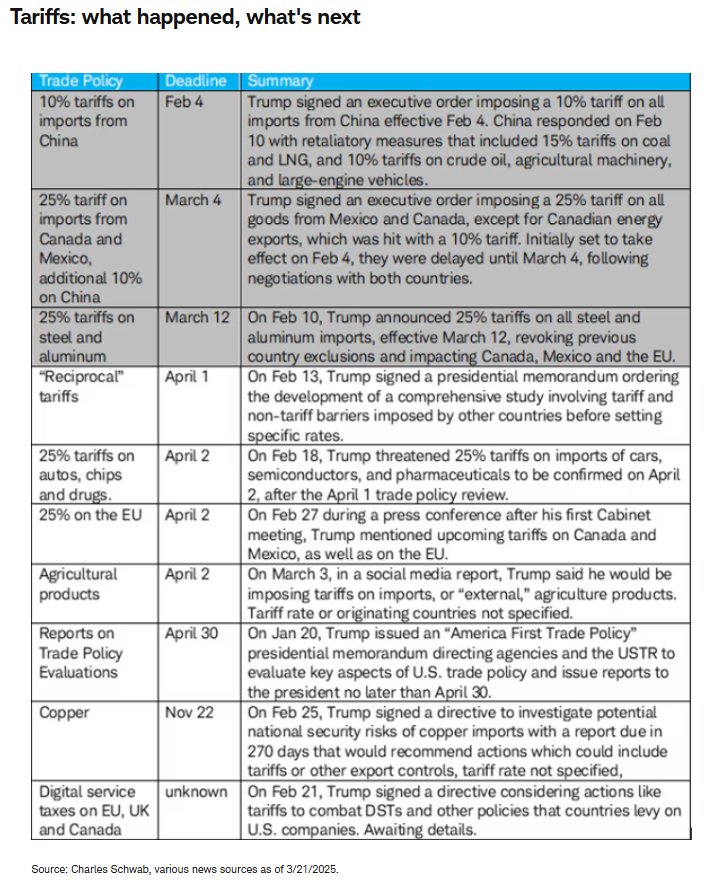
On April 2, the scale of President Donald Trump's tariff plans is likely to be unveiled—even if implementation is again delayed. On Feb 13, President Trump signed a presidential memorandum ordering the development of a comprehensive study due April 1st involving tariff and non-tariff barriers imposed by other countries to provide guidance on setting specific rates for U.S. imports. The Trump administration is likely to unveil new tariffs the following day. Additionally, April 2 is also when the four-week delay to tariffs on Mexican and Canadian goods compliant with the United States-Mexico-Canada Agreement (USMCA) will expire.

What?
On Sunday, March 23, news reports citing "officials close to the matter" reported that President Trump will announce widespread reciprocal tariffs on nations or blocs but is set to exclude some, and the administration is not planning separate, sectoral-specific tariffs to be unveiled at the same event. Yet, they may be coming. A mid-March meeting between Commerce Secretary Lutnick, U.S. Trade Representative Greer, and Canadian officials including the Ontario premier and the ambassador to the U.S. revealed what the high-level elements of the coming tariffs may include:
- A shift in tariff emphasis from a country-by-country basis to an industry-by-industry (with specific emphasis on cars, semiconductors, and pharmaceuticals). The details are likely to be complex, with the potential for individual tariff rates on up to 17,000 different product categories across 193 different countries.
- While the U.S. calls this tariff rate reciprocity, the rates appear to be unconnected to the import tariffs applied by other countries, making them fluid and hard to predict.
- Countries may be able to negotiate lower rates on targeted industries by aiding U.S. objectives.
Why?
As an economic or fiscal policy, the tariffs are unlikely to benefit the United States. Abundant research, along with the most widely used economics textbooks (Mankiw's Principles of Economics, Samuelson's Economics, for example), show that higher tariffs tend to restrict productivity and growth, while raising prices. Fiscally, tariffs will not cover the cost of extending the 2017 tax cuts, even using the most favorable assumptions.
However, as a geopolitical tool, tariffs are replacing sanctions as Washington's preferred method of statecraft. Achieving lower tariffs to access to the U.S. market is likely to require countries support U.S. objectives. Demands may encompass immigration, drug trafficking, defense spending, purchasing U.S. energy, narrowing trade balances, adjusting taxes and currency values based on what we have heard from President Trump thus far. Yet, countries may prefer to replace lost U.S. demand by stimulating their economies and lowering trade barriers among themselves as an alternative to acquiescence to shifting U.S. demands. Choosing to boost domestic demand is already underway in Europe. Specifically, Germany's lawmakers passed a landmark spending package, which allows for excluding defense spending from debt restrictions and sets up a 500-billion-euro fund to invest in infrastructure. China is also increasing domestic stimulus, as we discussed in our recent article Making International Great Again?. New bilateral trade agreements are also in the works; the most recent headlines involving deals with India and the European Union and India and New Zealand.
Where?
Although the April 2 impacts are likely to be felt worldwide, the major economies of the European Union, North America, and China may be places to focus on.
European Union
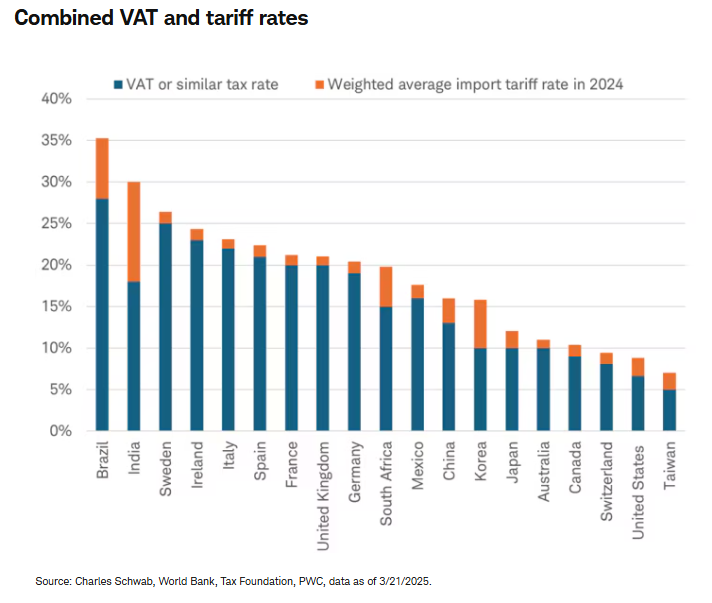
It is not clear what reciprocal tariffs the U.S. will impose on imports of goods from the European Union (EU) on April 2. The EU has previously offered Trump concessions, including reduced tariffs on U.S. vehicles, increased purchases of U.S. liquified natural gas along with offering to take on more of the burden of providing for Europe's defense. Although the EU's weighted average tariff rate is currently 1.3%, the Trump administration has focused on Europe's value added taxes, or VAT (which are applied to all goods whether domestically produced or imported). Among Europe's largest economies, this type of sales tax ranges from 19% in Germany, 20% in France and 22% in Italy. Adding the VAT to the EU's simple average tariff rate of about 5% gets closer to the estimated 25% tariff number Trump feels applies to U.S. products.
EU goods exports to the U.S. account for 3.5% of EU gross domestic product (GDP), according to data from the International Monetary Fund (IMF) We estimate that a 25% tariff on the EU would likely result in a near-term direct hit to the EU economy of about 0.8% of GDP. As an offset to this estimated impact to growth, Germany (Europe's largest economy) has approved a big defense spending and public investment package. The increased defense spending is above 1% of GDP and the infrastructure fund of 500 billion euros is expected to lead to an increase in fiscal spending for the next several years, potentially adding 1.5% to GDP growth per annum. In addition, on March 6, the European Council unveiled a proposal called the ReArm Europe Plan/Readiness 2030 to exempt defense spending from the EU's fiscal rules and to set up a 150-billion-euro EU loan facility to fund military expenditures. This proposed spending would still need approval by individual countries. Finally, two more rate cuts by the European Central Bank appear likely this year, taking the policy rate down to 2%. This added fiscal and monetary stimulus may deliver a potentially sizable boost to growth, potentially more than offsetting any drag from tariffs.
North America
Earlier this month, President Trump paused the Canada and Mexico tariffs that had been implemented two days earlier for goods with no tariffs under the USMCA. It is possible this is extended on April 2. Limiting the exemption to USMCA-compliant goods covers about 44% of total imports from Canada and Mexico. Another 40% of the total enters tariff-free based the U.S. Most Favored Nation (MFN) tariff schedule or other trade programs. For companies with products imported under the MFN, claiming eligibility under USMCA will require showing that 50-60% of the value-added of a good must be done within US/Mexico/Canada. That could be challenging for some industries, Certain industries have even higher thresholds, like the 75% for autos.
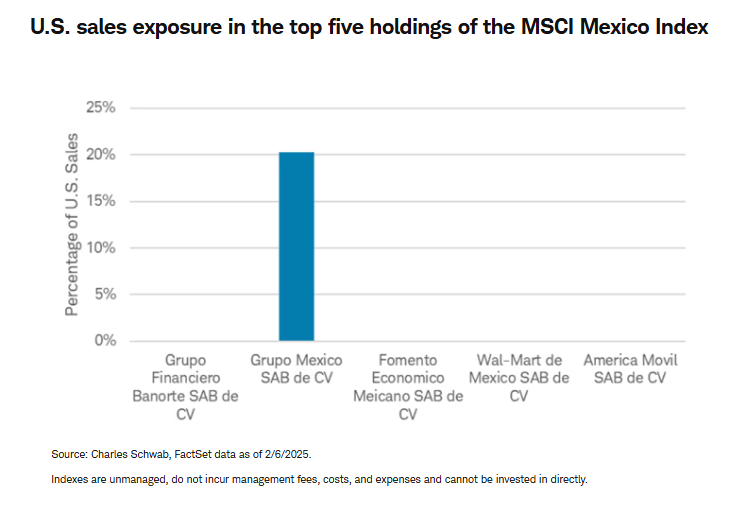
Mexico's exports make up about one-third of the country's GDP, with around 80% going to the United States. The economic hit to Mexico of 25% tariffs on more than half of all exports to the U.S. would risk recession. Yet, the impact on Mexican companies may be much less. Mexico's largest exports to the U.S. are goods produced by U.S. companies operating in Mexico, not Mexican companies. Mexico's biggest exporters are automotive manufacturers headquartered in the U.S. and listed on U.S. stock exchanges, including Ford and GM. In contrast, a lot of Mexican companies that have large U.S. sales come from their operations located in the U.S.; those goods would not be subject to tariffs (like CEMEX, the big Mexican cement maker). In fact, four of the top five Mexican stocks that make up more than 50% of the MSCI Mexico Index are not likely to be directly affected by the tariffs, because they serve the Mexican market (including a bank, a telecom provider, Mexico's Coca-Cola distributor, and Mexico's Wal-Mart). This is similar for non-energy Canadian companies, as well, making for what would likely be a bigger economic impact and potential recession for Canada, than the earnings or market impact for Canadian companies. Outside of energy, which may be impacted by a lower 10% tariff according to the Trump administration, the U.S. has a goods trade surplus with Canada according to the U.S. Census Bureau.
China
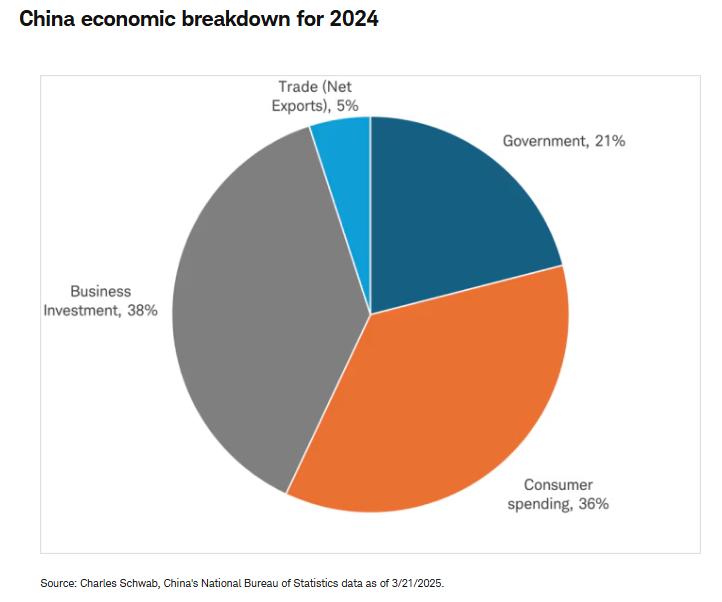
For China, it appears that there is little the government can do to appease the Trump administration or reduce its trade surplus with the United States. Trump's new 20% tariff, implemented in February, brings the total level of tariffs on China to 45% for most goods. China has retaliated with its own various measures, including tariffs, export controls and restrictions targeting U.S. companies. Additionally, China continues to announce new stimulus programs intended to support domestic consumer demand which makes up nearly 40% of China's GDP as an offset to weakness in direct goods exports to the U.S. which contributes to only about 3% of China's GDP.
China's leaders have declared a growth target of "around 5%" for 2025 at the March National People's Congress meeting for the second year in a row. Yet, China's economy is forecast to slow mildly this year by most economists. The forecast in last week's OECD (Organisation for Economic Co-operation and Development) Economic Outlook calls for just a 0.2% slowdown from last year's growth rate of 4.8%.
How big?
How big of an impact might the new tariffs have on the overall world economy? While certain industries may be heavily impacted, the overall global impact may be only a mild negative depending on the scale and scope of the new tariffs.
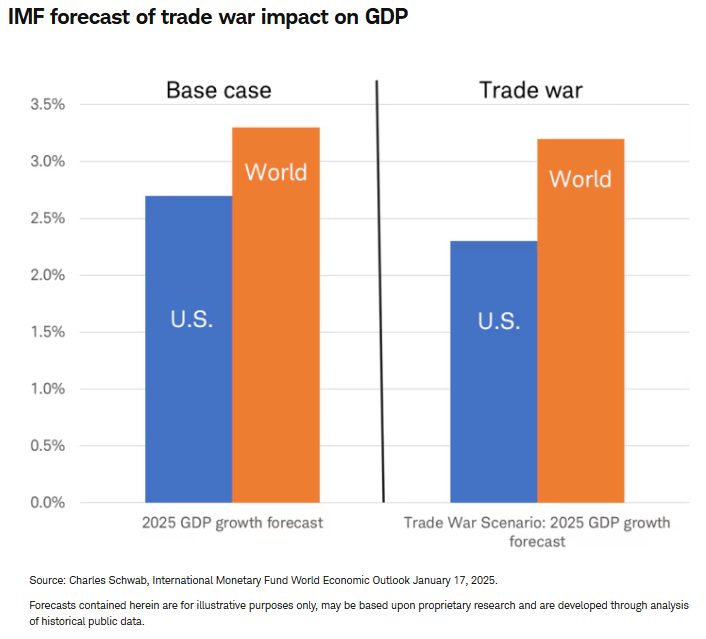
Now, the current weighted average of U.S. of import tariffs in place amounts to about 10%, based on 2024 import volumes, calculated with the additional 20% on China, 25% on non-USMCA compliant imports from Canada and Mexico, 10% on energy exports from Canada, and 25% on steel and aluminum. That marks a significant rise from about 2.6% at the end of last year. In October, the International Monetary Fund (IMF) published an analysis of how a 10% across-the-board import tariff implemented by all countries would impact global growth. Their conclusion was a 0.4% hit to U.S. growth, but only a 0.1% drag on the baseline forecast of global GDP growth of 3.2% in 2025. So far, new tariffs have been largely a U.S. issue, and retaliatory tariffs on U.S. exports have not matched those placed by the U.S. on its imports, so the impact would likely be considerably smaller than the IMF forecast. But how much higher tariffs may go is difficult to know without more details on the rates, industries, and countries. With Mexico, Canada, and China the U.S.'s largest trading partners, a big share of the impact of higher tariffs on the world economy is already in place to some degree. Even if the new tariffs double the drag on the global economy, when accounting for the offsetting stimulus programs in Europe and China the net impact might not be all that significant.
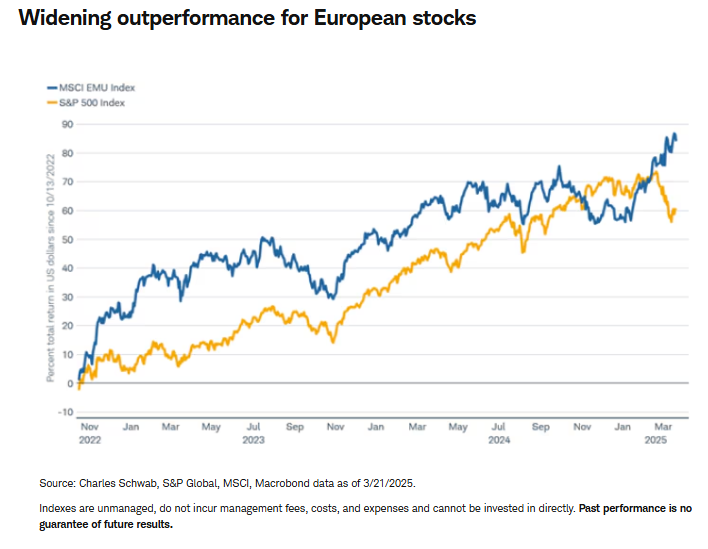
Last week's Economic Outlook from the Organization of Economic Cooperation and Development (OECD), a widely followed economic forecaster and policy analysis forum, forecasts an acceleration in economic growth for 2025 for major U.S. trading partners including the eurozone, United Kingdom, and Japan, helping offset the anticipated slowdown in the United States. We can see this in the rising economic and earnings growth forecasts for Europe and in the widening outperformance by international stocks, especially in Europe.
Michelle Gibley, CFA®, Director of International Research, and Heather O'Leary, Senior Global Investment Research Analyst, contributed to this report.
The information provided here is for general informational purposes only and should not be considered an individualized recommendation or personalized investment advice. The investment strategies mentioned here may not be suitable for everyone. Each investor needs to review an investment strategy for his or her own particular situation before making any investment decision. All expressions of opinion are subject to change without notice in reaction to shifting market conditions. Data contained herein from third-party providers is obtained from what are considered reliable sources. However, its accuracy, completeness, or reliability cannot be guaranteed. Examples provided are for illustrative purposes only and not intended to be reflective of results you can expect to achieve.
Please note that this content was created as of the specific date indicated and reflects the author's views as of that date. It will be kept solely for historical purposes, and the author's opinions may change, without notice, in reaction to shifting economic, business, and other conditions.
All corporate names and market data shown above are for illustrative purposes only and are not a recommendation, offer to sell, or a solicitation of an offer to buy any security.
Performance may be affected by risks associated with non-diversification, including investments in specific countries or sectors. Additional risks may also include, but are not limited to, investments in foreign securities, especially emerging markets, real estate investment trusts (REITs), fixed income, municipal securities including state specific municipal securities, small capitalization securities and commodities. Each individual investor should consider these risks carefully before investing in a particular security or strategy.
Forecasts contained herein are for illustrative purposes only, may be based upon proprietary research and are developed through analysis of historical public data.
Currency trading is speculative, volatile and not suitable for all investors.
Past performance is no guarantee of future results and the opinions presented cannot be viewed as an indicator of future performance.
Investing involves risk, including loss of principal.
International investments involve additional risks, which include differences in financial accounting standards, currency fluctuations, geopolitical risk, foreign taxes and regulations, and the potential for illiquid markets.
Investing in emerging markets may accentuate this risk.
Diversification and asset allocation strategies do not ensure a profit and do not protect against losses in declining markets.
Commodity-related products carry a high level of risk and are not suitable for all investors. Commodity-related products may be extremely volatile, may be illiquid, and can be significantly affected by underlying commodity prices, world events, import controls, worldwide competition, government regulations, and economic conditions.
The policy analysis provided by the Charles Schwab & Co., Inc., does not constitute and should not be interpreted as an endorsement of any political party.
The books Principles of Economics by Mankiw and Economics by Samuelson are not affiliated with, sponsored by, or endorsed by Charles Schwab & Co., Inc. (CS&Co.). Charles Schwab & Co., Inc. (CS&Co.) has not reviewed the book and makes no representations about its content.
Indexes are unmanaged, do not incur management fees, costs, and expenses and cannot be invested in directly. For more information on indexes, please see schwab.com/indexdefinitions.
BLOOMBERG® is a trademark and service mark of Bloomberg Finance L.P. and its affiliates (collectively "Bloomberg"). Bloomberg or Bloomberg's licensors own all proprietary rights in the Bloomberg Indices. Neither Bloomberg nor Bloomberg's licensors approves or endorses this material or guarantees the accuracy or completeness of any information herein, or makes any warranty, express or implied, as to the results to be obtained therefrom and, to the maximum extent allowed by law, neither shall have any liability or responsibility for injury or damages arising in connection therewith.
The MSCI Mexico Index is designed to measure the performance of the large and mid-cap segments of the Mexican market, covering approximately 85% of the free float-adjusted market capitalization in Mexico.
A message from Advisor Perspectives and VettaFi: To learn more about this and other topics, check out some of our webcasts.
© Charles Schwab
Read more commentaries by Charles Schwab