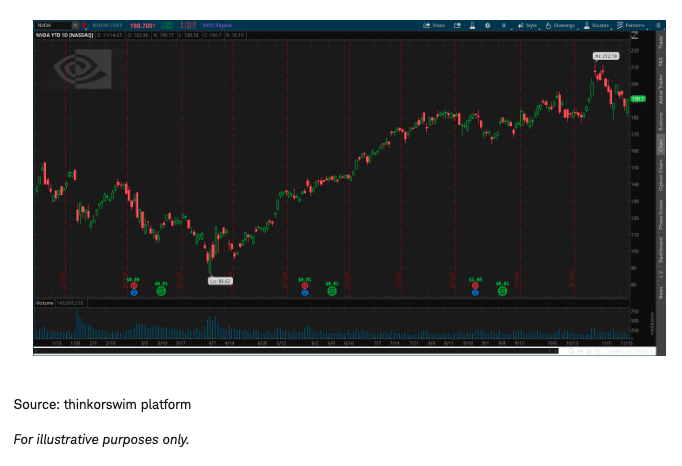
All eyes are on Nvidia (NVDA) as it prepares to report its fiscal third-quarter earnings after the bell Wednesday. Investors will closely monitor whether the chipmaker can sustain its extraordinary pace of AI-driven growth while keeping its gross margins above 70%. Forward guidance will also be particularly important to reassure markets that the AI infrastructure cycle still has further to run.
Nvidia became the first company to reach a $5 trillion market capitalization in late October before pulling back amid ongoing uncertainty around U.S.-China chip export restrictions and concerns about the sustainability of hyperscalers' AI spending. However, with shares still up over 35% year to date, and the company's forward price-to-earnings (P/E) ratio hovering around 30—compared to 22 for the S&P 500®—there's little room for disappointment in this quarter's earnings release.
The chipmaker will have to provide evidence that it can continue to grow revenues at an impressive clip and deliver high margins not just now, but for years to come—particularly with investors' AI enthusiasm beginning to wane in recent weeks. Last week, SoftBank (SFTBY) sold its entire $5.83 billion position in Nvidia. "I can't say if we're in an AI bubble or not," SoftBank CFO Yoshimitsu Goto said during an earnings conference call. SoftBank sold Nvidia "so that the capital can be utilized for our financing," Goto added.
Still, recent deal activity has underscored demand strength at the company. Nvidia announced a string of deals lately with the likes of Uber Technologies (UBER), Samsung (SSNLF), Nokia (NOK), Cisco (CSCO), T-Mobile (TMUS), Palantir (PLTR), Oracle (ORCL), and even the U.S. Department of Energy. From helping develop supercomputers and next-generation 6G telecom networks to enabling the buildout of fleets of self-driving cars, there appears to be plenty of appetite for Nvidia's chips for now.
"Investors will be listening for any potential signs of deceleration in AI compute demand or competitive pricing pressures," said Nathan Peterson, director of derivatives research and strategy at the Schwab Center for Financial Research. "Given the slew of AI deals that have been announced this quarter, along with the guide up in CapEx spend from the hyperscalers, one would think that demand has yet to reach saturation.

Nvidia's earnings expectations
Nvidia has made a habit of beating Wall Street's lofty earnings and revenue forecasts, but this time, the margin of outperformance could matter more than the headline numbers. With AI stocks trading at elevated valuations, Nvidia may require more than just strong earnings for the stock to rise. It may need to blow past analysts' forecasts.
"Investors have come to expect a beat/raise every time Nvidia has an earnings release, so assuming Nvidia delivers again, expectations will be matched against the degree of beat, with emphasis on forward guidance," said Peterson.
For reference, Nvidia's revenues rose 55.6% year over year to $46.7 billion last quarter, while its earnings per share (EPS) jumped 29.6% year over year to $1.05. Both topped consensus estimates, but only by 1.3% for revenues and 3.9% for EPS. With investors pricing in performance well ahead of analysts' forecasts, the stock fell slightly after its earnings report. That's been a recent pattern for Nvidia, and any shakiness in shares could have a broader impact on major indexes considering Nvidia's huge market cap. Generally, in recent quarters, investors appeared to focus on small areas of disappointment in earnings and guidance as an excuse to send shares lower.
In Wednesday's earning release, analysts expect quarterly revenue to rise 57% year over year to nearly $55 billion, according to Zacks Investment Research, and they see EPS spiking 53% year over year to $1.24. If Nvidia tops these estimates, investors should closely monitor the margin of the beat as well as the company's forward guidance.
Looking ahead, some analysts see a slowdown in Nvidia's revenue growth rate, at least in part due to the law of large numbers.
CFRA analysts said in a November 1 research note that they expect Nvidia's sales to rise 60% in fiscal year 2026, before falling to 39% in fiscal year 2027. Those are strong numbers for a company with a market cap near $5 trillion. But after sales doubled in fiscal year 2025 and fiscal year 2024, they still represent a distinct decline in sales growth. Strong guidance that leads analysts to boost these expectations could be beneficial for Nvidia shares, however.
AI Infrastructure demand—and beyond
Nvidia's explosive growth over the past few years has largely been powered by a select few hyperscalers. Tech giants like Microsoft (MSFT), Meta Platforms (META), and Alphabet (GOOGL) have poured billions into data centers packed with Nvidia graphics processing units (GPUs).
Investors have long been aware that Nvidia's elevated exposure to these hyperscalers—which could sharply cut spending at any point—is a risk worth monitoring. So far, these tech giants have continued to spend furiously on Nvidia chips, but any sign of a slowdown in cloud investment or a shift toward competitors' AI chips could quickly spook investors.
Wall Street analysts are already sniffing for signs of saturation in the AI chip market that could cause demand to slip. If they find any evidence of that in Nvidia's earnings report, it could put pressure on shares.
"Given CapEx budgets from the hyperscalers were revised higher during their most recent earnings release, Nvidia's forward guidance becomes the best leading indicator of the state of AI compute demand," said Peterson.
Much of the hyperscaler spending ends up in the pockets of Nvidia and its chip competitors, including Broadcom (AVGO) and Advanced Micro Devices (AMD). AMD recently announced a deal with OpenAI that could chip into the demand from that company for the Nvidia processors it's generally relied on. And Oracle (ORCL) is also buying AMD chips. AMD expects 25% revenue growth in its fourth quarter, a number that Nvidia's guidance may get compared to.
While Nvidia has surged in recent years due to its data center revenues derived largely from AI chip sales, the company may highlight new growth areas as competitors continue to enter the market. Investors should watch for comments about market potential in robotics, autonomous vehicles, gaming, and software sales. For Nvidia to maintain its leadership in the semiconductor market, it will need to extend its chip sales into every corner of the AI economy, not just AI data centers.
Guidance, margins in-focus
Nvidia's forward guidance will likely be the market's main focus this quarter. After years of exceptional growth, investors want to know whether AI-driven demand will continue to accelerate, or if its pace has begun to slow. This means monitoring not only projected revenue growth rates, but also segment performance, project ramp-ups, and any insights into how the overall AI market is expected to grow.
Nvidia's guidance could also provide insights into the state of competition in the AI chip market. Estimates place Nvidia's share of the AI chip market at between 80% to 90%, but that may be changing.
AMD's MI300 Series and upcoming MI400 Series accelerators have emerged as Nvidia's most credible challenger yet. The company has recently inked deals with not only OpenAI, but also Microsoft, Meta, and more. Intel (INTC), meanwhile, is working to re-establish its relevance in the data center GPU market with its Gaudi line. And Qualcomm (QCOM) announced in late October that it will release new AI accelerator chips to compete with Nvidia. The company's AI200 and AI250 chips, which are based on its neural processing unit (NPU) technology, will go on sale in 2026 and 2027, respectively. Additionally, hyperscalers are ramping up efforts to design in-house chips. For instance, Alphabet's Google is rolling out an AI chip called Ironwood. Combined, these competitors could gradually erode Nvidia's dominance in the AI chip market.
"Regarding competition, we've seen hyperscalers and OpenAI adopting AMD chips to diversify their supply chain, or plans to develop in-house chips," said Peterson. "Will there be any indication that competing chips are taking any share from Nvidia, or is the AI pie still growing enough to absorb more options? Investors will likely look to Nvidia's margin guidance to get a read on this."
Investors should also track Nvidia's research and development (R&D) spending. Maintaining its technology edge will likely require Nvidia to continue with an aggressive amount of R&D, especially as it pushes into next-generation AI chips and software ecosystems. The company has already announced its Vera Rubin chip architecture, which is slated for release in 2026. That will be followed up by an enhancement labeled Rubin Ultra in the second half of 2027, and then the so-called Feynman AI chip architecture in 2028.
Finally, investors will closely monitor Nvidia's gross margin outlook. After peaking at nearly 78% in 2024, the company's gross margins have recently dropped slightly, hitting 72.7% last quarter. Investors will be checking to see if that downward trend slowed in the upcoming earnings release. Consensus expects gross margins of 73.5% for the quarter, a number below that may spark fears that competition is leading to pricing pressure, threatening to erode Nvidia's dominant market position.
What to listen for in Nvidia's earnings call
-
The tone around AI demand. Monitor Nvidia CEO Jensen Huang's tone when discussing AI demand. "Last quarter, regarding demand for AI chips, CEO Jenson Huang said: 'everything is sold out,'" Peterson noted. "Will his tone maintain that same level of enthusiasm this time around?"
-
China sales and trade restrictions. Watch how management frames the impact of China's chip export restrictions and replacement demand elsewhere. The company has excluded guidance on H20 chip sales to China in recent quarters amid U.S.-China trade tensions. Track any changes to this pattern. The H20 chip is specifically designed for the Chinese market.
-
Blackwell, Rubin, and Feynman insights. Look for insights into demand for next-generation AI chip architectures. CEO Jensen Huang recently revealed that Nvidia has visibility into over $500 billion of combined Blackwell and Rubin revenue through 2026. Also, keep an eye out for signs that these new products are siphoning demand from currently available chip architectures like Hopper.
-
Days inventory outstanding (DIO). Track Nvidia's DIO. DIO is an important metric for semiconductor companies, because it reflects the supply/demand dynamics for their products. When DIO rises, it could indicate waning demand. Last quarter Nvidia's DIO stood at 106.
A message from Advisor Perspectives and VettaFi: Discover something new! Click here to register for our upcoming webcasts.
This material is intended for general informational and educational purposes only. This should not be considered an individualized recommendation or personalized investment advice. The investment strategies mentioned may not be suitable for everyone. Each investor needs to review an investment strategy for his or her own particular situation before making any investment decisions.
All expressions of opinion are subject to change without notice in reaction to shifting market conditions. Data contained herein from third-party providers is obtained from what are considered reliable sources. However, its accuracy, completeness, or reliability cannot be guaranteed.
All corporate names and market data shown are for illustrative purposes only and are not a recommendation, offer to sell, or a solicitation of an offer to buy any security.
Investing involves risk, including loss of principal.
Past performance is no guarantee of future results.
Supporting documentation for any claims or statistical information is available upon request.
The Schwab Center for Financial Research is a division of Charles Schwab & Co., Inc.
Investment and Insurance Products: Not a Deposit • Not FDIC Insured • Not Insured by any Federal Government Agency • No Bank Guarantee • May Lose Value
The Charles Schwab Corporation provides a full range of brokerage, banking and financial advisory services through its operating subsidiaries. Its broker-dealer subsidiary, Charles Schwab & Co. Inc. (Member SIPC), and its affiliates offer investment services and products. Its banking subsidiary, Charles Schwab Bank, SSB (member FDIC and an Equal Housing Lender), provides deposit and lending services and products.
This site is designed for U.S. residents. Non-U.S. residents are subject to country-specific restrictions. Learn more about our services for non-U.S. residents, Charles Schwab Hong Kong clients, Charles Schwab U.K. clients.
© 2025 Charles Schwab & Co., Inc. All rights reserved. Member SIPC. Unauthorized access is prohibited. Usage will be monitored.
© Charles Schwab
Read more commentaries by Charles Schwab