Will Oil Prices Return to Pre-War Levels? It Depends on China’s Economic Growth
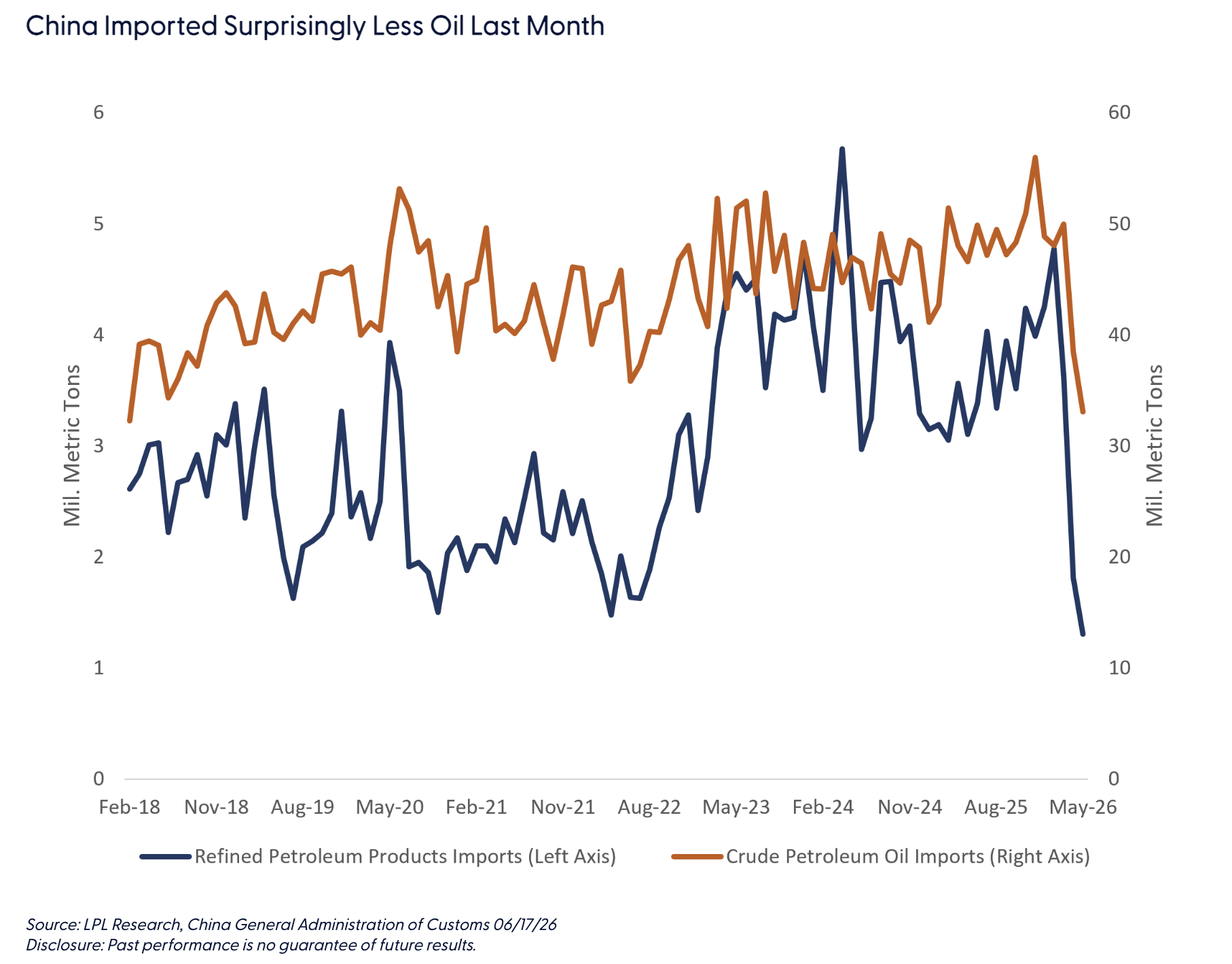
One of the key questions for investment professionals is whether oil prices will return to pre-war levels once the Middle East crisis is resolved. At the same time, many are asking why oil prices are not higher, especially since the latest geopolitical deal recently pushed crude to its lowest level since the initial attack. More than 100 days after the war in Iran disrupted the Strait of Hormuz, oil prices remain surprisingly contained, and one such reason could be China’s sharp pullback from the crude market. According to Vortexa data, Chinese crude imports by tanker fell to 6.7 million barrels a day last month, nearly 40% below the 2025 average1. That reduction — roughly 4 million barrels a day — is enormous, equal to the combined oil consumption of Germany and France. This could be the central factor keeping prices below $100 a barrel, as Beijing has somehow slashed imports without obvious economic damage other than a slowdown in year over year gross domestic product (GDP) from 5% in Q1 to 4.6% in Q2.

Chinese retrenchment has helped offset what would normally be a major supply shock. Even with the Strait of Hormuz effectively closed, oil has continued to leave the Gulf through Saudi and UAE pipelines and tanker shuttle operations. At the same time, the market entered the conflict with a sizable surplus, strategic reserves are being released at a record pace, and global refinery runs have fallen as demand weakens, especially in petrochemicals.
China is the key variable. Some price-suppressing forces, such as emergency stock releases and inventory drawdowns, are temporary. The central question is how long Beijing can continue importing so little crude. If Chinese buying returns before supply risks ease, oil’s next move could look very different.
Other factors have also dampened the oil price response. Refineries are more flexible than in past crises, allowing them to adjust crude slates and product output. Production growth in the Americas, including Brazil, Guyana, the U.S. and China, has added supply. Meanwhile, traders have increasingly hedged geopolitical risk through options rather than physical oil purchases, and better satellite imagery and tanker tracking have reduced the fog of war.
Read more: Introducing the IPO Class of 2026
But Do We Really Understand Tanker Activity?
It depends on how accurately we can track vessels.
The familiar model of maritime monitoring, the Automatic Identification System (AIS) signal, breaks down when geopolitics enter the picture. In places such as the Strait of Hormuz and the Red Sea, vessel movements help us assess crude flows and potential market disruptions. But that evidence can be incomplete, delayed, spoofed, or deliberately obscured.
The stakes are especially high in the Strait of Hormuz, one of the world’s most important oil chokepoints. A tanker track through the strait may appear to be a simple line on a map, but in a crisis it becomes a market-sensitive claim about whether oil is moving, whether a cargo is stalled, whether a sanctioned ship transited, or whether traders should price in disruption.
Several categories of maritime risk now shape the operating environment. “Dark vessels” could disappear from normal visibility to conceal port calls, route changes, or ship-to-ship transfers. “Spoofing” involves false position signals that can make a vessel appear somewhere it is not. “Shadow fleets” describe opaque networks of vessels that move sanctioned commodities.
In contested waters, the vessel track is only valuable if it is to be trusted. For energy markets, false signals can quickly become false narratives about supply, disruption, or sanctions risk.
Concluding Thoughts
Ultimately, whether oil prices return to pre-war levels depends on both the formal resolution of the Middle East crisis and the durability of China’s demand slowdown. China’s unusually steep reduction in crude imports, as shown in the “China Imported Surprisingly Less Oil Last Month” chart, has absorbed a large share of the supply shock, but that cushion may prove temporary if economic activity reaccelerates, inventories are rebuilt, or Beijing resumes normal buying patterns. At the same time, today’s oil market is pricing not only barrels, but also information quality. Tanker flows, shadow-fleet activity, spoofed signals, and dark vessels can all distort the narrative around supply risk. For now, surplus inventories, strategic reserve releases, flexible refineries, hopeful political deals, and weaker Chinese demand have kept crude prices contained. But if China’s growth strengthens before geopolitical risks fully fade, and if vessel-tracking data becomes harder to trust, the market could quickly shift from complacency back toward scarcity pricing.
1 https://www.vortexa.com/insights/asia-crude-imports-rebound
Jeffrey Roach guides the overall view of the economy for LPL Financial Research and has over 20 years of experience in investing and economics.
Important Disclosures
This material is for general information only and is not intended to provide specific advice or recommendations for any individual. There is no assurance that the views or strategies discussed are suitable for all investors. To determine which investment(s) may be appropriate for you, please consult your financial professional prior to investing.
Investing involves risks including possible loss of principal. No investment strategy or risk management technique can guarantee return or eliminate risk.
Indexes are unmanaged and cannot be invested into directly. Index performance is not indicative of the performance of any investment and does not reflect fees, expenses, or sales charges. All performance referenced is historical and is no guarantee of future results.
This material was prepared by LPL Financial, LLC. All information is believed to be from reliable sources; however LPL Financial makes no representation as to its completeness or accuracy.
Unless otherwise stated LPL Financial and the third party persons and firms mentioned are not affiliates of each other and make no representation with respect to each other. Any company names noted herein are for educational purposes only and not an indication of trading intent or a solicitation of their products or services.
Asset Class Disclosures –
International investing involves special risks such as currency fluctuation and political instability and may not be suitable for all investors. These risks are often heightened for investments in emerging markets.
Bonds are subject to market and interest rate risk if sold prior to maturity.
Municipal bonds are subject and market and interest rate risk and potentially capital gains tax if sold prior to maturity. Interest income may be subject to the alternative minimum tax. Municipal bonds are federally tax-free but other state and local taxes may apply.
Preferred stock dividends are paid at the discretion of the issuing company. Preferred stocks are subject to interest rate and credit risk. They may be subject to a call features.
Alternative investments may not be suitable for all investors and involve special risks such as leveraging the investment, potential adverse market forces, regulatory changes and potentially illiquidity. The strategies employed in the management of alternative investments may accelerate the velocity of potential losses.
Mortgage backed securities are subject to credit, default, prepayment, extension, market and interest rate risk.
High yield/junk bonds (grade BB or below) are below investment grade securities, and are subject to higher interest rate, credit, and liquidity risks than those graded BBB and above. They generally should be part of a diversified portfolio for sophisticated investors.
Precious metal investing involves greater fluctuation and potential for losses.
The fast price swings of commodities will result in significant volatility in an investor's holdings.
This research material has been prepared by LPL Financial LLC.
Not Insured by FDIC/NCUA or Any Other Government Agency | Not Bank/Credit Union Deposits or Obligations | Not Bank/Credit Union Guaranteed | May Lose Value
For Public Use – Tracking: #1126431
A message from Advisor Perspectives and VettaFi: Discover something new! Click here to register for our upcoming webcasts.
Read more commentaries by LPL Financial