Market volatility—and the feelings of uncertainty that follow—tend to frighten investors. Yet for investors with an overlay program, one approach to volatility is evergreen—rebalancing.
Amid the market instability around the resurgence of Middle East tensions earlier this year, Parametric was asked how our clients have approached the uncertain investment landscape. With the tool of rebalancing, volatility and market turbulence can be seen as opportunities rather than obstacles in the investment process.
At their core, rebalancing programs seek to reduce portfolio drift away from the long-term strategic asset allocation. Overweight asset classes that have outperformed can be sold at relatively high prices and underweight asset classes that have underperformed can be bought at relatively low prices—manifesting the core investment philosophy of buy low, sell high.
How has rebalancing found opportunity so far in 2026?
For a rebalancing program, volatility and differential asset class performance can act as a buoy, potentially providing greater opportunities.
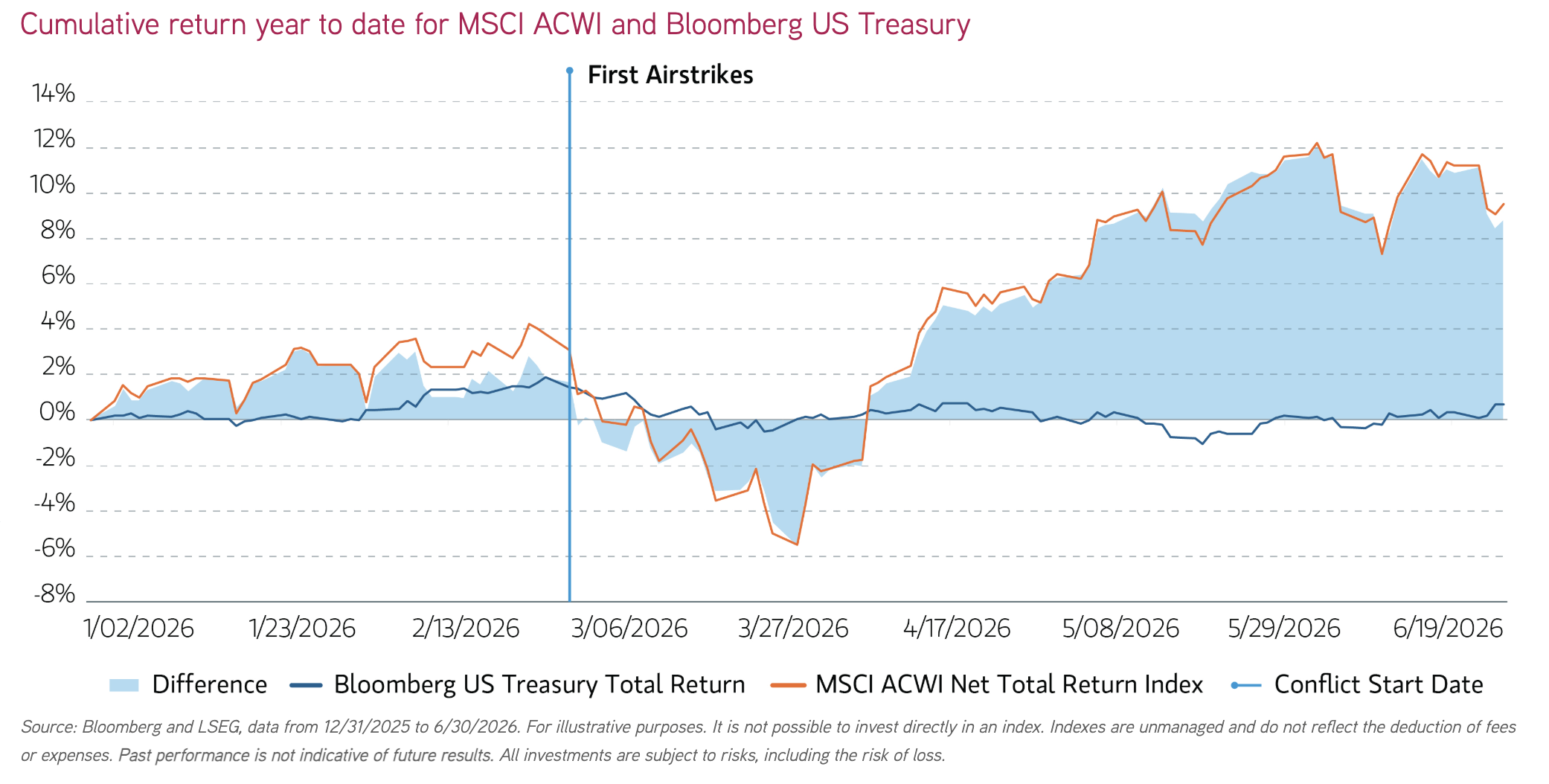
Take, for example, the year-to-date performance of the MSCI All Country World Index (ACWI) relative to the Bloomberg US Treasury Index.
See more: How Advisors Can Assist Clients in Rebalancing Their Portfolio Over Time
Prior to the first airstrikes in late February, the equity-bond return differential was relatively subdued, ranging from 0% to 2.5% and averaging 1.7%. That stability gave way to a reversal by late March, when the differential fell to approximately -6%. The move then swung decisively in the opposite direction, climbing nearly 18% from its trough to a peak of almost 12%.
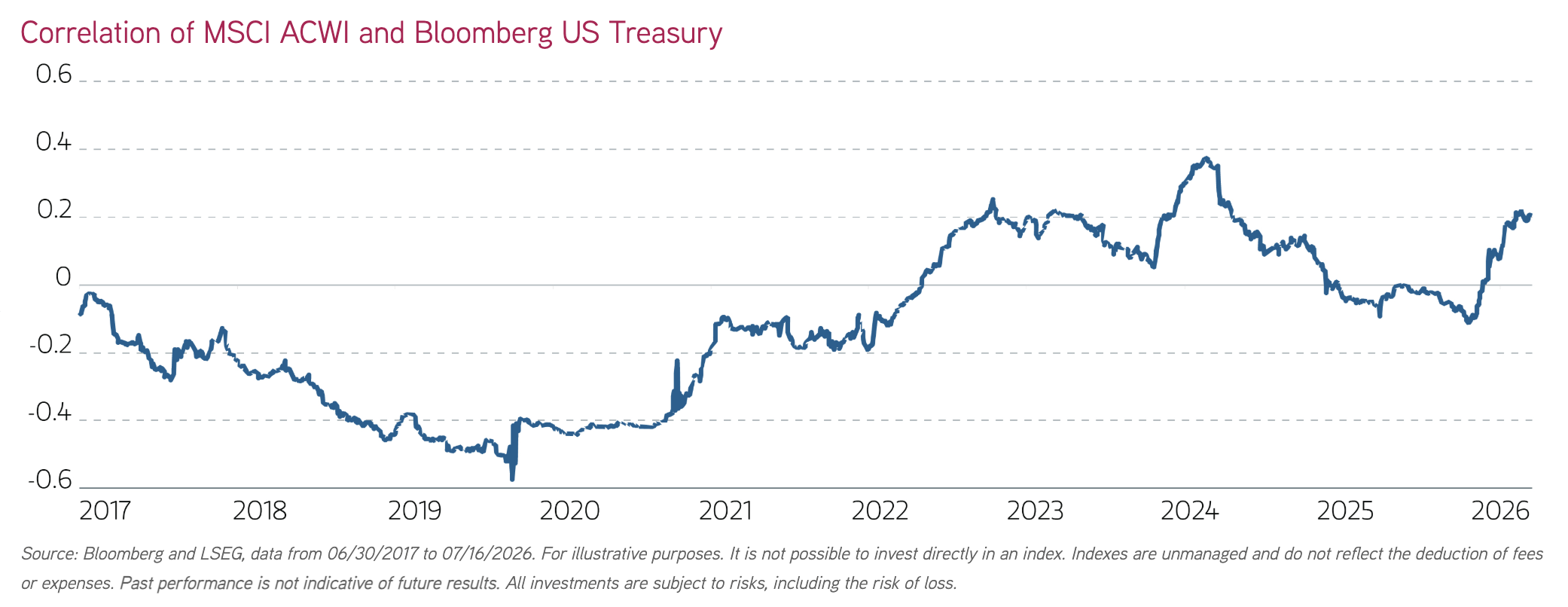
Much commentary since 2022 has focused on how the elevated stock-bond correlation has created headwinds to the diversification1 of a traditional 60/40 portfolio. Before 2022, this correlation was largely negative, resulting in clearer rebalancing opportunities as asset classes moved in opposing ways. Since mid-2022—aside from dips into negative territory around the tariff announcements in early 2025 and again in the first quarter this year—that relationship has trended positive, potentially reducing these rebalancing opportunities.
However, for all the handwringing about positive stock-bond correlation, we still see value in rebalancing on an asset allocation basis—as long as there is disproportionate relative performance between the asset classes.
The bottom line
Parametric employs a variety of rebalancing approaches. Most commonly, we review asset class drift daily and rebalance based on predetermined thresholds. For example, a 60/40 portfolio might rebalance once it drifts to 58/42.
Another approach is to establish a total portfolio tracking error budget. Through this rebalancing methodology, portfolios are monitored holistically, and the portfolio is rebalanced when the total expected tracking error exceeds a predetermined budget.
Regardless of the approach used, Parametric believes that a rules-based systematic program is key to the successful implementation of rebalancing.
1 Diversification does not eliminate the risk of loss.
A program of regular rebalancing cannot assure a profit or protect against a loss in a declining market.
The views expressed in these posts are those of the authors and are current only through the date stated. These views are subject to change at any time based upon market or other conditions, and Parametric and its affiliates disclaim any responsibility to update such views. These views may not be relied upon as investment advice and, because investment decisions for Parametric are based on many factors, may not be relied upon as an indication of trading intent on behalf of any Parametric strategy. The discussion herein is general in nature and is provided for informational purposes only. There is no guarantee as to its accuracy or completeness. Past performance is no guarantee of future results. All investments are subject to the risk of loss. Prospective investors should consult with a tax or legal advisor before making any investment decision. Please refer to the Disclosure page on our website for important information about investments and risks.
07.30.2027 | RO 5787207
Investment advisory services offered through Parametric Portfolio Associates LLC ("Parametric"), an investment advisor registered with the US Securities and Exchange Commission (CRD #114310). Parametric is also registered as a portfolio manager with the securities regulatory authorities in certain provinces of Canada (National Registration Database No. 42850) with regard to specific products and strategies. Parametric provides advisory services directly to institutional investors and indirectly to individual investors through financial intermediaries. The information on this website does not constitute an offer to sell, or a solicitation of an offer to purchase, securities in any jurisdiction to any person to whom it is not lawful to make such an offer. Investing entails risks, and there can be no assurance that Parametric (and its affiliates) will achieve profits or avoid incurring losses. All investments are subject to potential loss of principal. Parametric does not provide tax or legal advice. Prospective investors should consult with a tax or legal advisor before making any investment decision. Please refer to the disclosure page for important information about investments and risks.
S&P Dow Jones Indices are a product of S&P Dow Jones Indices LLC (“S&P DJI”) and have been licensed for use. S&P® indexes are registered trademarks of S&P DJI; Dow Jones® is a registered trademark of Dow Jones Trademark Holdings LLC (“Dow Jones”); S&P DJI, Dow Jones, and their respective affiliates do not sponsor, endorse, sell, or promote Parametric and its strategies, will not have any liability with respect thereto, and do not have any liability for any errors, omissions, or interruptions of the S&P Dow Jones Indices.
©2026 Parametric Portfolio Associates LLC. All rights reserved. 800 Fifth Avenue, Suite 2800, Seattle, WA 98104.
A message from Advisor Perspectives and VettaFi: Discover something new! Click here to register for our upcoming webcasts.
© Parametric
Read more commentaries by Parametric