Key Takeaways
- We believe the AI opportunity extends past visible US hyperscalers and model developers to the infrastructure layer that enables AI at scale.
- Many of the strongest emerging markets companies sit in highly consolidated parts of the AI hardware supply chain, where scale, technical expertise and high barriers to entry can support pricing power and attractive returns.
- China is building a parallel AI ecosystem, supported by policy, domestic demand and a drive for technological self-sufficiency.
The artificial intelligence (AI) boom has been led by Silicon Valley, but the next phase of value creation may be decided by physical bottlenecks. Every model, chatbot and productivity tool depends on a vast physical network of chips, memory, servers, power systems and cooling equipment. Many of the companies that control these scarce inputs are based in emerging markets, creating a different way to access AI growth: not by chasing the most visible applications, but by identifying the infrastructure champions that allow AI to scale.
The EM Bottlenecks Behind AI
Many of the most critical components of AI infrastructure are produced by a small and increasingly consolidated group of highly specialized companies. A significant share of that expertise sits in Taiwan and South Korea. Taiwan is central to the advanced chips and servers that power AI systems, while South Korea supplies the high-performance memory needed to process vast amounts of data quickly. Other specialist manufacturers help bring these parts together so they can be used by the large cloud computing companies. As AI systems become bigger and more powerful, they also need more electricity, better cooling and faster connections between all the different pieces of hardware.
This means that while much of the spending originates with US cloud platforms that need more data centers and computing power, a meaningful share of the economics can accrue to EM companies. In other words, industry profits are not confined to the companies building the applications; they can also sit with the infrastructure champions that make those applications possible.
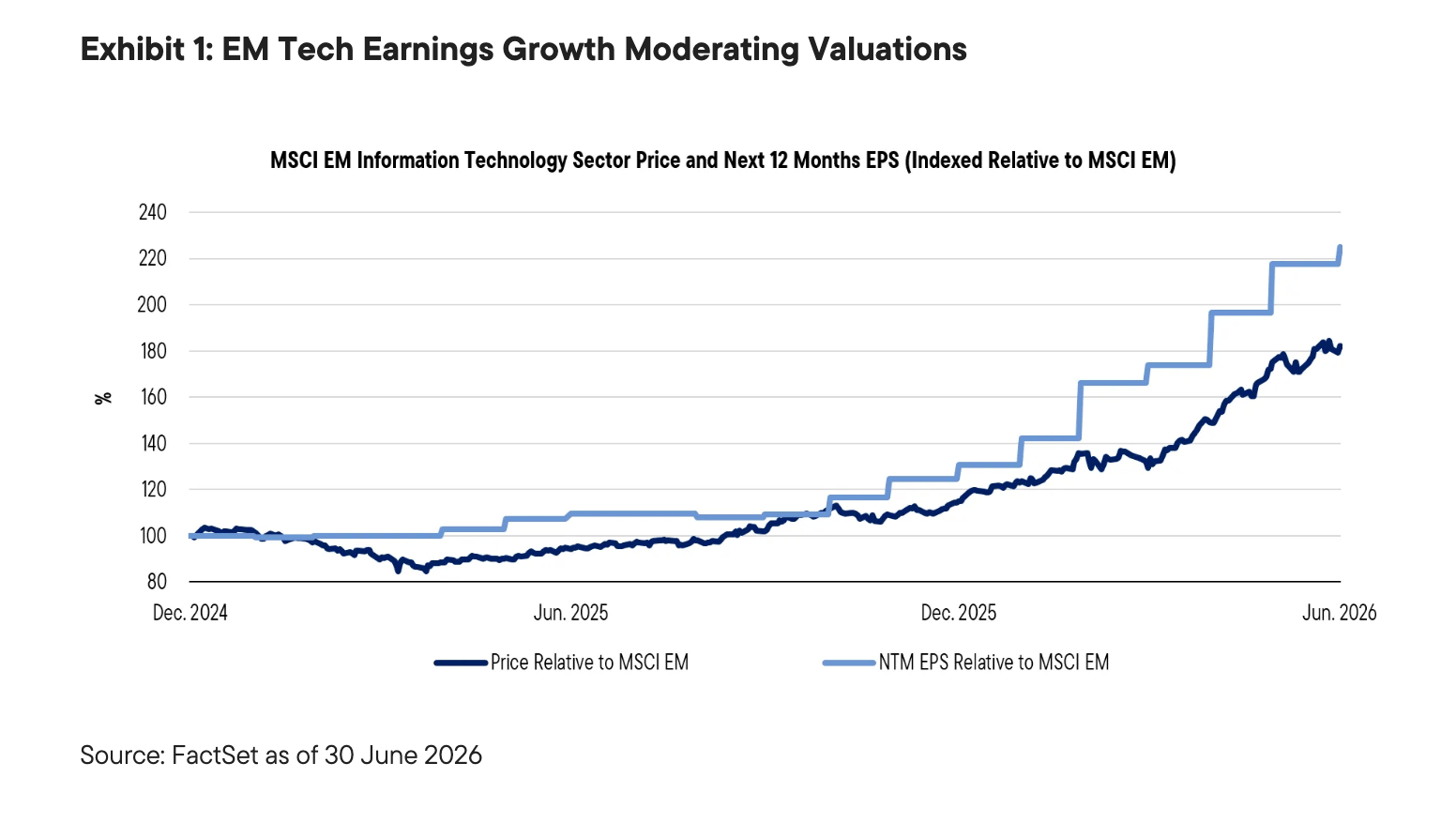
The investment case is strengthened by industry structure. Many parts of the semiconductor and hardware supply chain have consolidated dramatically over the past decade. That consolidation gives the strongest companies better pricing power, stronger returns on capital and a larger share of the value created by the AI infrastructure cycle. For investors, the opportunity is not simply to buy AI growth, but to identify where scarcity, scale and consolidation allow that growth to translate into attractive economics (Exhibit 1).
This opportunity is not without risk. Technology cycles can be volatile, capital requirements are significant and geopolitical tensions remain an important consideration. This is where active management becomes critical: continuously assessing AI developments around the world and understanding how they may affect individual portfolio holdings.
The recent volatility in semiconductor stocks appears disconnected from any material change in long-term fundamentals. While investors may be reassessing expectations and risk appetite, share prices can often react more sharply than the underlying outlook would suggest in the short term. Over longer periods, however, investment returns are ultimately driven by a company’s ability to execute, grow earnings and deliver on its fundamentals.
See more: On AI Bubbles & Keeping Clients Invested Without Ignoring Risk
China: A Parallel AI Ecosystem
China deserves its own place in this discussion because its AI ecosystem is developing differently and should therefore be viewed through a different lens. US restrictions on access to the most advanced chips and semiconductor manufacturing tools have made the path more difficult. But rather than stopping China’s AI ambitions, those constraints have reinforced the strategic importance of building a more domestic technology stack.
China is now building a more self-contained AI supply chain that spans domestic chips, servers, cloud platforms, models and applications. Its technology is not directly comparable with the leading global ecosystem at the individual chip level, but China is reconfiguring the problem. Where access to the most advanced hardware is constrained, it can still pursue scale, local optimization, cheaper deployment models and tighter hardware-software integration.
For investors, the China story is therefore not simply about catch-up. It is about the emergence of a separate AI ecosystem shaped by constraint, policy support, local demand and cost advantage. China may not win by matching the frontier chip-for-chip; it may succeed by optimizing around constraint through scale, cost discipline and hardware-software integration.
The Long-Term Opportunity
In the AI era, emerging markets are not peripheral; they are central to the infrastructure that makes AI possible. While Silicon Valley may capture the headlines, some of the most compelling opportunities may lie with the emerging market companies that supply the infrastructure behind AI. The next phase of AI investing may be less about who builds the most visible applications, and more about who controls the scarce capacity that allows those applications to scale.
WHAT ARE THE RISKS?
All investments involve risks, including possible loss of principal.
Equity securities are subject to price fluctuation and possible loss of principal. Small- and mid-cap stocks involve greater risks and volatility than large-cap stocks.
Investment strategies which incorporate the identification of thematic investment opportunities, and their performance, may be negatively impacted if the investment manager does not correctly identify such opportunities or if the theme develops in an unexpected manner. Focusing investments in information technology (IT) and technology-related industries carries much greater risks of adverse developments and price movements in such industries than a strategy that invests in a wider variety of industries.
International investments are subject to special risks, including currency fluctuations and social, economic and political uncertainties, which could increase volatility. These risks are magnified in emerging markets. Investments in companies in a specific country or region may experience greater volatility than those that are more broadly diversified geographically.
There are special risks associated with investments in China, Hong Kong and Taiwan, including less liquidity, expropriation, confiscatory taxation, international trade tensions, nationalization, and exchange control regulations and rapid inflation, all of which can negatively impact the fund. Investments in Taiwan could be adversely affected by its political and economic relationship with China.
WF: 11819208
IMPORTANT LEGAL INFORMATION
This material is intended to be of general interest only and should not be construed as individual investment advice or a recommendation or solicitation to buy, sell or hold any security or to adopt any investment strategy. It does not constitute legal or tax advice. This material may not be reproduced, distributed or published without prior written permission from Franklin Templeton.
The views expressed are those of the investment manager and the comments, opinions and analyses are rendered as at publication date and may change without notice. The underlying assumptions and these views are subject to change based on market and other conditions and may differ from other portfolio managers or of the firm as a whole. The information provided in this material is not intended as a complete analysis of every material fact regarding any country, region or market. There is no assurance that any prediction, projection or forecast on the economy, stock market, bond market or the economic trends of the markets will be realized. The value of investments and the income from them can go down as well as up and you may not get back the full amount that you invested. Past performance is not necessarily indicative nor a guarantee of future performance. All investments involve risks, including possible loss of principal.
Any research and analysis contained in this material has been procured by Franklin Templeton for its own purposes and may be acted upon in that connection and, as such, is provided to you incidentally. Data from third party sources may have been used in the preparation of this material and Franklin Templeton ("FT") has not independently verified, validated or audited such data. Although information has been obtained from sources that Franklin Templeton believes to be reliable, no guarantee can be given as to its accuracy and such information may be incomplete or condensed and may be subject to change at any time without notice. The mention of any individual securities should neither constitute nor be construed as a recommendation to purchase, hold or sell any securities, and the information provided regarding such individual securities (if any) is not a sufficient basis upon which to make an investment decision. FT accepts no liability whatsoever for any loss arising from use of this information and reliance upon the comments, opinions and analyses in the material is at the sole discretion of the user.
Franklin Templeton has environmental, social and governance (ESG) capabilities; however, not all strategies or products for a strategy consider “ESG” as part of their investment process.
Products, services and information may not be available in all jurisdictions and are offered outside the U.S. by other FT affiliates and/or their distributors as local laws and regulation permits. Please consult your own financial professional or Franklin Templeton institutional contact for further information on availability of products and services in your jurisdiction.
Issued in the U.S. by Franklin Templeton, One Franklin Parkway, San Mateo, California 94403-1906, (800) DIAL BEN/342-5236, franklintempleton.com. Investments are not FDIC insured; may lose value; and are not bank guaranteed.
You need Adobe Acrobat Reader to view and print PDF documents. Download a free version from Adobe's website.
CFA® and Chartered Financial Analyst® are trademarks owned by CFA Institute.
A message from Advisor Perspectives and VettaFi: Discover something new! Click here to register for our upcoming webcasts.
Read more commentaries by ClearBridge Advisors