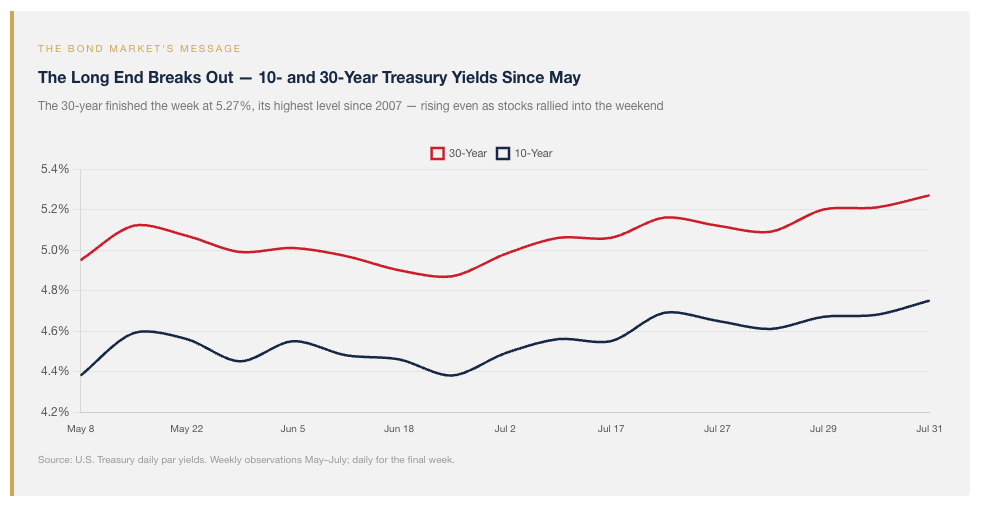
On Wednesday afternoon the Federal Reserve held interest rates steady for a fifth consecutive meeting, and stocks buckled: the Dow fell 1,153 points, its worst day since April of last year. That evening Microsoft reported blowout earnings, and on Thursday its shares added roughly $450 billion in market value — the largest single-day gain any company has ever recorded. By Friday's close the S&P 500 had recovered everything it lost on Fed day and more, finishing the week higher at 7,489.72, only about a percent and a half below the record it set in early June. Beneath the rebound, though, the week's most important number moved the other way: the yield on the thirty-year Treasury climbed to 5.27%, a level last seen in 2007, and the ten-year reached 4.75%, its high for the year. This is not two markets disagreeing about the facts. Both listened to the same press conference — a central bank that talks about 2% inflation and, for the fifth meeting running, declined to act on it. Stocks flinched, then — with Microsoft's help — heard a dove, and to stocks a patient Fed is a gift: easy money, strong earnings, buy. The bond market heard a debtor: a government borrowing close to $2 trillion a year, whose central bank will not defend its inflation target, must pay its longest lenders more — and so long-term yields rose even as stocks rallied. Same message; the argument is over what it costs. And because every valuation in the stock market ultimately rests on the rate the bond market sets, only one of these tapes can be right for long. We think it is the bond market's, and explaining why is the purpose of this letter.
See more: Fed Watch: Is It a Matter of When, Not If?
It has been nearly two months since our June 8 update, and the news came quickly. At his first meeting as Chair in mid-June, Kevin Warsh presided over a remarkable shift: the Fed's published projections flipped from cutting rates to raising them, with nine of eighteen officials penciling in at least one increase this year and the committee lifting its own 2026 inflation forecast to 3.6%. The ceasefire signed with Iran in mid-June collapsed within three weeks, and oil traveled accordingly — Brent from above $110 in the spring to the low $70s at the start of July and back to the high $80s by Friday, with weekend reports of renewed de-escalation talks poised to swing it yet again. That round trip flattered June's inflation report: consumer prices fell 0.4% in the month, the largest one-month decline since April 2020, pulling the annual rate down to 3.5%, with core inflation at 2.6%. Second-quarter growth arrived at a modest-looking 1.5%. Then came Wednesday: another hold, but with three of the twelve voting members formally dissenting because they wanted to raise rates — the most dissent any new Fed chairman has faced this early in his tenure since 1970. Interest-rate futures now lean toward at least one hike before year-end.
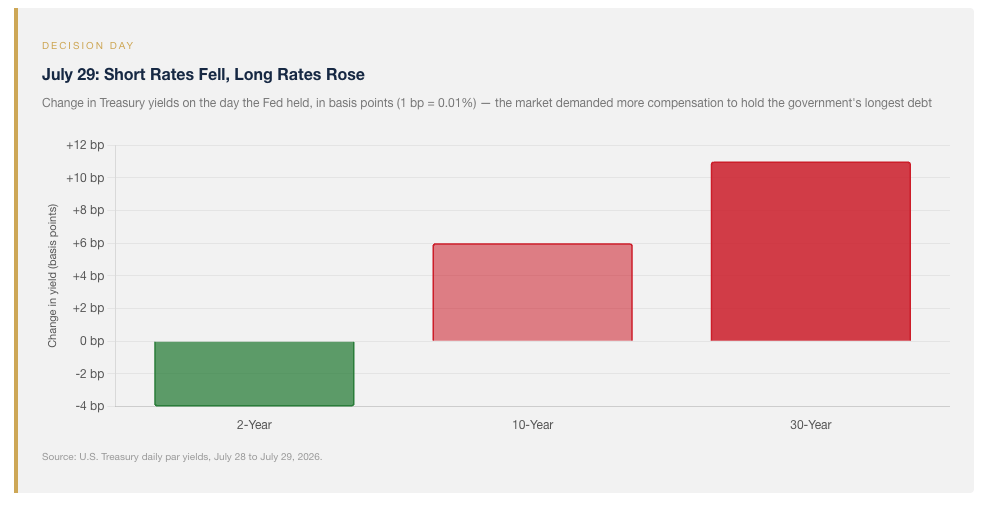
Why would anyone want to raise rates into a 1.5% growth quarter? Because the slowdown is smaller than it looks, and so is the inflation progress. The headline growth figure was dragged down by swings in imports and inventories — companies shuffling goods around tariff deadlines. Sales to private domestic buyers, the economy's underlying engine, grew at a 3.9% rate last quarter, accelerating from the first quarter, while business investment in equipment and software grew at double-digit annual rates as the AI build-out moved from press release to purchase order. Meanwhile the Fed's preferred inflation gauge — a different index from the CPI, and the one its 2% target is written in — ran at 3.7% in June, 3.3% even excluding food and energy, and wage costs rose faster than expected last quarter. Yet the same economy contains a genuine recession in its rate-sensitive corners: investment in nonresidential structures — offices, plants, warehouses — has shrunk for ten consecutive quarters, and housing investment is only beginning to stabilize after a year of declines. Raising rates would punish the economy's weakest sectors to restrain its strongest. So the new chairman reaches for words instead. “There is no soft inflation target,” he said Wednesday. “There is only a target, and it is 2 percent.” Notice what that sentence does not promise: a rate hike. In the same press conference he argued that five years of above-target inflation “cannot be cured in nine weeks” and that markets have already done much of the tightening for him — firm about the destination, in no hurry to travel. All the while, the Fed's balance sheet has quietly resumed growing, up roughly $100 billion this year, as it buys Treasury bills to keep short-term lending markets running. The bond market priced the whole package, not the soundbite. Two-year yields — which already sit well above the Fed's current rate because eventual hikes are priced in — slipped on decision day as traders trimmed the odds of an imminent move after a fifth straight hold, while thirty-year yields jumped about a tenth of a percentage point. If investors had believed the 2% vow, the long bond would have rallied on it. Instead they charged the government more, not less, for the Fed's patience — a sign, to us, that the market may expect a hike or two but no longer believes the destination.
“There is no soft inflation target… There is only a target, and it is 2 percent.”
— Federal Reserve Chairman Kevin Warsh, July 29, 2026
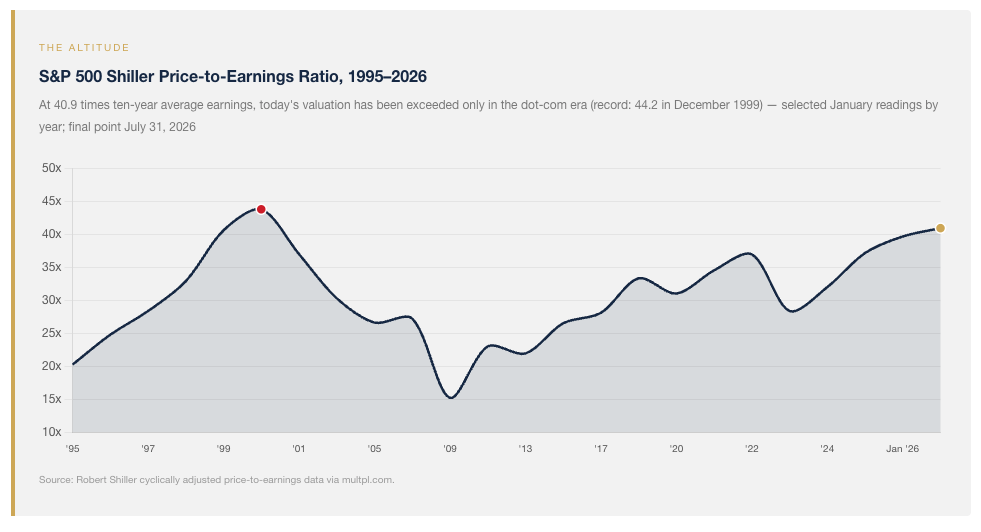
What is absent from this picture is credit. High-yield bond spreads — the extra interest lenders demand from the riskiest corporate borrowers, and the classic early warning of recession — sit at just 2.84%, near their lowest levels in two decades. Spreads this tight signal no broad solvency worry, and we are not forecasting a credit bust or an economic collapse. The near-term risk is simpler, and it comes from the Fed itself. An economy this strong beneath the surface and inflation this sticky argue that the committee will eventually have to act on its own words — not least because the tightening markets have done for the chairman is the wrong kind, a rising inflation premium that raises Washington's bill without cooling the boom, and because three dissents say his colleagues' patience is running out. In our view, the odds that the Fed tightens by year-end are high and rising — and the stock market, for all its poise, is not positioned for that outcome. Investors have borrowed a record $1.50 trillion against their portfolios, up 49% in a year, and, netting that debt against the cash in their accounts, they have never been deeper in the hole. The S&P 500 trades at 41 times its ten-year average earnings — a level exceeded only at the peak of the dot-com era on that measure, known as the Shiller price-to-earnings ratio — and its ten largest companies make up roughly 40% of the index, an all-time high. A market priced this richly and borrowed this heavily does not need a catastrophe to stumble; it needs only a Fed that finally means what it says. So we expect the next few months to be choppy even as the twelve-month backdrop — procyclical fiscal policy, a genuine productivity boom feeding earnings, and a central bank that will ultimately ease through its balance sheet — remains constructive. A sharp repricing in that context has historically been, for the prepared investor, an opportunity rather than an ending.
We also owe you the other side of the ledger, because it is formidable. With three-fifths of the S&P 500 reported, second-quarter profits are running 47% above a year earlier, and companies have beaten expectations by the widest margin since records began in 2008 — though, tellingly, most of that record surprise came from just two companies, Alphabet and Amazon, and owed more to unusual investment gains than to day-to-day operations; because earnings have grown into prices, the index's price-to-earnings ratio on forward estimates, at 19.6, actually sits below its five-year average — a gentler verdict than the ten-year measure's, because it takes this boom's earnings at face value. The productivity gains from artificial intelligence are real, in our view, and the investment driving them is now unmistakable in the official data. The consumer, in aggregate, is still spending. But the aggregate hides the distribution. The top tenth of earners now accounts for roughly half of all consumer spending, by Moody's Analytics' estimate, and that cohort's confidence is tied to the very asset prices we have been describing — while at the other end, subprime auto delinquencies touched a three-decade high in January and remain elevated. An economy whose spending leans this heavily on portfolio values is one more reason a stumble in markets would not stay confined to Wall Street.
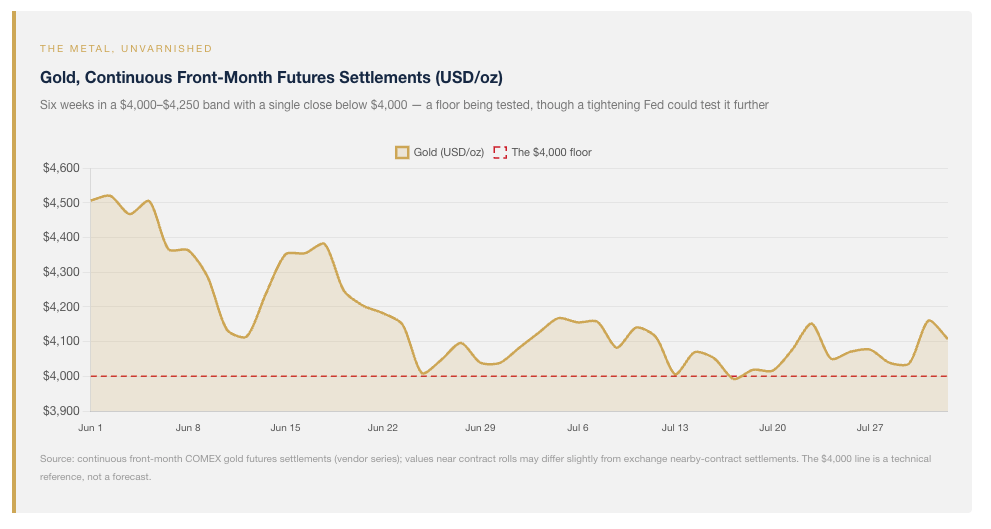
Which brings us to gold, the position our readers ask about most, and we will address it as directly as we did in March and June. For the past six weeks the metal has been testing a floor: since June 18 it has settled between roughly $4,000 and $4,250, closing below $4,000 exactly once — $3,992 on July 16 — and it finished the week just above $4,100, about 27% below the record near $5,600 set in late January. We will not invent a catalyst where none exists: with the Fed talking of hikes and the dollar firmer, gold lacks a near-term spark. And we owe you the honest version of what comes next, because it cuts both ways. If the Fed stays on hold, we believe a bottom is forming here. If the Fed begins raising rates into year-end — our base case — the low may not yet be in: higher real yields and a firmer dollar are gold's least favorite weather, and in 2022 the metal kept sliding for months after the hikes began, bottoming only when the end of tightening came into view. A retest of July's low, or a break somewhat beneath it, would be consistent with that script — uncomfortable, and unremarkable. What limits the downside, in our judgment, is the buyer beneath the market: central banks purchased 289 tonnes in the second quarter, 62% more than a year earlier — extending the elevated pace of official buying seen throughout the past four years — purchases more than six times what gold funds worldwide sold on net. That is patient, price-insensitive accumulation by institutions positioning for precisely the world this letter describes. So the sequence we would prepare for is this: a floor that forms either here or modestly lower during the tightening, followed by the easing that tightening itself brings forward — through the balance sheet if not the policy rate — and with it the setup for gold's next advance, more plausibly a story for next year than for next quarter. We would treat any deeper flush accordingly: as accumulation, not alarm.
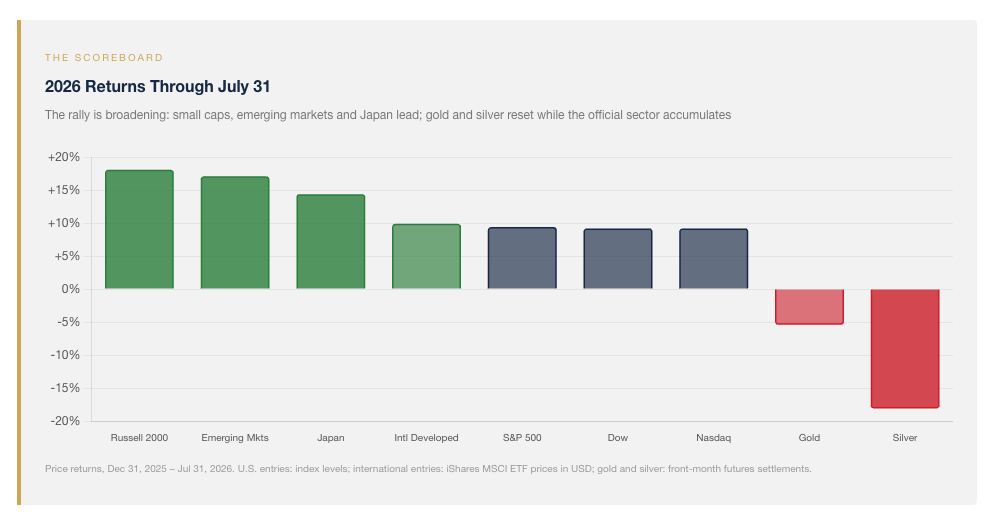
So how do we expect markets to track into the close of the year, and beyond? Our base case is turbulence without tragedy, and the rhyme worth studying is 2022 — at lower voltage. Then as now, a richly valued, crowded market ran into a Federal Reserve forced to choose, for a season, its credibility over Wall Street's comfort, and the unusual thing happened: stocks and bonds fell together, the classic 60/40 portfolio suffered one of its worst years on record, and value beat growth by more than twenty percentage points. On the Shiller measure, today's valuations are higher than January 2022's — but the voltage is lower, a hike or two rather than four percentage points of them, and the cushions are thicker: the Fed's balance sheet is growing rather than shrinking, fiscal policy is loose, and earnings are compounding rather than stalling. So we expect 2022 in miniature: a choppy second half — monetary policy turning from tailwind to headwind against a crowded market — in which stocks and long bonds are vulnerable together; the longest Treasurys, already down more than 40% in price from their 2020 peak, fell further still last week. Leadership, meanwhile, keeps rotating toward value, real assets, and markets beyond the crowded corner — small caps are up 18% this year, emerging markets 17%, Japan 14% in dollar terms, all ahead of the S&P 500. Gold, for its part, is somewhere in the middle of the 2022 script: then, the metal fell more than 20%, kept falling while the hikes ran, bottomed months before the last one — and then more than tripled to January's record. Whether this cycle's low proves to be July's floor or a level somewhat beneath it, the pattern reads the same way to us: a setup, not a warning, with the next advance a story for next year. Beyond December, we expect the sequel to rhyme as well: once a tightening has bought back enough credibility, the easing begins — through the balance sheet — into an economy whose fiscal, liquidity and earnings tailwinds never stopped blowing, with inflation settling nearer 3% than 2%. That is the world in which hard assets and international value do the compounding. The tests come quickly — the Treasury's refunding Wednesday, the jobs report Friday, inflation data and a thirty-year auction next week, Jackson Hole later this month — and with no Fed meeting until September 15, the bond market will spend six weeks grading Washington's homework with no teacher in the room. If you would like to discuss how to position for this environment, we invite you to speak with a Euro Pacific Asset Management advisor or visit EuroPac.com.
A message from Advisor Perspectives and VettaFi: Discover something new! Click here to register for our upcoming webcasts.
Investment risk
Please read about the Risks of investing in the Funds. You should carefully consider the Fund’s investment objectives, risk, charges and expenses before investing. Investing involves risk, including potential for loss of principal. The risks of investing in emerging market and foreign securities may be higher than the risks associated with investing other securities. Diversification cannot assure a profit or protect against loss in a down market. Dividends are not guaranteed and may fluctuate. Fund holdings are subject to change and risk. Past performance cannot predict future results. To obtain a prospectus or summary prospectus that contains this and other information about the Funds, please Click Here or call 1-866-878-2881. Please read the prospectus carefully before investing. Euro Pacific Asset Management Funds are distributed by Distribution Services, LLC (Euro Pacific Asset Management is not affiliated with Distribution Services, LLC).
Disclosure: Any tax or legal information provided is merely a summary of our understanding and interpretation of some of the current income tax regulations and it is not exhaustive. Investors must consult their tax advisor or legal counsel for advice and information concerning their particular situation. Neither the Funds nor any of its representatives may give legal or tax advice.
© Euro Pacific Capital
Read more commentaries by Euro Pacific Capital