The Real Story Behind Rising Bond Yields
US 10-year Treasury yields have climbed roughly 50-basis points since the start of 2026. This is not an inflation scare. Despite the sharp rise in energy prices following the outbreak of war with Iran, market-based measures of medium-term inflation expectations have drifted lower. The entire repricing has come through real yields, with the 10-year real rate now approaching 2.5%.
Growth Is Doing the Heavy Lifting
US real yields have been rising because despite multiple shocks, the US economy continues to surprise to the upside. Growth has been supported by artificial intelligence (AI) capital expenditure super-cycle and resilient consumers. The first half of 2026 has brought early signs that corporate investment is broadening beyond AI. We are also seeing tentative improvement in employment growth, which until recently has been a notable soft spot. Together these developments suggest the expansion is becoming more self-sustaining.
The Market Is Repricing Neutral
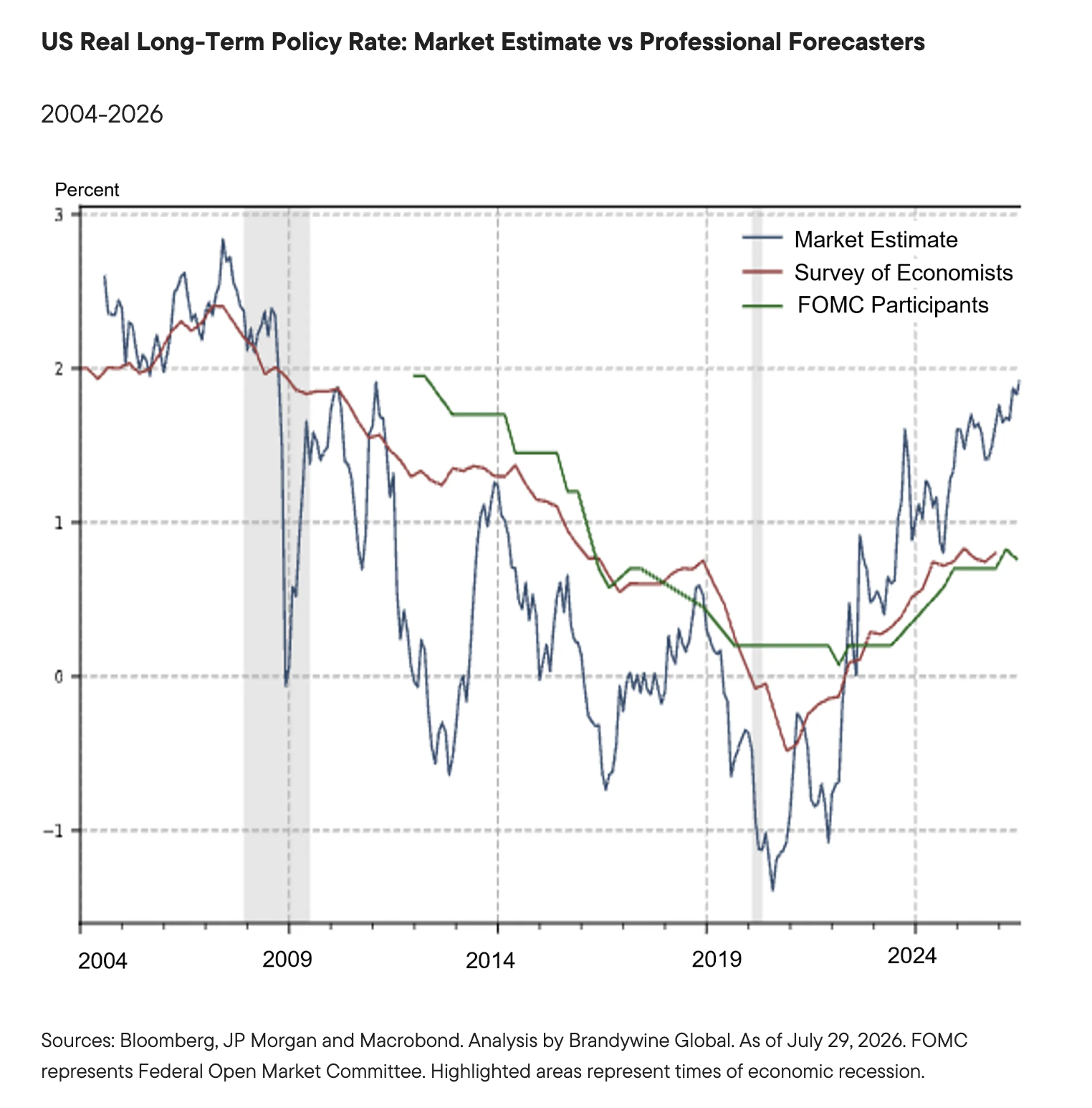
The rise in real yields also reflects a structural re-assessment of the neutral real policy rate. The confidence bands around r-star estimates are enormous. But the broad contours of the debate are clear. Before the global financial crisis, the neutral real rate was generally estimated at 2%–2.5%. During the 2010s, amid secular stagnation fears, estimates collapsed toward zero. Today, the Federal Reserve (Fed) and most sell-side economists put neutral real policy rate at around 0.75%-1.00%.
See more: Old-Fashioned Bond Math for a New-Fashioned Fed
The Asset Allocation Angle
Where does this leave investors? In the near term, robust growth justifies real yields staying elevated.
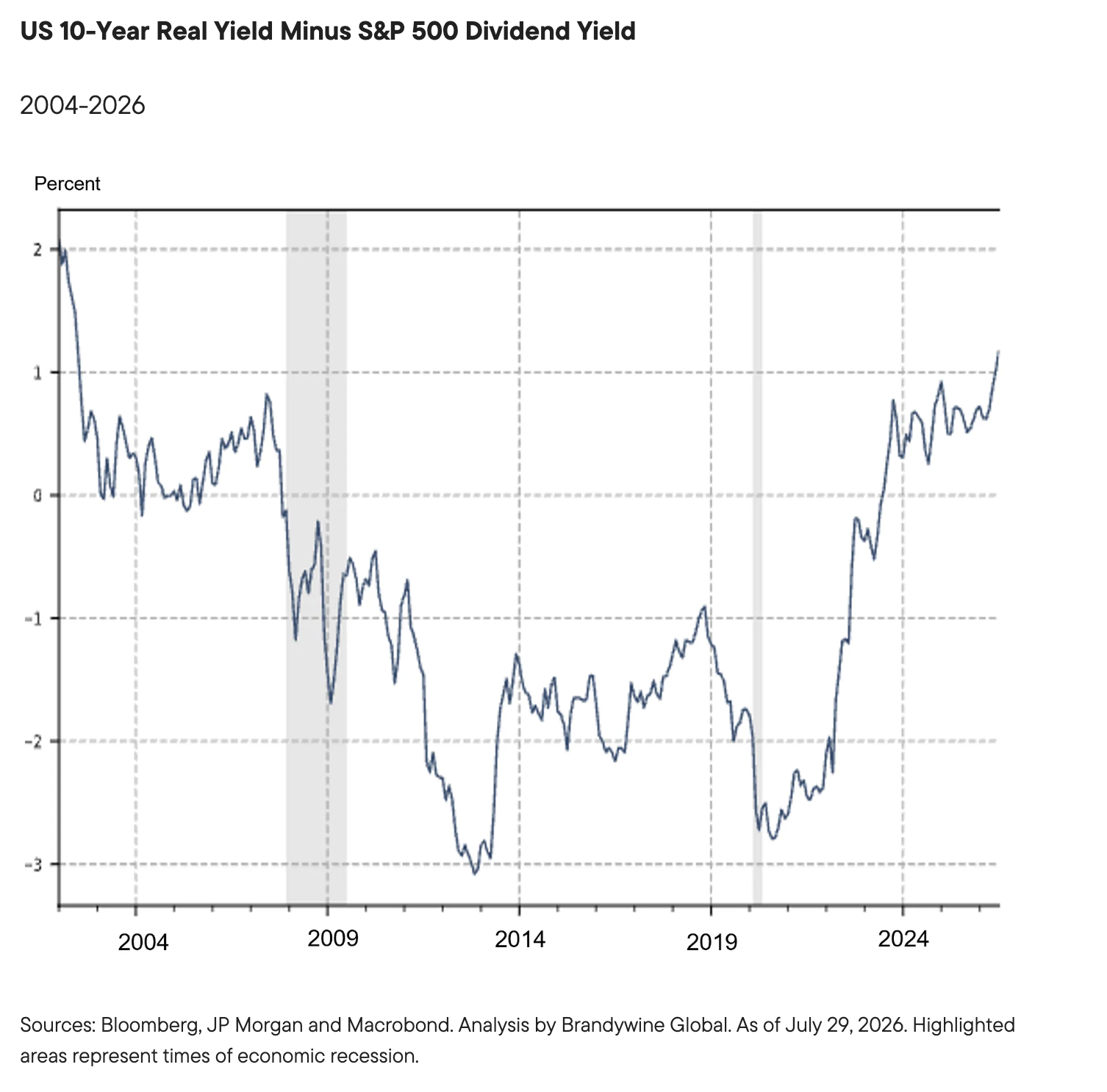
But from a medium-term asset allocation perspective, the calculus is shifting. Real yields approaching 2.5% may represent genuinely attractive compensation for a risk-free asset. The spread between the US 10-year real yield and the S&P 500 dividend yield is now at its widest since the early 2000s. Bonds have not offered this kind of relative value versus equities in over two decades.
Market-implied estimates of the natural real rate have been rising and now approach 1.8%–2%. If monetary policy was genuinely restrictive as the Fed estimates suggest, we would expect to see the evidence. Instead, financial conditions are very easy, growth is decent, and credit growth is picking up. The most logical explanation is that the neutral rate is higher than official estimates suggest and the bond market is pricing this accordingly.
The rise in real yields reflects a healthier economy and a recognition that the ultra-low neutral rates of the 2010s were an aberration, not a permanent state. That repricing has been painful for bond holders. But the upside is that bond holders can now earn a real return that is competitive with other major asset classes, and with considerably lower volatility.
Conclusion
In short, rising real yields are not simply a headwind for markets; they are also a signal of a more resilient economy and a meaningful reset in the return potential of high-quality bonds. For investors, the key takeaway is that fixed income once again offers compelling real income, diversification and relative value after years of unusually low yields.
WHAT ARE THE RISKS?
All investments involve risks, including possible loss of principal.
Fixed income securities involve interest rate, credit, inflation and reinvestment risks, and possible loss of principal. As interest rates rise, the value of fixed income securities falls. Low-rated, high-yield bonds are subject to greater price volatility, illiquidity and possibility of default.
Equity securities are subject to price fluctuation and possible loss of principal.
International investments are subject to special risks, including currency fluctuations and social, economic and political uncertainties, which could increase volatility. These risks are magnified in emerging markets.
There is no assurance that any estimate, forecast or projection will be realized.
WF: 11816708
IMPORTANT LEGAL INFORMATION
This material is intended to be of general interest only and should not be construed as individual investment advice or a recommendation or solicitation to buy, sell or hold any security or to adopt any investment strategy. It does not constitute legal or tax advice. This material may not be reproduced, distributed or published without prior written permission from Franklin Templeton.
The views expressed are those of the investment manager and the comments, opinions and analyses are rendered as at publication date and may change without notice. The underlying assumptions and these views are subject to change based on market and other conditions and may differ from other portfolio managers or of the firm as a whole. The information provided in this material is not intended as a complete analysis of every material fact regarding any country, region or market. There is no assurance that any prediction, projection or forecast on the economy, stock market, bond market or the economic trends of the markets will be realized. The value of investments and the income from them can go down as well as up and you may not get back the full amount that you invested. Past performance is not necessarily indicative nor a guarantee of future performance. All investments involve risks, including possible loss of principal.
Any research and analysis contained in this material has been procured by Franklin Templeton for its own purposes and may be acted upon in that connection and, as such, is provided to you incidentally. Data from third party sources may have been used in the preparation of this material and Franklin Templeton ("FT") has not independently verified, validated or audited such data. Although information has been obtained from sources that Franklin Templeton believes to be reliable, no guarantee can be given as to its accuracy and such information may be incomplete or condensed and may be subject to change at any time without notice. The mention of any individual securities should neither constitute nor be construed as a recommendation to purchase, hold or sell any securities, and the information provided regarding such individual securities (if any) is not a sufficient basis upon which to make an investment decision. FT accepts no liability whatsoever for any loss arising from use of this information and reliance upon the comments, opinions and analyses in the material is at the sole discretion of the user.
Franklin Templeton has environmental, social and governance (ESG) capabilities; however, not all strategies or products for a strategy consider “ESG” as part of their investment process.
Products, services and information may not be available in all jurisdictions and are offered outside the U.S. by other FT affiliates and/or their distributors as local laws and regulation permits. Please consult your own financial professional or Franklin Templeton institutional contact for further information on availability of products and services in your jurisdiction.
Issued in the U.S. by Franklin Templeton, One Franklin Parkway, San Mateo, California 94403-1906, (800) DIAL BEN/342-5236, franklintempleton.com. Investments are not FDIC insured; may lose value; and are not bank guaranteed.
You need Adobe Acrobat Reader to view and print PDF documents. Download a free version from Adobe's website.
CFA® and Chartered Financial Analyst® are trademarks owned by CFA Institute.
A message from Advisor Perspectives and VettaFi: Discover something new! Click here to register for our upcoming webcasts.
© Brandywine Global Investment Management
Read more commentaries by Brandywine Global Investment Management