Is College Worth it?
Membership required
Membership is now required to use this feature. To learn more:
View Membership Benefits
"After bread, education is the first need of the people."
— Georges Danton, speech to the Convention, 1793
These words are engraved in stone on the side of the Boston Public Library.
THE COMMONWEALTH REQUIRES THE EDUCATION OF THE PEOPLE AS THE SAFEGUARD OF ORDER AND LIBERTY
Note the word “requires.” Our founders believed education is a prerequisite to the survival and success of the American experiment.
This week we wrap up our look higher education in the US, through a financial lens.
Ask anyone under 30 whether college is worth it, and you might get a long stare before you get an answer. Most people seem to agree: the cost is too high, and many believe degrees have been devalued and education politicized.
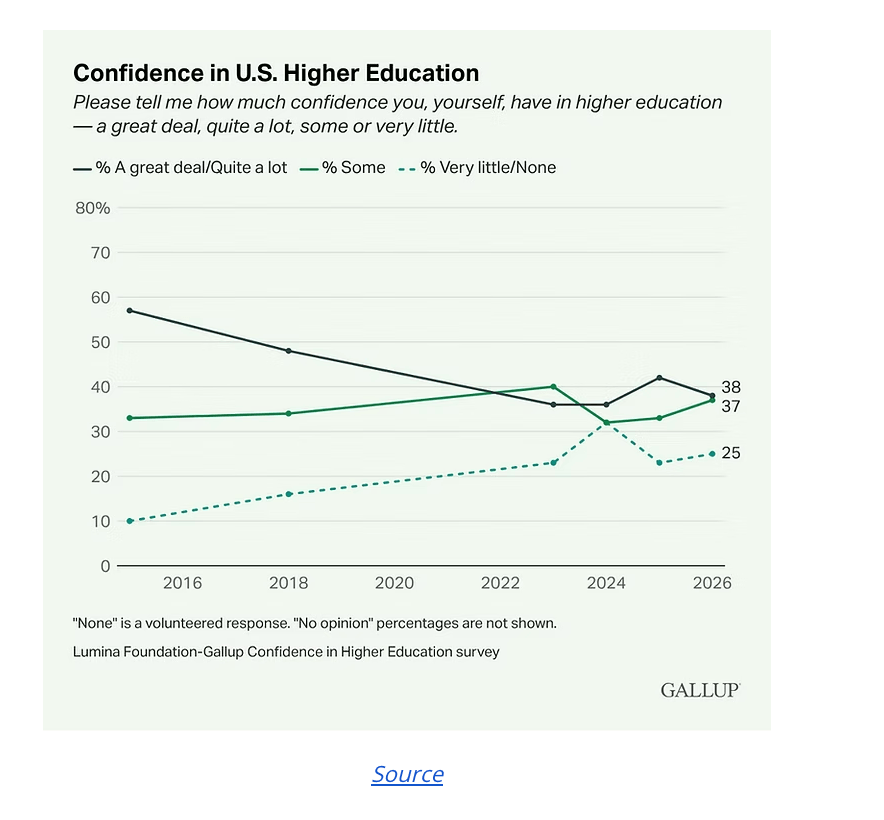
Confidence in higher education is declining. Gallup and the Lumina Foundation found only 38% of Americans have "a great deal" or "quite a lot" of confidence in higher education this year, down from 42% last year and 57% in 2015.[1]
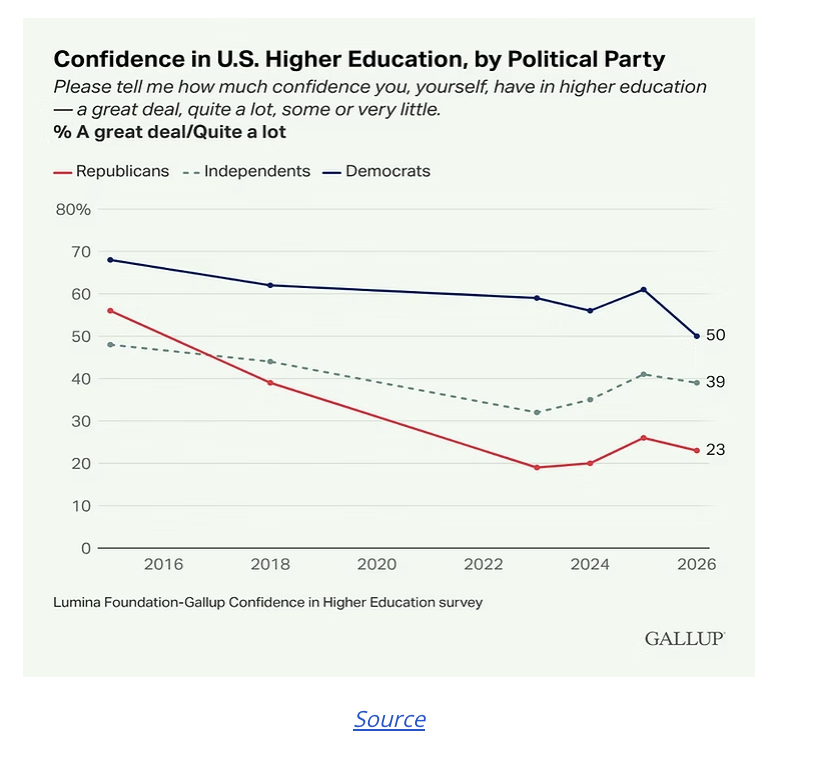
By party, the decline isn't even: Democrats drove this year's drop, falling from 61% in 2025 to 50% this year. Republicans, meanwhile, have seen the largest collapse over the full decade: confidence has fallen 33 points since 2015, from 56% to just 23% today.[2]
See more: School for Scoundrels
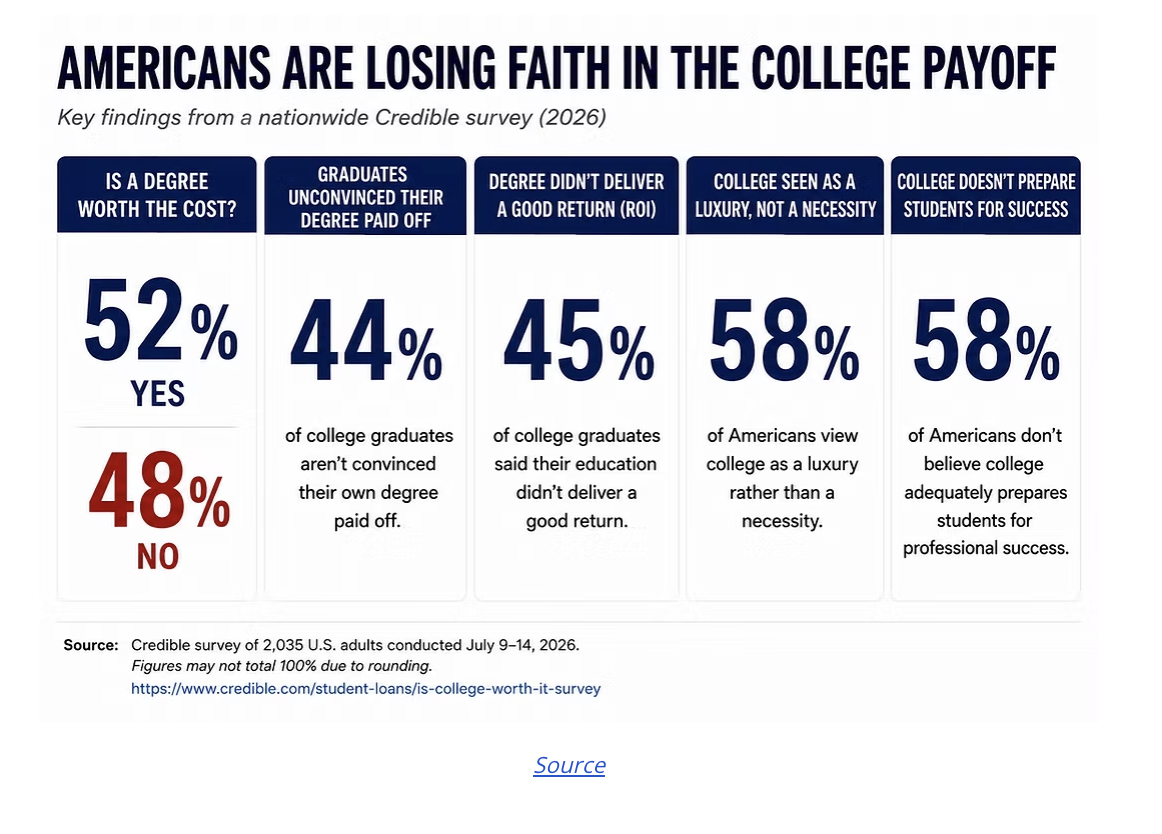
A separate survey, this one by Credible, found Americans split almost evenly, 52-48, on whether a degree is worth the cost, and among college graduates specifically, 44% aren't convinced their own degree paid off, while 45% said their education didn't deliver a good return. The same survey found 58% see college as a luxury, not a necessity, and 58% don't think it prepares students for professional success.[3]
This is a good time to remind you – we are studying the “vibe,” meaning, what people feel. One of my former mentors used to tell me, perception is reality. If you are convinced you are getting a raw deal, a basked of statistics likely won’t change your mind.
But looking past the vibe, the data does get more interesting. The New York Fed puts the internal rate of return on a bachelor's degree at 12.5% and finds it's held between 12 and 13% for three decades.[4] Huh.
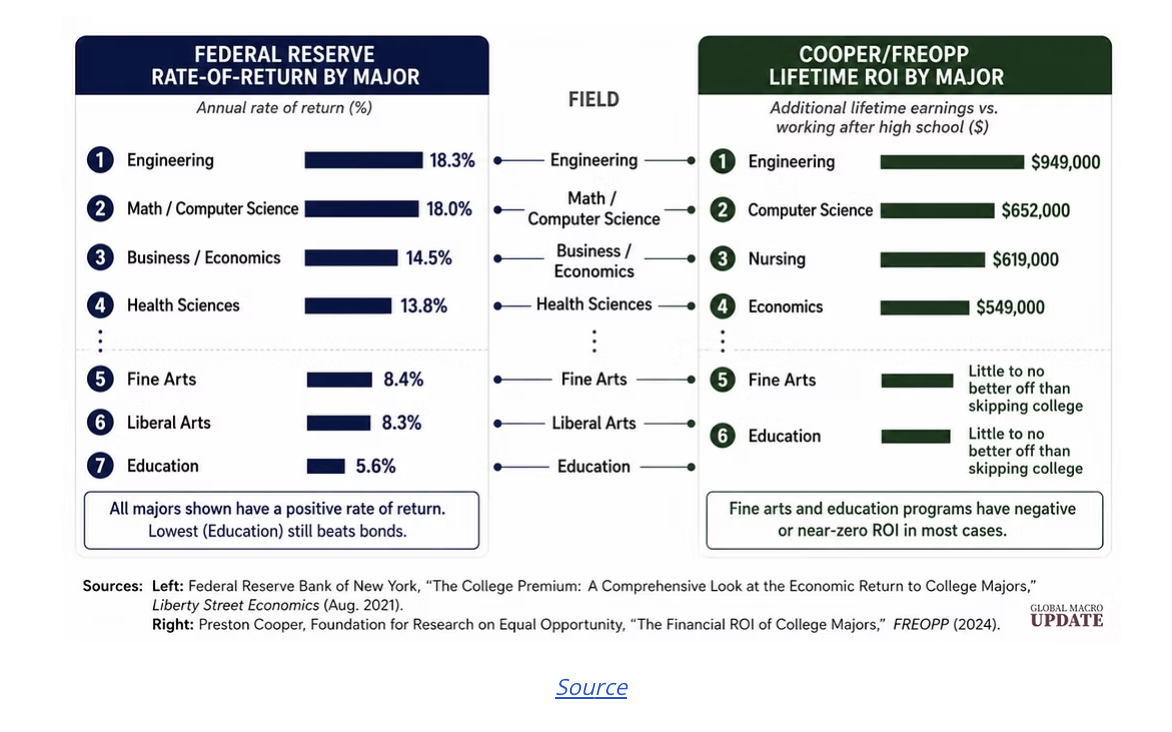
Preston Cooper at the Foundation for Research on Equal Opportunity modeled 53,000 individual programs and found the median bachelor's still clears $160,000 over a lifetime. Engineering leads at $949,000, with computer science, nursing, and economics all clearing well over $500,000.[5] However, fine arts and education sit at the bottom, leaving graduates little better off than if they'd skipped college entirely.
The Fed found nearly the same ordering using an internal rate of return, Engineering at 18.3%, math and computer science at 18.0%, business, economics, and health sciences close behind. Fine arts, liberal arts, and education land at the bottom. Education dead last at 5.6%.[6] The point is, regardless of which ROI metric you use (dollars over a lifetime, or annual percentage return), the fields at the top and the fields at the bottom stay the same. The Fed measures a yearly return. Cooper measures a total lifetime dollar gain, after costs and foregone earnings are subtracted.
It is interesting to note where they disagree: The Fed still calls the bottom-ranked majors a sound investment for the typical student.
But Cooper doesn't. He says fine arts leaves students financially worse off most of the time, and that 23% of bachelor's programs are outright negative-ROI, a figure that climbs to nearly a third of all currently enrolled students once you include associate, master's, and doctoral programs alongside bachelor's. The nuance is in what each side compares graduates to. The Fed compares them to the average high school grad. Cooper compares them to what those same students, given their demographics, academic profile, and family background, would likely have earned without the degree.
That's Cooper answering the "it depends on the kid" objection before anyone raises it. His model isn't asking what the average fine arts major earns, it's asking what that specific student would have earned anyway, then measuring the degree against that.
Regardless, below is a side-by-side comparison of ROI as reported by the Federal Reserve and Cooper/FREOPP.
Today students are getting pickier about what they study, and increasingly trying shorter and cheaper options before committing to a four-year degree. Total postsecondary enrollment is up 1.0% year over year, bachelor's programs grew just 1.0%, certificate programs grew 10.2%. [7]
In fact, certificates have climbed from 12.4% of all undergraduate credentials awarded in 2014–15 to 16.1% in 2023–24, a decade-long shift measured in people who finished, not just enrolled.[8] Registered apprenticeships have grown 80% over the past decade to roughly 700,000 active participants.[9]
Some institutions are finding out what happens if they don't adapt. Saint Augustine's University, a four-year degree-granting institution, filed for Chapter 11 bankruptcy this year and announced a pivot toward certificates and apprenticeship programs. It won't be the last. More than 440 small colleges are projected to face the same reckoning. Some are dipping into restricted donor funds just to keep the lights on.
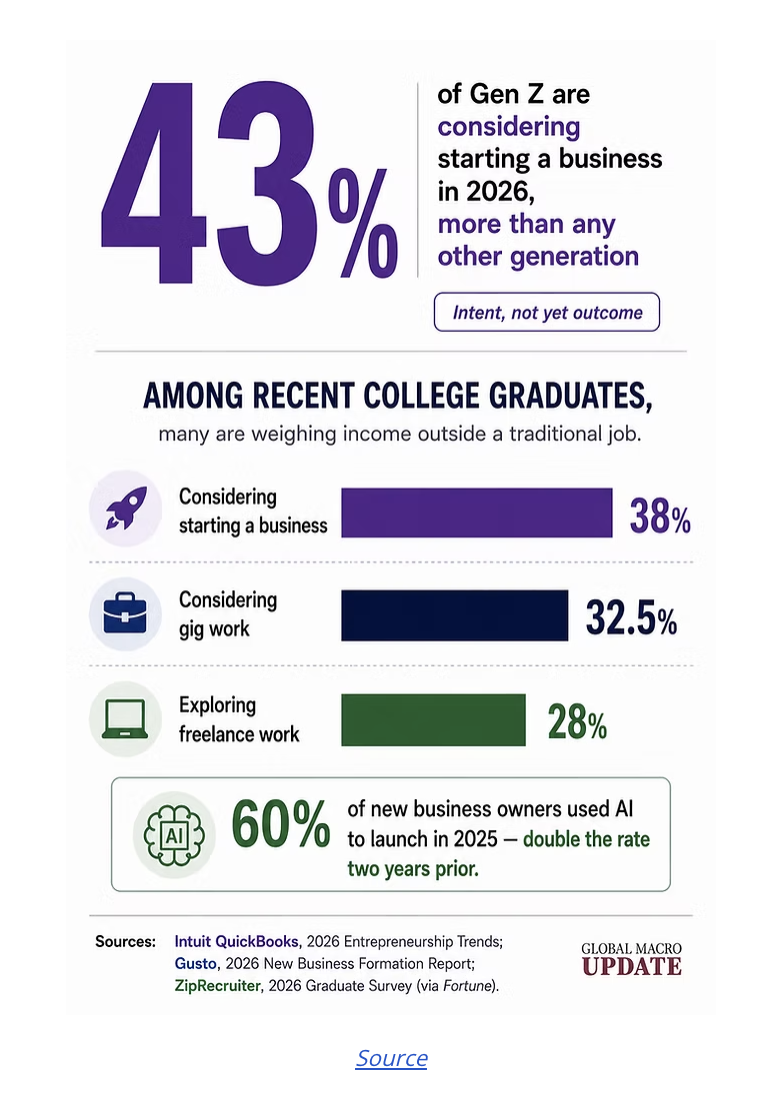
But even among people who do get a degree, a growing number aren't converting it into a traditional job. They're building (or working to build) something else entirely. Forty-three percent of Gen Z say they plan to start a business in 2026, ahead of every other generation, intent, not yet outcome, but the clearest signal yet that entrepreneurship is becoming a default option, not a fallback.[10] Among people who just graduated specifically: 38% are considering starting a business, 32.5% are weighing gig work, 28% are exploring freelance.[11]
Part of it is AI. 60% of new business owners used it to launch in 2025, double the rate two years prior, lowering the cost of trying.[12] Part of it is momentum. Business application growth is running around 8.2% year over year.[13] And it’s driven by youth: 43% of Gen Z report entrepreneurial intent, against 39% of millennials and 21% of Gen X.[14]
AI doesn’t look to have made the degree option worse. It looks to have made the backup plan better, more affordable. So even though college's value hasn't changed, the choice between the two has. This doesn't directly answer whether college is worth it per se. But it does show what a generation raised on that question is doing about it.
Two things are worth considering that will dramatically impact the stats moving forward, and neither of them existed as a factor a generation ago. Alternatives to a four-year degree are getting more government support too. Workforce Pell Grants, once reserved for traditional colleges, now extend to short-term job-training programs.
There's also a demographic trend happening. The number of U.S. high school graduates peaked last year, and is predicted to decline roughly 13% by 2041.[15] Fewer 18-year-olds means fewer traditional applicants, regardless of what anyone decides about the value of a degree. Both of those move the numbers on their own, fewer applicants on one side, more federal support for the alternative on the other.
Where This Leaves Us
Maybe "worth it, or not" was never the right question. It might be better to ask: worth it for whom, doing what, exactly? Engineering clears $949,000 in lifetime ROI. Fine arts, most of the time, leaves students no better off than if they'd skipped college entirely. Does that mean it's worthless? No… but if you leave your college with six figures in debt, you might feel like you’d been had.
But the same caution that applies to the four-year degree should apply to its alternatives, too. Certificates and short-term credentials are growing fast, and Washington is now subsidizing them the way it once subsidized bachelor's degrees: almost unconditionally. Will similar distortions or major price increases follow?
Next week we’ll tackle the final sector contributing to the K-shaped economy: healthcare. What a mess! Until then,
Let me know what you think — reply to this note or drop a comment.
Thanks for reading.
Ed D’Agostino, Partner & COO
[1] https://news.gallup.com/poll/712322/confidence-higher-education-slips-back-slightly.aspx
[2] https://news.gallup.com/poll/712322/confidence-higher-education-slips-back-slightly.aspx
[3] https://www.credible.com/student-loans/is-college-worth-it-survey
[4] https://libertystreeteconomics.newyorkfed.org/2025/04/is-college-still-worth-it/
[5] https://freopp.org/whitepapers/does-college-pay-off-a-comprehensive-return-on-investment-analysis/
[6] https://libertystreeteconomics.newyorkfed.org/wp-content/uploads/sites/2/2025/04/LSE_2025_CollegeNotWorthIt_data.xlsx
[7] https://nscresearchcenter.org/final-spring-enrollment-trends/
[8] https://www.insidehighered.com/news/student-success/academic-life/2025/04/10/college-completion-growth-spurred-certificates
[9] https://www.npr.org/2026/03/08/nx-s1-5719246/trump-set-a-target-of-1-million-apprenticeships-heres-how-thats-going
https://www.nytimes.com/2026/05/27/headway/young-americans-apprentice-labor-economy.html
[10] https://quickbooks.intuit.com/r/small-business-data/entrepreneurship-in-2026/
[11] https://www.ziprecruiter-research.org/economic-insights-research/grad-survey-2026 ; https://fortune.com/2026/04/24/gen-z-entrepreneurship-gig-work-freelance-entry-level-jobs-corporate-america/
[12] https://gusto.com/resources/gusto-insights/new-business-formation-2026
[13] https://www.finder.com/small-business/new-businesses
[14] https://quickbooks.intuit.com/r/small-business-data/entrepreneurship-in-2026/
[15]wiche.edu/resources/report-u-s-high-school-graduates-will-peak-next-year-then-most-states-will-see-steady-declines-through-2041/
A message from Advisor Perspectives and VettaFi: Discover something new! Click here to register for our upcoming webcasts.
Membership required
Membership is now required to use this feature. To learn more:
View Membership BenefitsSponsored Content
Upcoming Virtual Events View All