Key Takeaways
- Earnings delivery and market leadership are continuing to broaden out to a larger group of market constituents; we believe a focus on earnings should be a part of any equity investor’s playbook when trying to ascertain market leadership in the coming months.
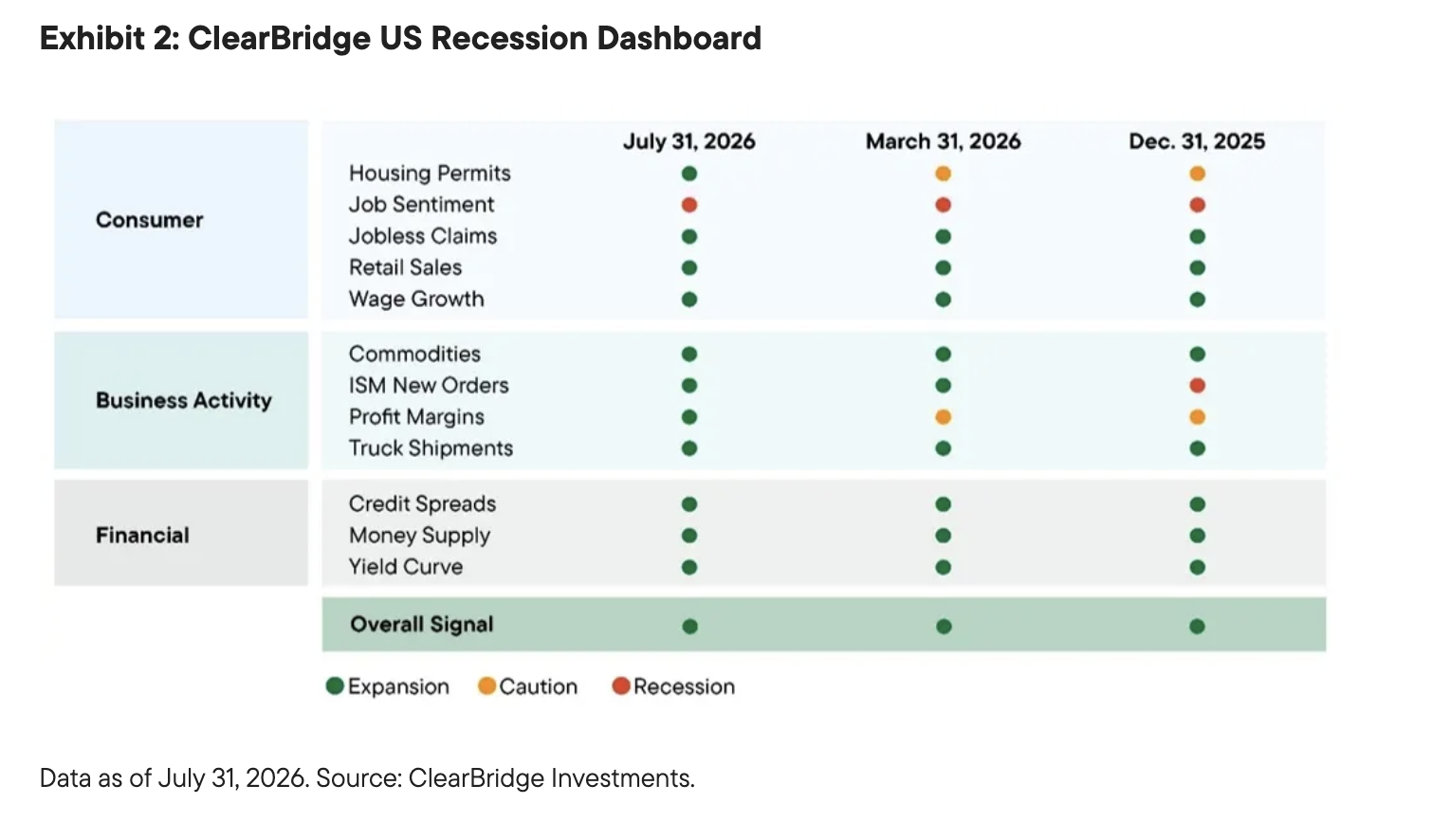
- Corporate commentary from key industrial bellwethers suggests a broader capex cycle is finally underway, a view confirmed by key datapoints such as ISM New Orders and the ClearBridge US Recession Dashboard broadly, which maintains its overall green signal this month and had no changes.
- Although the market may still be undergoing a period of digestion following the second quarter’s strong gains, we believe the path of least resistance for stocks is higher in the second half of the year with earnings continuing to power the way.
US equity market leadership underwent a rotation in July, with previous leaders turning into laggards and vice versa. This was most notable in the AI and momentum trades, with the latter (as measured by the S&P 500 Momentum Index) giving back ~40% of its year-to-date gains in July, while many AI leaders witnessed even larger drawdowns. Although the very end of the month (and the first few days of August) witnessed a bounce back, many investors are searching for clues regarding future market leadership after several head-spinning weeks.
We believe a focus on earnings should be a part of any equity investor’s playbook when trying to ascertain market leadership in the coming months. A review of the last several years shows that earnings have been even more closely tied to market returns than is typical, with more than 100% of the S&P 500’s price return attributable to improving earnings expectations—as opposed to multiple expansion—since April 2020. Earnings growth narrowed meaningfully in 2022–24, however, with most of the market’s earnings and returns driven by a small group of stocks that became known as the Magnificent Seven.1
See more: Investing Outlook: Strength, Surprises and the Road Ahead
However, the second half of 2025 marked a shift in this dynamic, with earnings delivery and market leadership broadening out to a larger group of index constituents. This trend continued in the first half of 2026, and we expect it to remain intact in the coming quarters. The market has begun to pick up on this dynamic, with the equal-weight version of the S&P 500 outpacing the cap-weighted by 3.1% through the first seven months of this year.
Looking ahead, we believe the key question US equity investors are facing is whether earnings delivery once again narrows into a more concentrated group of AI darlings, or if instead the next phase of the AI infrastructure buildout benefits a wider swath of the economy. The industrials sector, for example, is benefiting from a strong environment for AI data center buildouts, although AI is not the only source of growth for the sector.
Corporate commentary from key industrial bellwethers suggests a broader capex cycle is finally underway. For example, Old Dominion Freight Line mentioned that it is “encouraged by the continued improvement in demand that began late last year,” while Illinois Tool Works, which produces engineered fasteners and components, noted that “growth was pretty broad-based.” These anecdotes from bellwether companies are consistent with recent observations from ClearBridge industrials analyst Sunny Huang, who notes:
“Growth is broadening out beyond data centers, supported by improving demand across manufacturing, reshoring, automation, aerospace, infrastructure and select nonresidential construction markets. This suggests that sector momentum is being supported by multiple end-market drivers rather than a single investment cycle.”
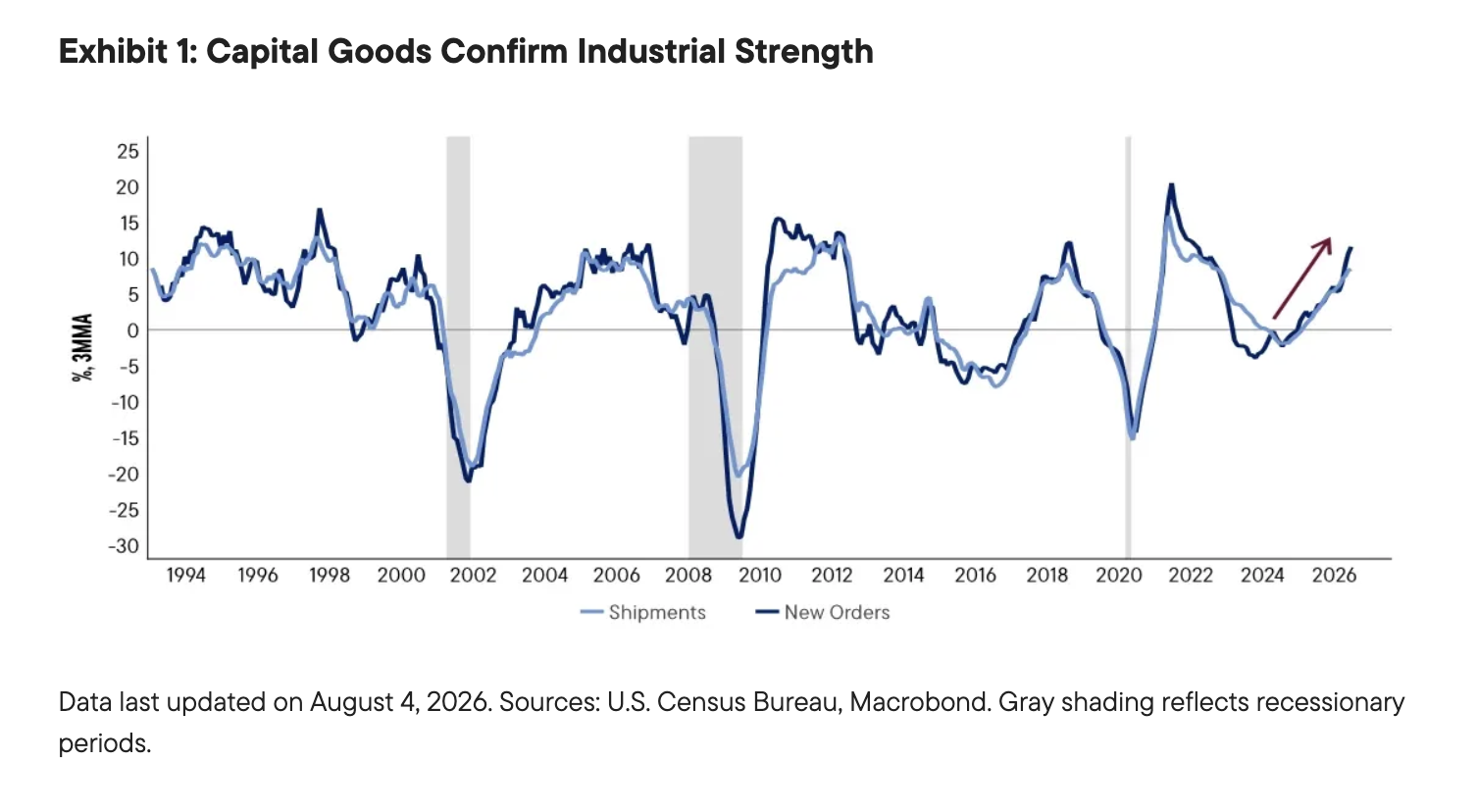
This improvement in the industrial economy is also evident in the data, with the output from one of most widely followed measures of business investment: Non-Defense Capital Goods Ex-Aircraft Orders/Shipments, which has been growing at a double-digit pace as of late.
Other widely followed industrial metrics such as the ISM Manufacturing PMI tell a similar story. The headline manufacturing PMI rose to 55.6 last month, solidly in expansionary territory and the strongest reading in over four years (last above 55 in May 2022). Importantly, the more forward-looking New Orders subcomponent—a ClearBridge US Recession Dashboard indicator—came in even stronger at 56.7. This indicator remains firmly in green territory along with the overall dashboard signal, and there are no changes to the ClearBridge US Recession Dashboard this month.
Although the strength from both AI- and non-AI-related industrial activity should be a key support for the economy in the back half of the year, there are concerns that the consumer may come under pressure as the benefits from the One Big Beautiful Bill (OBBB) wane and heavier-than-expected cuts to social safety net programs ramp into year-end.
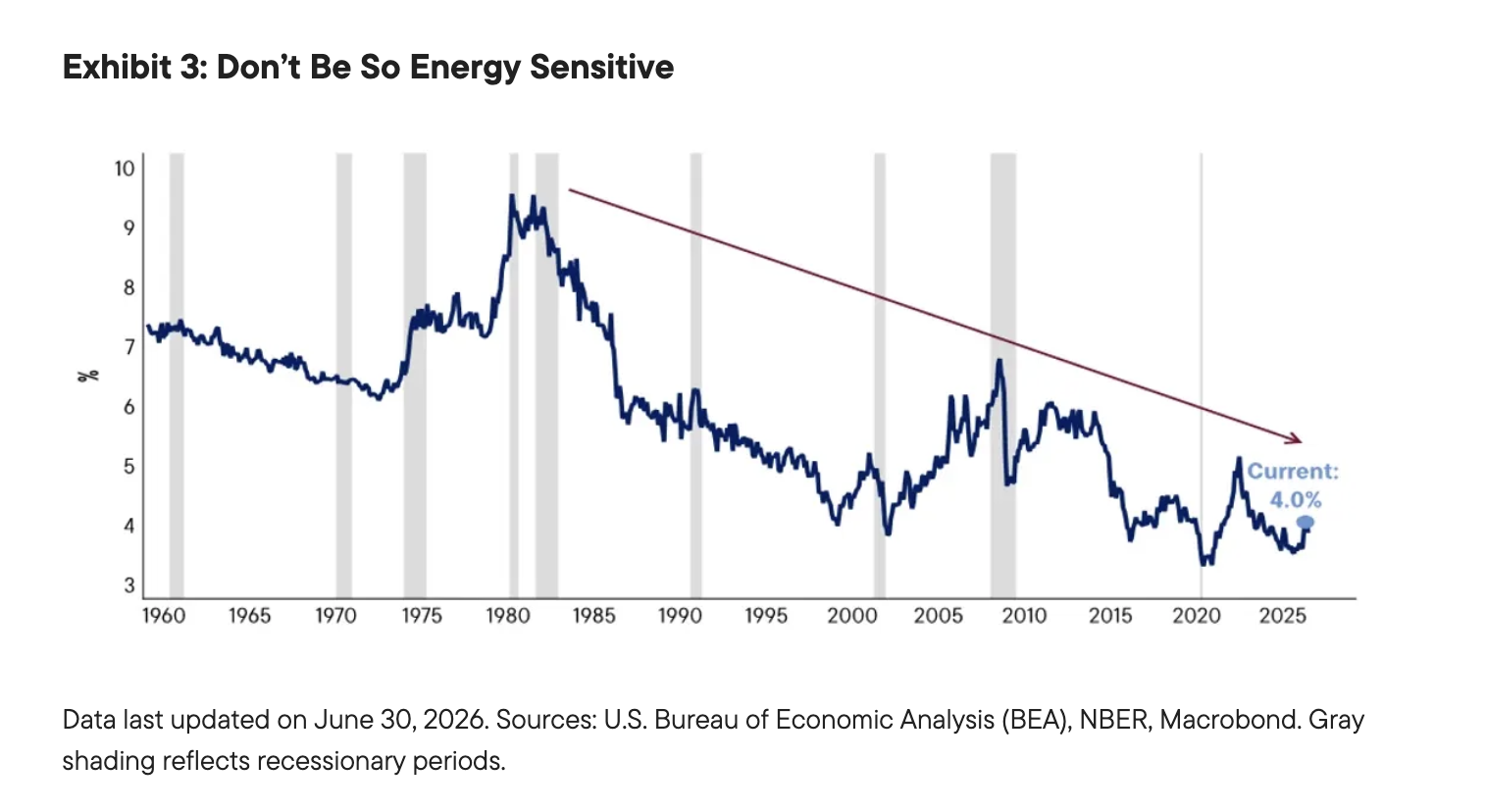
The underlying resilience of the US consumer should not be disregarded, however. The headwind from higher energy prices has been lessened with WTI and Brent oil contracts both trading back below $80 in the first days of August. Importantly, we continue to believe that structural changes in US energy independence and consumer energy intensity are mitigating factors from an economic risk perspective in the face of oil price volatility.
Oil prices notwithstanding, doubting the US consumer has been a perilous exercise over the past six years. We do not see material signs of a shift in consumer spending at this point, with high-frequency data such as credit card spending holding up. Despite higher energy prices, real consumption grew at a better-than-expected 3.2% annualized pace last quarter, helped by larger tax refunds and lower withholdings stemming from last year’s OBBB. Consumption is expected to slow to 2% in the second half of the year, but easing inflation and a stable labor market (in terms of wages) should continue to support household budgets.
The firm economic backdrop—anchored by a strengthening industrial cycle, a stable labor market and a resilient consumer—supports the case for broader earnings leadership through the second half of 2026 and into next year. Furthermore, sell-side consensus expects the Magnificent Seven to deliver 4.9% next-12-month (NTM) EPS growth in 2027, well below the 16.6% expectation for the other 493 stocks in the benchmark. This is a sharp reversal from earlier this year as well as the recent past, when the group’s earnings outpaced the “S&P 493.” If realized, this shift should create opportunities for active managers that can navigate the concentration risk embedded in the S&P 500. Although the market may still be undergoing a period of digestion following the second quarter’s strong gains, we believe the path of least resistance for equities is higher in the second half of the year with earnings continuing to power the way.
Endnote
1. Alphabet (Google), Amazon, Apple, Meta Platforms (Facebook), Microsoft, Nvidia and Tesla.
WHAT ARE THE RISKS?
All investments involve risks, including possible loss of principal. Past performance is no guarantee of future results. Please note that an investor cannot invest directly in an index. Unmanaged index returns do not reflect any fees, expenses or sales charges.
Equity securities are subject to price fluctuation and possible loss of principal. Large-capitalization companies may fall out of favor with investors based on market and economic conditions. Small- and mid-cap stocks involve greater risks and volatility than large-cap stocks.
Commodities and currencies contain heightened risk that include market, political, regulatory, and natural conditions and may not be suitable for all investors.
US Treasuries are direct debt obligations issued and backed by the “full faith and credit” of the US government. The US government guarantees the principal and interest payments on US Treasuries when the securities are held to maturity. Unlike US Treasuries, debt securities issued by the federal agencies and instrumentalities and related investments may or may not be backed by the full faith and credit of the US government. Even when the US government guarantees principal and interest payments on securities, this guarantee does not apply to losses resulting from declines in the market value of these securities.
IMPORTANT LEGAL INFORMATION
This material is intended to be of general interest only and should not be construed as individual investment advice or a recommendation or solicitation to buy, sell or hold any security or to adopt any investment strategy. It does not constitute legal or tax advice. This material may not be reproduced, distributed or published without prior written permission from Franklin Templeton.
The views expressed are those of the investment manager and the comments, opinions and analyses are rendered as at publication date and may change without notice. The underlying assumptions and these views are subject to change based on market and other conditions and may differ from other portfolio managers or of the firm as a whole. The information provided in this material is not intended as a complete analysis of every material fact regarding any country, region or market. There is no assurance that any prediction, projection or forecast on the economy, stock market, bond market or the economic trends of the markets will be realized. The value of investments and the income from them can go down as well as up and you may not get back the full amount that you invested. Past performance is not necessarily indicative nor a guarantee of future performance. All investments involve risks, including possible loss of principal.
Any research and analysis contained in this material has been procured by Franklin Templeton for its own purposes and may be acted upon in that connection and, as such, is provided to you incidentally. Data from third party sources may have been used in the preparation of this material and Franklin Templeton ("FT") has not independently verified, validated or audited such data. Although information has been obtained from sources that Franklin Templeton believes to be reliable, no guarantee can be given as to its accuracy and such information may be incomplete or condensed and may be subject to change at any time without notice. The mention of any individual securities should neither constitute nor be construed as a recommendation to purchase, hold or sell any securities, and the information provided regarding such individual securities (if any) is not a sufficient basis upon which to make an investment decision. FT accepts no liability whatsoever for any loss arising from use of this information and reliance upon the comments, opinions and analyses in the material is at the sole discretion of the user.
Franklin Templeton has environmental, social and governance (ESG) capabilities; however, not all strategies or products for a strategy consider “ESG” as part of their investment process.
Products, services and information may not be available in all jurisdictions and are offered outside the U.S. by other FT affiliates and/or their distributors as local laws and regulation permits. Please consult your own financial professional or Franklin Templeton institutional contact for further information on availability of products and services in your jurisdiction.
Issued in the U.S. by Franklin Templeton, One Franklin Parkway, San Mateo, California 94403-1906, (800) DIAL BEN/342-5236, franklintempleton.com. Investments are not FDIC insured; may lose value; and are not bank guaranteed.
You need Adobe Acrobat Reader to view and print PDF documents. Download a free version from Adobe's website.
CFA® and Chartered Financial Analyst® are trademarks owned by CFA Institute.
A message from Advisor Perspectives and VettaFi: Discover something new! Click here to register for our upcoming webcasts.
© ClearBridge Investments
Read more commentaries by ClearBridge Investments