Key Takeaways:
- Consumers remain resilient, but spending is increasingly shifting toward value, convenience, and frequent everyday purchases.
- Retail ETFs can bridge staples and discretionary exposure.
- E-commerce is evolving from discretionary shopping toward an everyday retail channel spanning groceries, essentials, and services.
The consumer remains resilient, but spending is becoming increasingly selective. Bank of America’s August Consumer Checkpoint showed total card spending per household increased 5.0% year-over-year in July, with spending excluding gasoline up 4.3%. Although growth moderated from June, Bank of America attributed much of that slowdown to the fading of temporary boosts, including the timing of major online sales and World Cup related spending, rather than a broad deterioration in underlying demand.
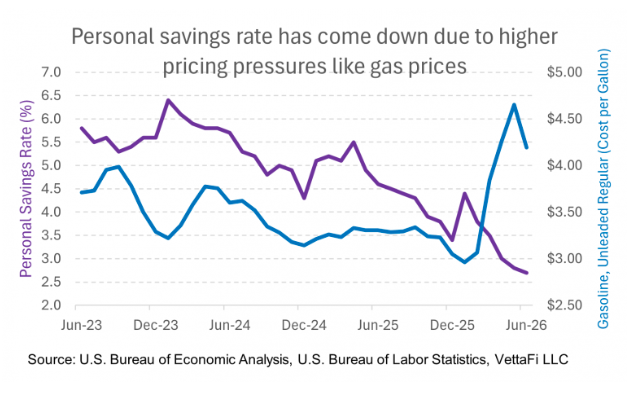
Still, households have less room for discretionary purchases. The personal saving rate was just 2.7% in June, according to the Bureau of Economic Analysis, likely due to higher inflationary costs. This points to a consumer that is still willing and able to spend, but is becoming more deliberate about where those dollars go.
For investors, that makes the retail opportunity less about whether consumers are spending and more about which companies are capturing their spending. Value, convenience, and frequent purchases remain important themes, benefiting warehouse clubs, discount retailers, and companies tied to everyday necessities. At the same time, e-commerce is becoming more integrated into routine purchases such as groceries and household goods. Memberships, advertising, marketplaces, and fulfillment are also giving some of the largest retailers additional ways to monetize customer relationships beyond traditional merchandise sales. We’ll take a look at these trends — and a few ETFs that follow them — in this note.
A Closer Look at Discretionary vs. Staples
Recent earnings illustrate how uneven the consumer discretionary environment has become. In its second quarter, Amazon’s North America segment sales rose 16% year over year, while the company said grocery and everyday essentials continued to grow meaningfully faster than the rest of its stores business. Amazon also delivered more than 40% more items same-day or overnight during the first half of the year.
Other areas of discretionary spending tell a more mixed story. eBay reported 15% year over year growth in both revenue and gross merchandise volume in the second quarter, and completed its acquisition of resale marketplace Depop on July 30, expanding its exposure to resale and value-oriented fashion. Nike, by comparison, reported a 7% decline in Nike Direct revenue in its latest quarter, including a 12% decline in Nike Brand Digital sales. Together, these results reinforce the idea that consumers are still spending, but company and brand trends matter more as households become selective.
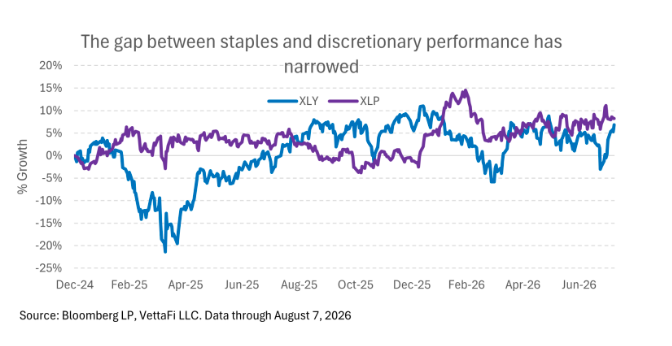
For investors seeking broad exposure to the sector, the State Street Consumer Discretionary Select Sector SPDR ETF (XLY) is the largest consumer discretionary sector ETF. However, its performance is heavily influenced by its two largest holdings, Amazon.com Inc. (AMZN) and Tesla Inc. (TSLA), which together account for 40% of the portfolio. While both companies have contributed significantly to the sector’s long-term performance, they also behave differently from many traditional consumer businesses and align closely with the technology sector.
Beyond these two names, XLY provides exposure to a wider range of consumer activity through retailers, restaurants, home improvement companies, and other discretionary businesses such as Home Depot (HD), TJX Companies (TJX), and McDonald’s (MCD). That difference is particularly relevant in the current environment, where opportunities within consumer discretionary may depend less on broad sector strength and more on which companies are best positioned around value, convenience, and resilient consumer demand.
Consumer staples offer a different mix of exposures. Recent earnings continue to show relatively resilient demand for everyday products, although performance is not uniform across the board. Coca-Cola reported 5% global unit case volume growth in its latest quarter. P&G, however, reported flat organic sales in its fiscal fourth quarter, while Colgate-Palmolive experienced weaker volume in North America despite positive organic sales growth globally.
This points to a significant distinction for staples investors: Necessity does not always guarantee demand. As with discretionary purchases, brand strength, pricing, value, and the ability to maintain volumes all matter when households are paying closer attention to price.
For investors seeking broad exposure to the sector, the State Street Consumer Staples Select Sector SPDR ETF (XLP) also highlights another important theme: the growing strength of value-oriented, membership-based retailers. Walmart (WMT) and Costco (COST), which together account for more than 20% of XLP, have increasingly used scale, low prices, and recurring membership revenue to deepen customer loyalty and capture a larger share of household spending.
Those retailers are particularly relevant to the current value and convenience theme. For instance, Costco’s July sales update showed net sales rising 10.7% year over year, while digitally enabled comparable sales increased 17.7%. Costco’s membership model also provides a recurring source of revenue: Membership fees reached $1.37 billion in its latest reported quarter, up from $1.24 billion a year earlier. Walmart is pursuing a similar diversification of its business model through e-commerce, advertising, marketplaces, and membership programs. In its latest reported quarter, global e-commerce grew 26%, global advertising grew 37%, and membership fee income increased 17.4%.
These companies illustrate why staples exposure today can extend beyond traditional defensive characteristics. Scale, low prices, digital convenience, and recurring customer relationships can help large retailers compete for a greater share of the consumer wallet, even when shoppers become more selective. (Read more about the staples sector in this research note.)
Retail ETFs Can Help Bridge the Sector Divide
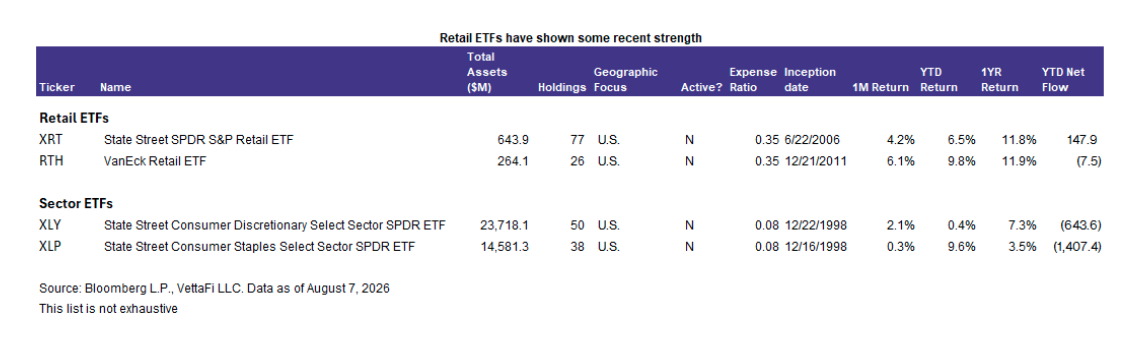
The line between consumer discretionary and staples is increasingly blurred, as many major retailers sell a mix of necessities and discretionary goods while competing on the same themes of value, convenience, and e-commerce. Investors looking to capture these broader retail trends rather than make a sector-specific bet may instead consider retail-focused ETFs such as the SPDR S&P Retail ETF (XRT) or VanEck Retail ETF (RTH).
XRT holds about 75 stocks (80% are consumer discretionary) and tracks a modified equal-weighted index, so more weight is given to smaller and midcap retailers. RTH is much more concentrated in the dominant retail companies. It has only about 26 holdings, with Amazon at roughly 22% of its weight, as of August 10. It also has meaningfully less discretionary exposure: around 55% discretionary, 27% staples, and 15% health care.
E-commerce Is Embedded in Retail — But Still Investable as a Standalone Theme
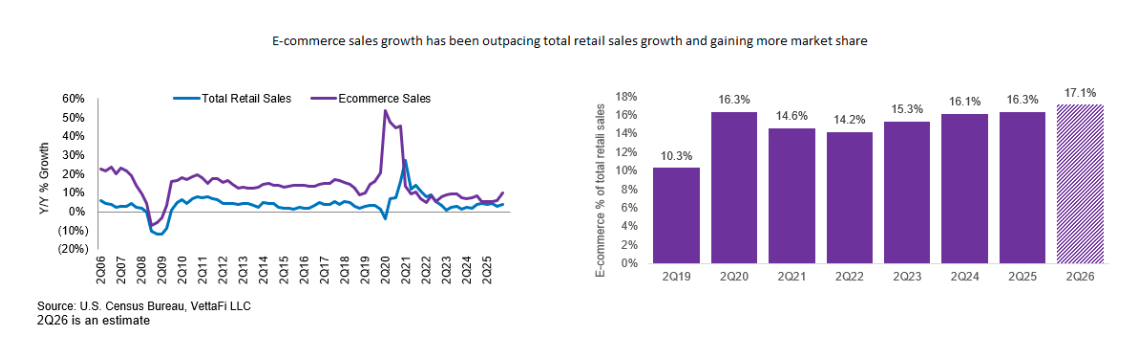
E-commerce remains one of the strongest growth drivers in retail. According to the U.S. Census Bureau, U.S. retail e-commerce sales reached an estimated $326.7 billion in 1Q26, up 2.7% from 4Q25 and 9.8% from 1Q25. That compares with total retail sales growth of 1.5% quarter over quarter and 3.9% year over year. E-commerce also accounted for 16.9% of total retail sales in the quarter, showing that online sales continue to gain share even as the broader consumer environment remains uneven. Based on my estimates, I expect e-commerce sales to continue its increase — potentially reaching 17.1% of total retail sales. (Read more about e-commerce trends in my earlier research note.)
The growth of e-commerce is becoming increasingly significant because it is no longer driven primarily by discretionary purchases. Instead, digital retail is becoming more closely tied to convenience, value, and frequent purchases across categories such as grocery, household essentials, health, and beauty.
These trends are bringing the e-commerce theme closer to the consumer staples story, in addition to its traditional connection with consumer discretionary. Consumers may be more cautious, but they are still buying necessities and increasingly using digital platforms to compare prices, access discounts, replenish everyday goods, and choose between pickup and delivery.
Dedicated E-commerce ETFs Offer Different Versions of the Theme
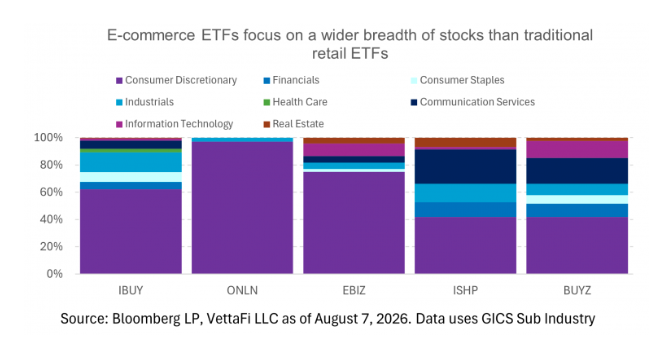
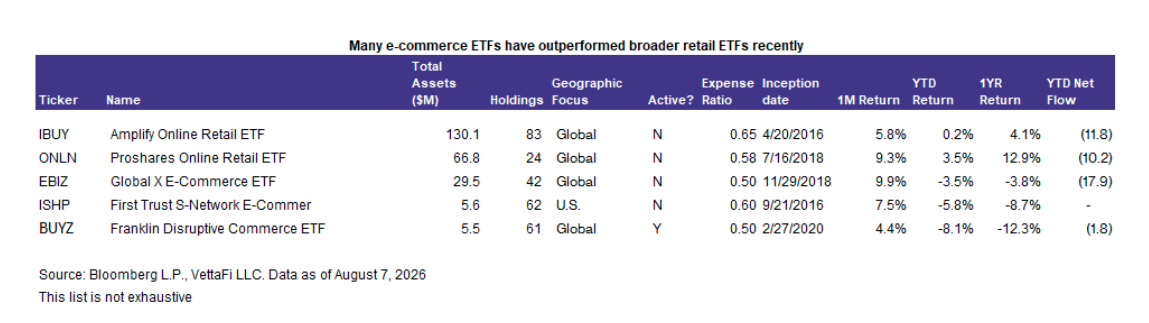
E-commerce is now embedded across the retail ecosystem, including broad retail ETFs, consumer discretionary ETFs, and even staples-oriented funds with exposure to companies like Walmart and Costco. But for investors who want a more focused look at e-commerce, including exposure to internet companies (technology), financials (payment systems), and industrials (logistics and delivery companies), several ETFs exist that specifically follow that theme. A few options are listed below:
-
Amplify Online Retail ETF (IBUY): This ETF is the largest global e-commerce ETF, with around $130 million in assets. It holds companies in online retail, online travel, online marketplace, and omnichannel retail that have at least 70% of revenues or a minimum of $100 billion in annual retail sales in online transactions. For omnichannel retailers, online sales must be at least 10% of total annual retail sales and more than $2 billion in revenue, or in the top five of global online retail market share. Equally-weighted, these stocks have a 10% aggregate cap on omnichannel. While a global ETF, IBUY holds mostly U.S. stocks, with non-U.S. domiciled stocks capped at a 25% total weight. Holdings include Wayfair (W), Etsy Inc (ETSY), DoorDash (DASH), Paypal Holdings (PYPL), and Booking Holdings (BKNG).
-
ProShares Online Retail ETF (ONLN): Holdings include online retailers, e-commerce retailers, or internet retailers. Unlike IBUY, ONLN excludes online travel companies. Holdings are weighted based on market capitalization, with non-U.S. companies limited to a total of 25%. While its peers have smaller exposure to Amazon, ONLN has a 23% weight to this stock. Amazon, Alibaba Group (BABA), and eBay (EBAY) make up around 40% of the ETF’s weight.
-
First Trust S-Network E-Commerce ETF (ISHP): ISHP invests in the top 15 companies by market cap in four business segments: content navigation, online retail, online marketplace, and e-commerce infrastructure. These companies are then equal-weighted. This ETF holds some unique stocks not included by many of its peers, including internet stocks like Reddit Inc (RDDT)and Meta Platforms (META), in addition to logistics/delivery companies like FedEx Corp (FDX) and United Parcel Service (UPS).
Originally posted on ETF Trends
For more news, information, and analysis visit the Thematic Investing Content Hub.
VettaFi LLC (“VettaFi”) is the index provider for IBUY and ISHP, for which it receives an index licensing fee. However, IBUY and ISHP are not issued, sponsored, endorsed, or sold by VettaFi, and VettaFi has no obligation or liability in connection with the issuance, administration, marketing, or trading of IBUY or ISHP.
A message from Advisor Perspectives and VettaFi: Discover something new! Click here to register for our upcoming webcasts.
More Global Markets Topics >