"The price of monopoly is upon every occasion the highest which can be got... the highest which can be squeezed out of the buyers, or which it is supposed they will consent to give."
— Adam Smith, The Wealth of Nations, 1776
This week we continue our series on the major causes of our K-shaped economy. To recap, three big components of the economy are growing in cost more quickly than the rate of inflation or wage growth, and have for decades. We've covered two. First housing, then higher education. Now we look at the biggest and perhaps messiest of the three: healthcare.
If you started from scratch, there's no way you'd design a healthcare system that looks anything like ours, even if you were the most evil of geniuses.
First, some good news: many things in healthcare really have gotten dramatically better and cheaper. Sequencing a human genome, for instance, cost close to a billion dollars in 2003. Today, under $1,500, making CRISPR therapy available to treat a plethora of diseases that once had no cure.
Cataract surgery cost roughly $2,000 a case in 1985, under $800 by 2012. Hepatitis C went from an $84,000 cure at launch to a fraction of that.
GLP-1s are shrinking our friends right in front of our eyes. How many of you have gotten together with someone you haven’t seen in a few months, to find them half the size they were? Incredible! The long-term benefits to human health and our healthcare system will be enormous.
There are many reasons to be proud of our healthcare advances. But for many (the lower leg of the K) healthcare is brutally expensive if not downright unaffordable. And it’s getting worse.
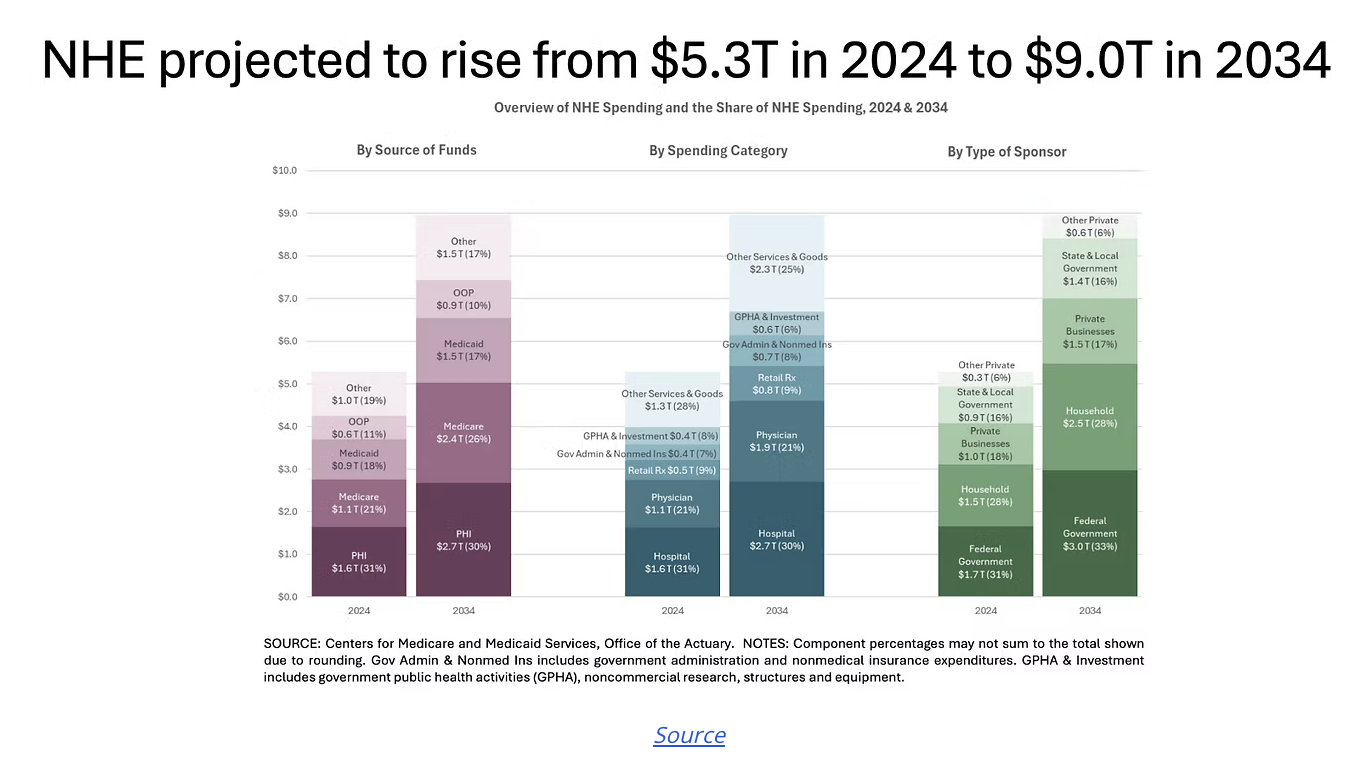
US healthcare spending is skyrocketing, hitting $5.3 trillion in 2024, up 7.2% in a single year, or $15,474 for every person in the country, 18% of the entire US economy.[1]
The Centers for Medicare and Medicaid Services own actuaries project total spending to nearly double again within a decade, reaching $9.0 trillion by 2034.
Yet, none of this is because Americans are using more healthcare. In fact, we see doctors about as often as people in peer countries do.[2] The price is relentlessly rising. Between 2000 and 2024, medical care prices rose 121.3% while consumer prices overall rose 86.1%. [3]
Healthcare didn't just get more expensive. It outran inflation for a quarter century. Note: see the pattern here? Housing, higher education, and healthcare—three massive expenses for the average household—all outpacing wage growth and inflation. The cumulative impact is a society on a political knife’s edge. People are understandably disillusioned and looking to political extremes for answers. I’ll get into this more in the coming weeks. For now, I’m just reminding you why we have embarked on this somewhat depressing series in the first place... Now back to the story.
Why does care cost more? The answers could fill a book. Maybe we start with who's setting the price.
See more: Access Is Valuable. But It Isn't the Same as Care.
Why Hospitals Can Charge What They Charge
The short answer is they can get away with it. The long answer begins with what Medicare pays versus what private insurers pay for the same care. Medicare's rate is set by the government, by formula, hospitals can't negotiate it. Private insurers negotiate their own rate directly, and negotiation only goes one way when one side has no real alternative.
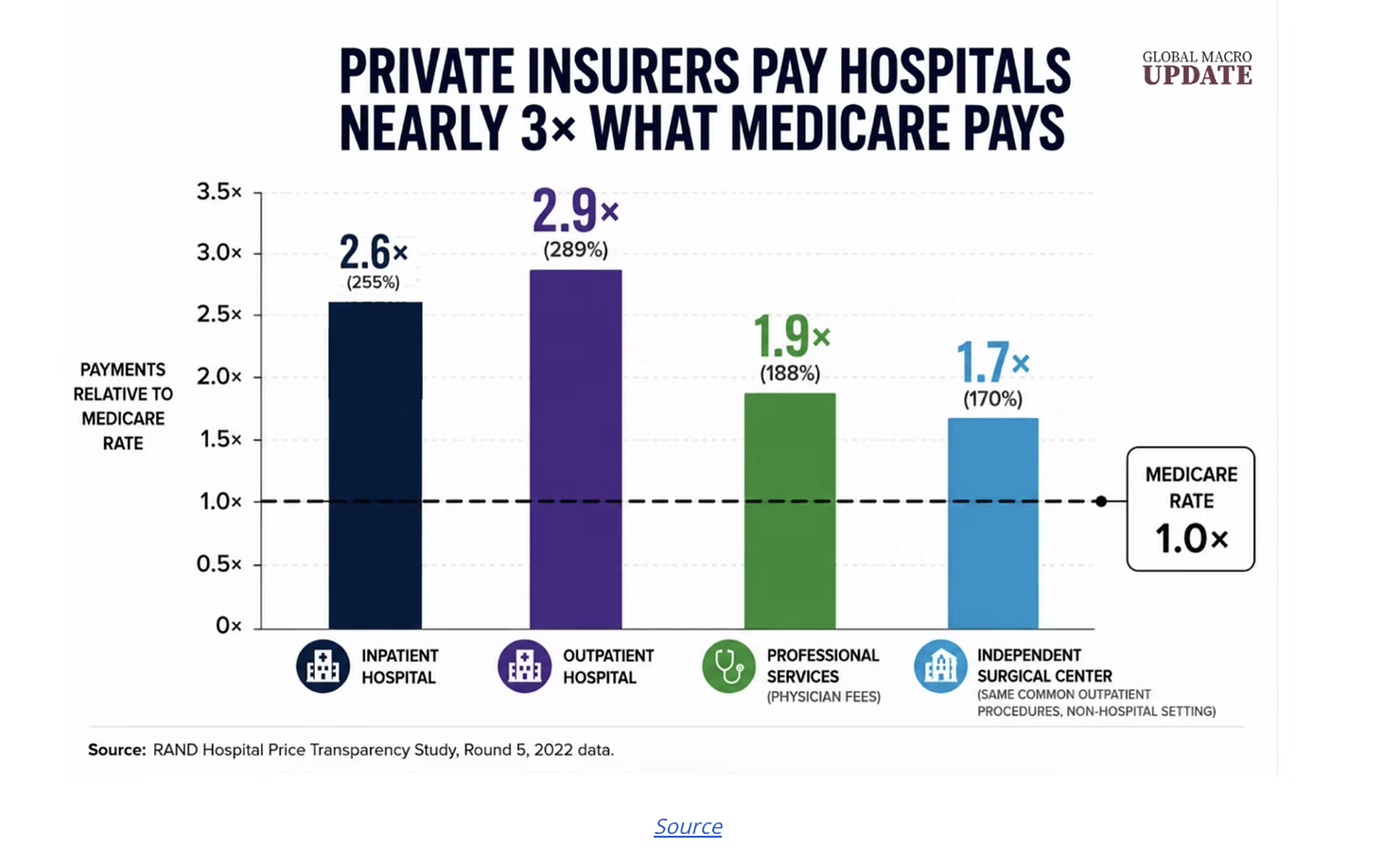
In 2022, private insurers paid hospitals 254% of Medicare's rate for the same care, the highest gap RAND has measured. And hospitals having the upper hand in these negotiations is increasingly common.[4] In 2024, a single system controlled at least half the inpatient market in 76% of American metro areas. In 83%, one or two systems controlled more than three-quarters of it. Small towns tend toward outright monopoly.[5] Big cities aren't far behind.
You can see it in a single MRI. A Johns Hopkins and Michigan State study found commercial prices running 2 to 6 times Medicare for identical scans. For example, take a brain MRI. Medicare pays $446 for it. Private insurers pay $1,788, four times more, for the same machine, the same scan.[6] The only variable seems to be who can be squeezed.
The Washington Post just told the story about Marcelle Crago, a nurse in Asheville, North Carolina, who was quoted over $9,000 for meniscus surgery at Mission Hospital. Mission Hospital, by the way, is the only major system in the region since a merger in 1998. Marcelle shopped around and paid a third of that at an independent outpatient center. Mission's own prices run 334% of Medicare.
To put it in perspective, here's the markup on what private insurers actually paid hospitals in 2022, compared to what Medicare pays for the same thing.
To be fair to hospitals, there's a real counterargument: Medicare's own rates run below what many hospitals say it costs them to treat a Medicare patient, so some of that gap is hospitals recouping their costs from privately insured patients.
Regardless, the pattern holds nationally: fewer competitors, higher prices. Hospital mergers that don't even overlap in the same city still tend to raise prices at the acquiring hospital, by an average of 12.9% within six years.[7]
The result is a messy system where, increasingly, hospitals often aren't pricing against competitors. They're pricing against what the market will bear.
There's supposed to be a backstop against that: insurance. But insurance costs are rising too, and the thing that's supposed to protect you from a high price so often doesn't.
Having Insurance Doesn't Mean You Can Afford to Use It
Having insurance is supposed to mean the price of care isn't the thing standing between you and treatment. For a growing number of people, it doesn't work that way.
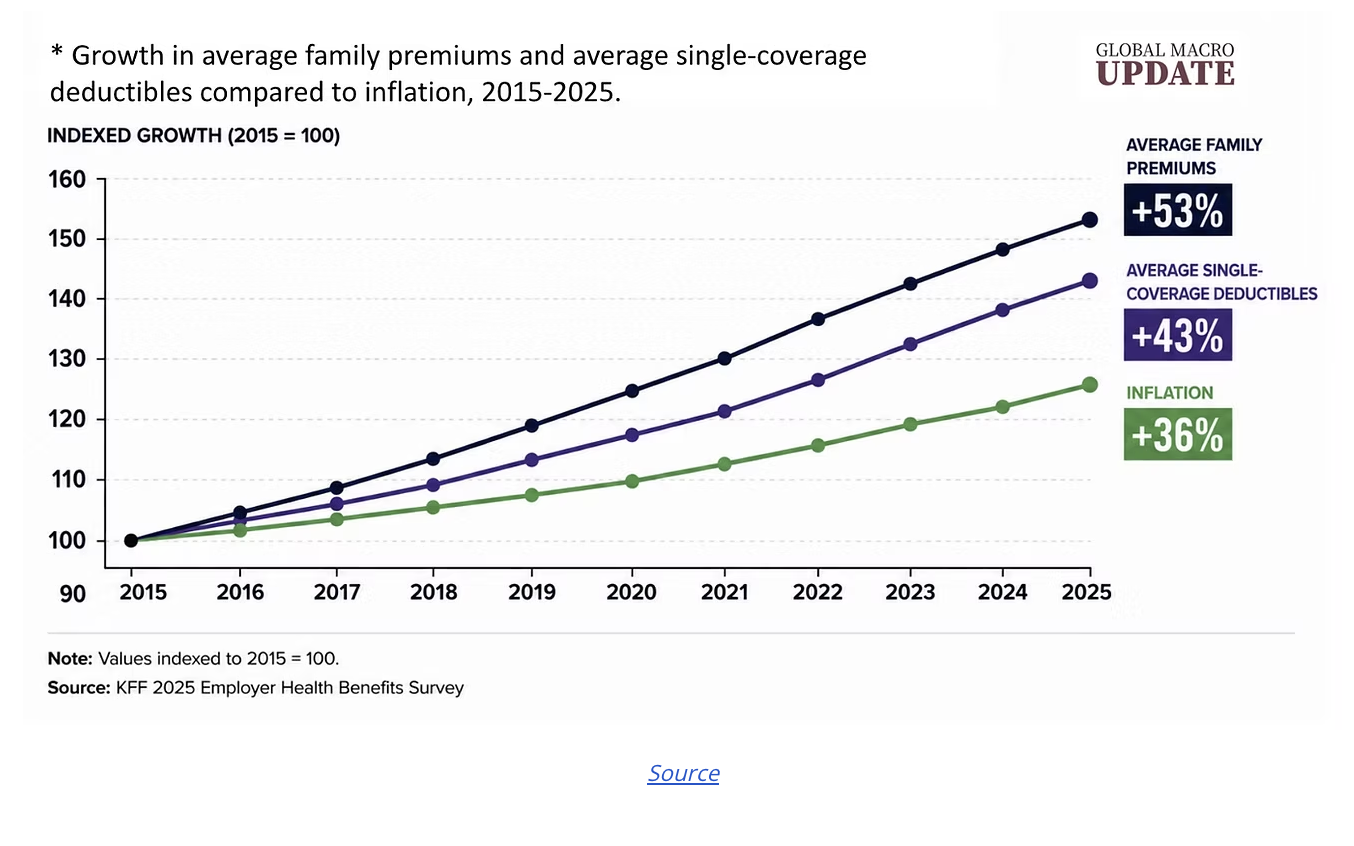
The average family premium hit $26,993 in 2025, up 53% over the past decade. The average deductible for a single person: $1,886, up 43% over the same ten years. Both have grown far faster than inflation, which rose about 36% over that stretch.[8] What’s happening is the cost of coverage has outrun the cost of everything else…
For someone making $40,000 a year, a $1,886 deductible is a sizable portion of their paycheck.
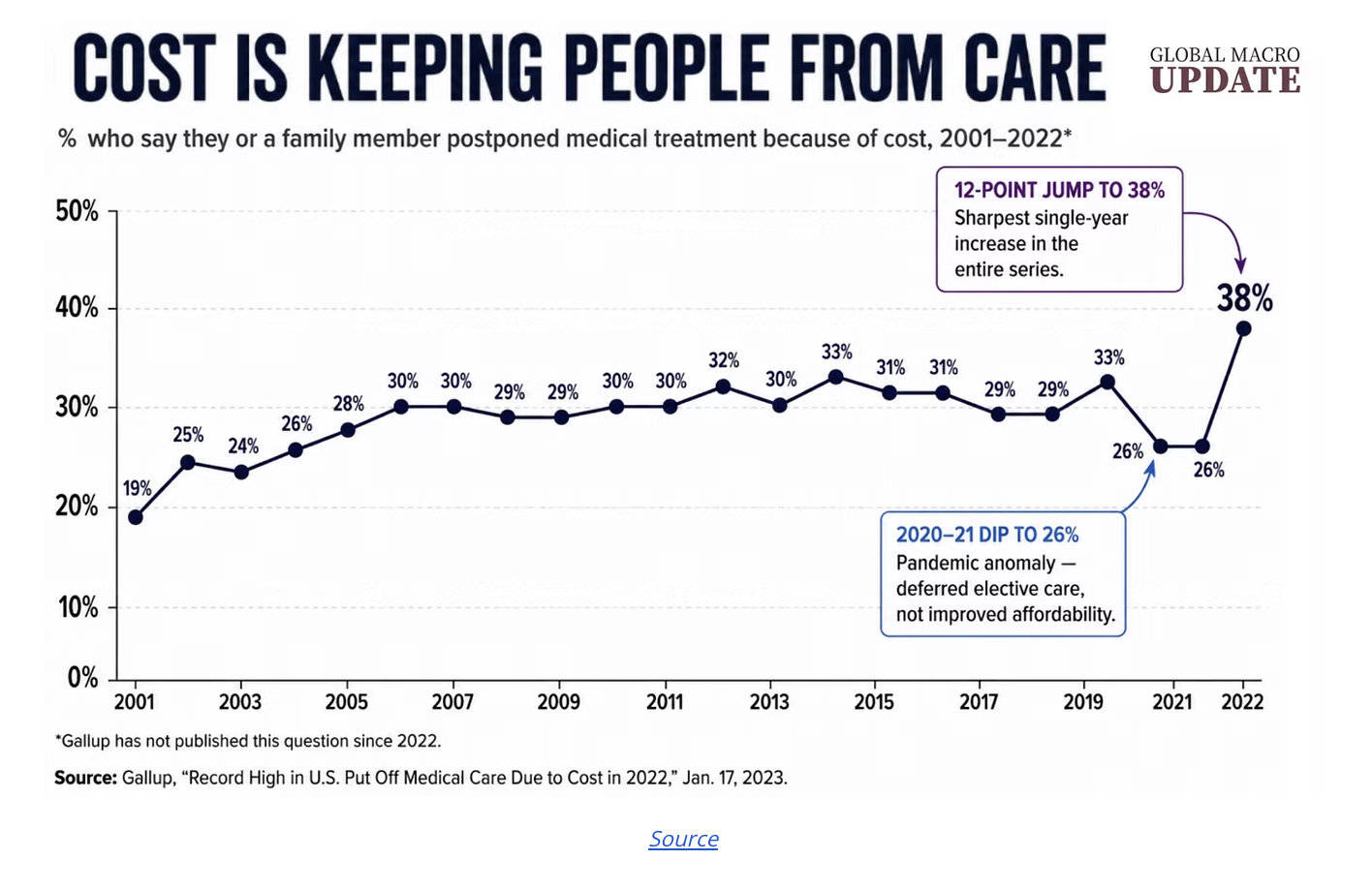
And if they work for a smaller company, it's worse, the average deductible at small firms runs $2,631, versus $1,670 at large ones.[9] Faced with that bill, a growing number of people are simply opting out, skipping the appointment, delaying the test, not filling the prescription. In 2001, 19% of Americans said they or a family member had put off medical treatment because of cost. By 2022 that number had exactly doubled, to 38%, the sharpest single-year jump in the series.[10]
A more recent survey suggests no relief. In 2024, the Commonwealth Fund found 48% of working-age adults had gone without needed care because of cost, a skipped prescription, test, or specialist visit.[11] Of those, 41% said their health problem got worse as a result.
And the lower the income, the more likely someone went without. In 2022, 34% of households under $40,000 delayed care for a serious condition, versus 29% in the middle and 18% among six-figure earners.[12]
Hospital pricing power is just one of many reasons American healthcare costs are out of control.
Everything about the US healthcare system is complicated. I don’t have space in this letter to cover even a fraction of the contributors. Look at prescription drug cost and the way drugs are sold and distributed. Americans pay roughly three times more than other wealthy nations for our prescriptions. This is also true for medical devices.
Then there is the preposterous billing system, and insurance companies themselves contribute to the problem. And of course, this sector, like education, suffers from administrative bloat.
One source of expense that doesn’t get a lot of attention is leverage. Perhaps a better descriptor would be financial engineering. There is a cottage industry of Private Equity and real estate investment trusts (REITs) that specialize in extracting value from the healthcare system, leaving individual healthcare facilities saddled with permanent debt in the form of leases.
A market with pricing power, very little competition, and near guaranteed payment flow through insurance and government reimbursement attracts the kind of sharks who know how to bleed value from a never-ending supply of customers.
We’ll wrap up our brief look at healthcare next week as we dig deeper into these issues. Until then,
Let me know what you think — reply to this note or drop a comment.
Thanks for reading.
Before we go...
I’m looking for a research assistant. The ideal candidate is a self-starter, willing to tackle a variety of tasks including updating spreadsheets, supporting research projects, and assisting with social media. The position is remote. The candidate should have a baseline level of comfort with AI and good writing skills.
If you or someone you know is interested in an entry level position with opportunities for growth, a resume and cover letter may be sent to [email protected]
Ed D’Agostino, Partner & COO
[1] https://www.cms.gov/data-research/statistics-trends-and-reports/national-health-expenditure-data/nhe-fact-sheet
[2] https://www.healthaffairs.org/doi/10.1377/hlthaff.2018.05144
[3] https://www.healthsystemtracker.org/brief/how-does-medical-inflation-compare-to-inflation-in-the-rest-of-the-economy/
[4] https://www.rand.org/news/press/2024/05/13.html
[5]https://www.kff.org/health-costs/one-or-two-health-systems-controlled-the-entire-market-for-inpatient-hospital-care-in-nearly-half-of-metropolitan-areas/
[6] https://radiologybusiness.com/topics/healthcare-management/healthcare-economics/shoppable-radiology-services-medicare-rates
[7] https://pmc.ncbi.nlm.nih.gov/articles/PMC11782062/
[8] https://www.kff.org/health-costs/annual-family-premiums-for-employer-coverage-rise-6-in-2025-nearing-27000-with-workers-paying-6850-toward-premiums-out-of-their-paychecks/
[9] https://www.kff.org/health-costs/2025-employer-health-benefits-survey/
[10] https://news.gallup.com/poll/468053/record-high-put-off-medical-care-due-cost-2022.aspx
[11] https://www.commonwealthfund.org/publications/surveys/2024/nov/state-health-insurance-coverage-us-2024-biennial-survey
[12] https://news.gallup.com/poll/468053/record-high-put-off-medical-care-due-cost-2022.aspx
A message from Advisor Perspectives and VettaFi: Discover something new! Click here to register for our upcoming webcasts.
© Mauldin Economics
More Inflation Topics >