Key takeaways:
-
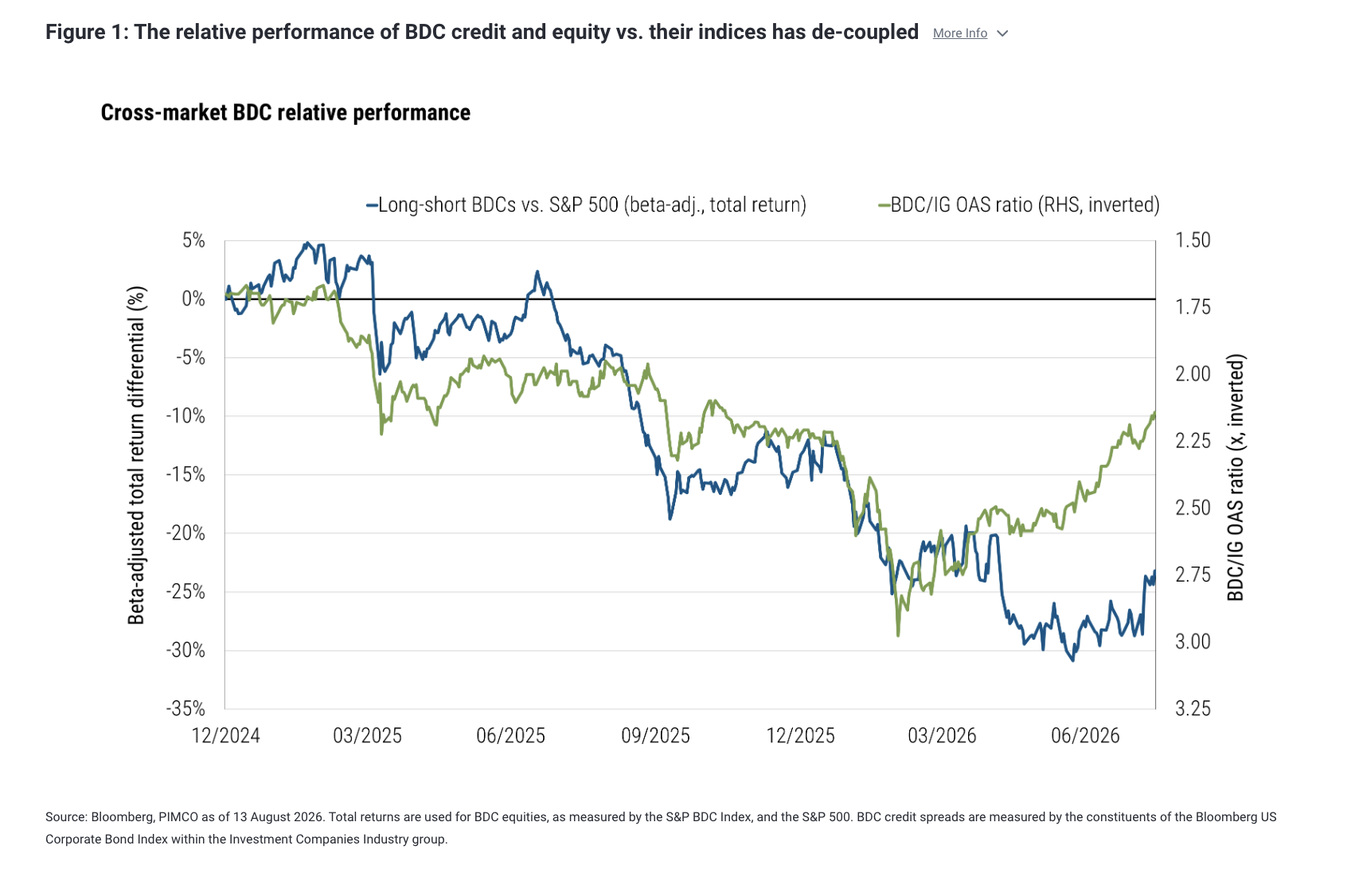
Performance within business development company (BDC) capital structures continues to diverge. BDC bonds have recovered most of their underperformance while equities continue to lag, suggesting investors are demanding a higher risk premium to compensate for uncertainty around portfolio valuations.
-
The valuation reset has yet to occur. Beyond concerns that portfolio marks have yet to fully adjust to public market valuations, BDCs also face a shrinking origination advantage as pricing premiums over the broadly syndicated loan market compress, making it increasingly difficult to generate excess returns relative to public credit.
-
The risk for BDCs is not that history repeats itself but that it rhymes. When valuations of private and public credit diverge materially, they ultimately tend to converge, and while BDCs may be able to delay that adjustment through various liquidity and balance-sheet levers, lingering pressure on equity valuations remains a meaningful risk.
The performance across the capital structure of BDCs – funds that invest in small and midsize private U.S. businesses – continues to diverge, with their bonds outperforming and equities lagging (see Figure 1). What explains this gap? The simplest answer is an asset valuation story: Credit investors have recourse to the assets against which they lend, while equity investors are increasingly focused on the credibility of reported net asset values (NAVs). Equity investors are essentially demanding more risk premium as compensation for the uncertainty around the true marks of portfolio holdings, and this skepticism is unlikely to abate without a better price discovery mechanism.
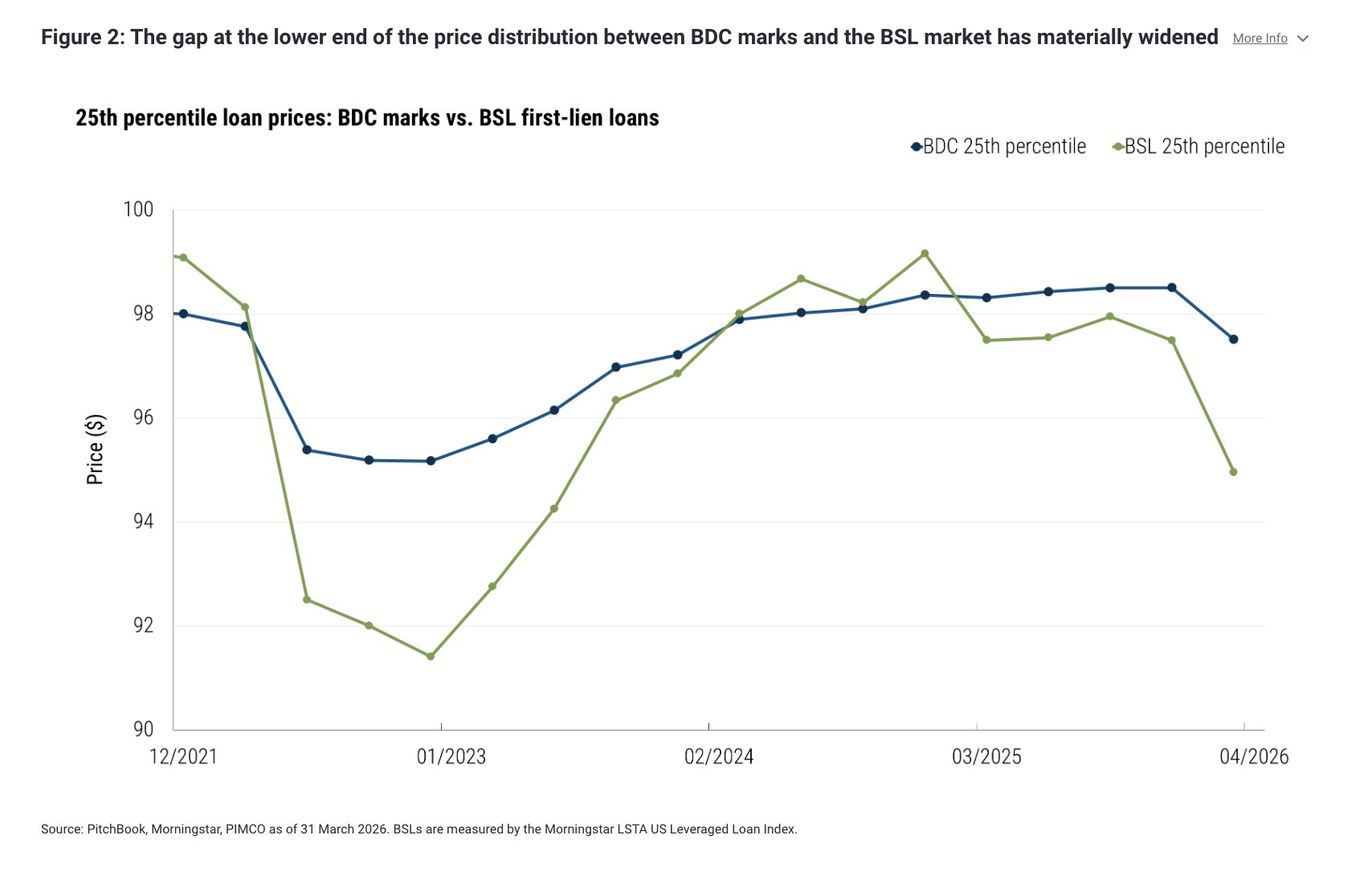
Indeed, in our view, the true valuation reset has yet to begin in earnest. More than two quarters after redemption pressures began to weigh on semi-liquid direct lending vehicles, and despite a growing number of signs of financial distress across parts of the market, BDC portfolios show little evidence of a meaningful valuation reset. Loan marks remain elevated, both in absolute terms and relative to the broadly syndicated loan (BSL) market.
If anything, the gap appears to be widening. Figure 2 illustrates this divergence by comparing the 25th percentile of BSL prices with BDC portfolio valuations over time.
See more: BDCs: Not All Yield Is Created Equal
While similar divergences emerged during periods of acute stress, such as the COVID-19 shock or the 2022 Russia-Ukraine war and subsequent hiking cycle, the current episode is unfolding against a backdrop of relatively more benign market conditions and low levels of systemic stress.
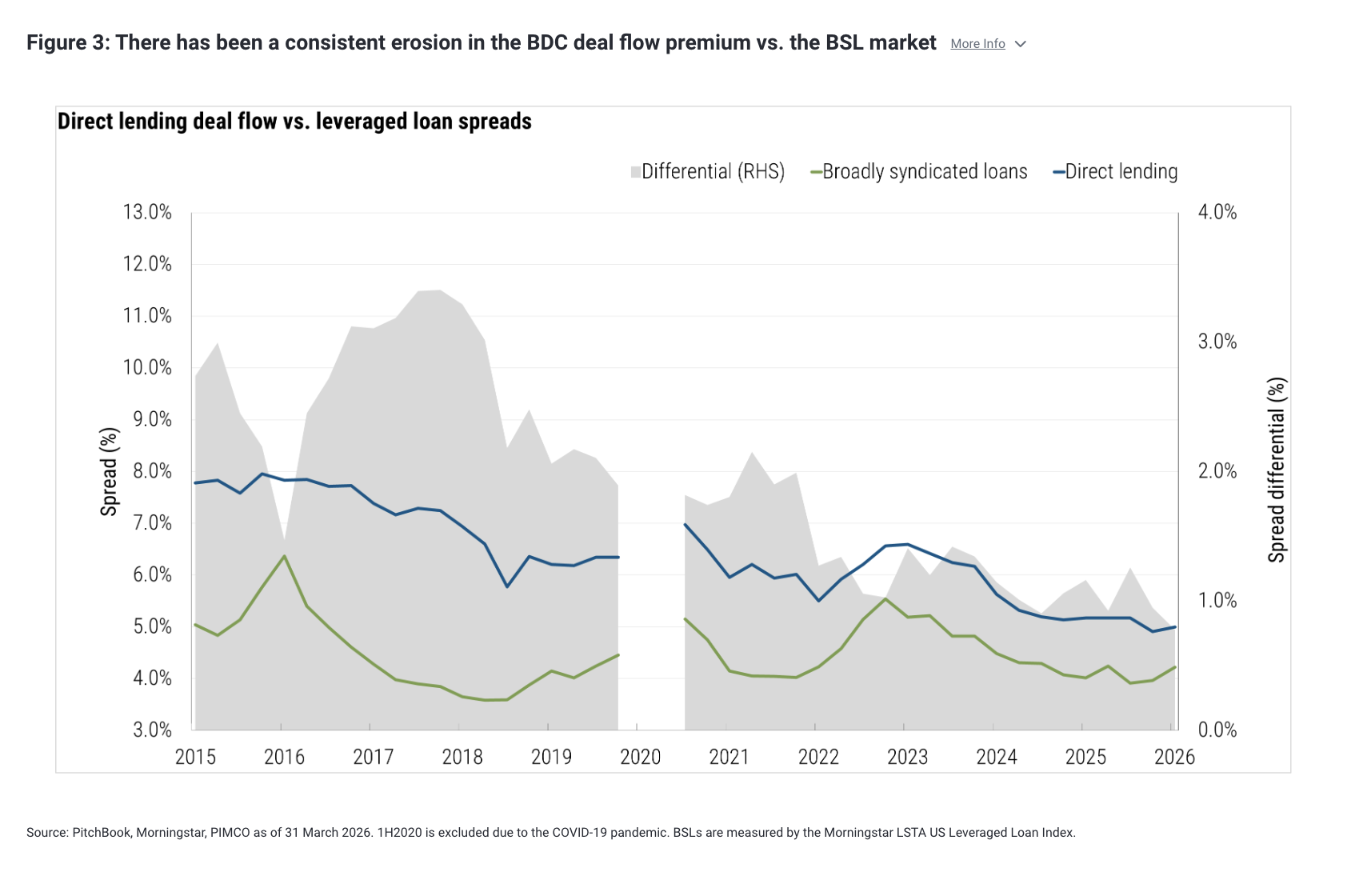
The challenge for BDCs extends beyond elevated marks on existing loans. As shown in Figure 3, the incremental yield advantage available in new direct lending transactions has also compressed substantially. Deals originated in 2017 and 2018 offered BDCs an average spread pickup of more than 300 basis points (bps) over leveraged loans. By the first quarter of 2026, the most recent period for which filings are available, that advantage had fallen to less than 100 bps.
In other words, while existing portfolios continue to be carried at elevated valuations, the economics of deploying new capital have become increasingly less differentiated from those available in public credit markets.
Where might this divergence between public market pricing and BDC marks lead? The recent experience of private real estate offers a useful, albeit imperfect, precedent. During the 2022 dislocation, private real estate vehicles initially resisted the decline seen in publicly traded REITs, only for valuations to converge later through a combination of public market recovery and private market markdowns.
A similar outcome cannot be ruled out for BDCs. That said, the adjustment process is likely to be slower, given the support provided by bank credit facilities, ongoing principal repayments, and the presence of liquid assets that can be sold to meet cash needs. Nevertheless, if marks ultimately need to move closer to where comparable risk trades in public markets, the potential for further valuation pressure on BDC equity remains a meaningful risk.
Michael Puempel and Gabriel Cazaubieilh contributed to this report.
Disclosures
Statements concerning financial market trends or portfolio strategies are based on current market conditions, which will fluctuate. Outlook and strategies are subject to change without notice.
Past performance is not a guarantee or a reliable indicator of future results. Forecasts, estimates and certain information contained herein are based upon proprietary research and should not be considered as investment advice. There is no guarantee that stated results will be achieved.
All Investments contain risk and may lose value. An investment in a business development company (BDC) is subject to credit and investment risk, leverage risk, market and valuation risk, price volatility risk, liquidity risk, interest rate risk and structural and regulatory risk. Broadly syndicated loans (BSL) involve interest rate and market risk, credit risk, default risk, liquidity, structural and legal risks. Private credit involves an investment in non-publicly traded securities which may be subject to illiquidity risk. Portfolios that invest in private credit may be leveraged and may engage in speculative investment practices that increase the risk of investment loss. REITs are subject to risk such as poor performance by the manager, adverse changes to tax laws or failure to qualify for tax-free pass-through of income. The value of real estate and portfolios that invest in real estate may fluctuate due to: losses from casualty or condemnation, changes in local and general economic conditions, supply and demand, interest rates, property tax rates, regulatory limitations on rents, zoning laws, and operating expenses.
References to specific securities and their issuers are not intended and should not be interpreted as recommendations to purchase, sell or hold such securities. It is not possible to invest directly in an unmanaged index.
PIMCO as a general matter provides services to qualified institutions, financial intermediaries and institutional investors. Individual investors should contact their own financial professional to determine the most appropriate investment options for their financial situation. This material contains the opinions of the author and such opinions are subject to change without notice. This material has been distributed for informational purposes only and should not be considered as investment advice or a recommendation of any particular security, strategy or investment product. Information contained herein has been obtained from sources believed to be reliable, but not guaranteed. No part of this material may be reproduced in any form, or referred to in any other publication, without express written permission. PIMCO is a trademark of Allianz Asset Management of America LLC in the United States and throughout the world.
CMR2026-0814-5843953
A message from Advisor Perspectives and VettaFi: Discover something new! Click here to register for our upcoming webcasts.
© PIMCO
More Alternative Investments Topics >