Governments can print money, but they cannot print credibility. Once investors begin to question a country's fiscal trajectory, borrowing costs rise, confidence erodes, and policy choices become increasingly constrained. The age of cheap debt allowed many governments to overlook these limits. Today, they are becoming harder to escape.
With the era of exceptionally low interest rates a distant memory, countries are discovering that carrying debt is harder than accumulating it. Since bottoming out in January 2021, median sovereign bond yields around the world have risen by about 3.5 percentage points in both advanced and emerging economies. Elevated borrowing costs have pushed interest payments steadily upward, making debt service an increasingly significant claim on public finances.
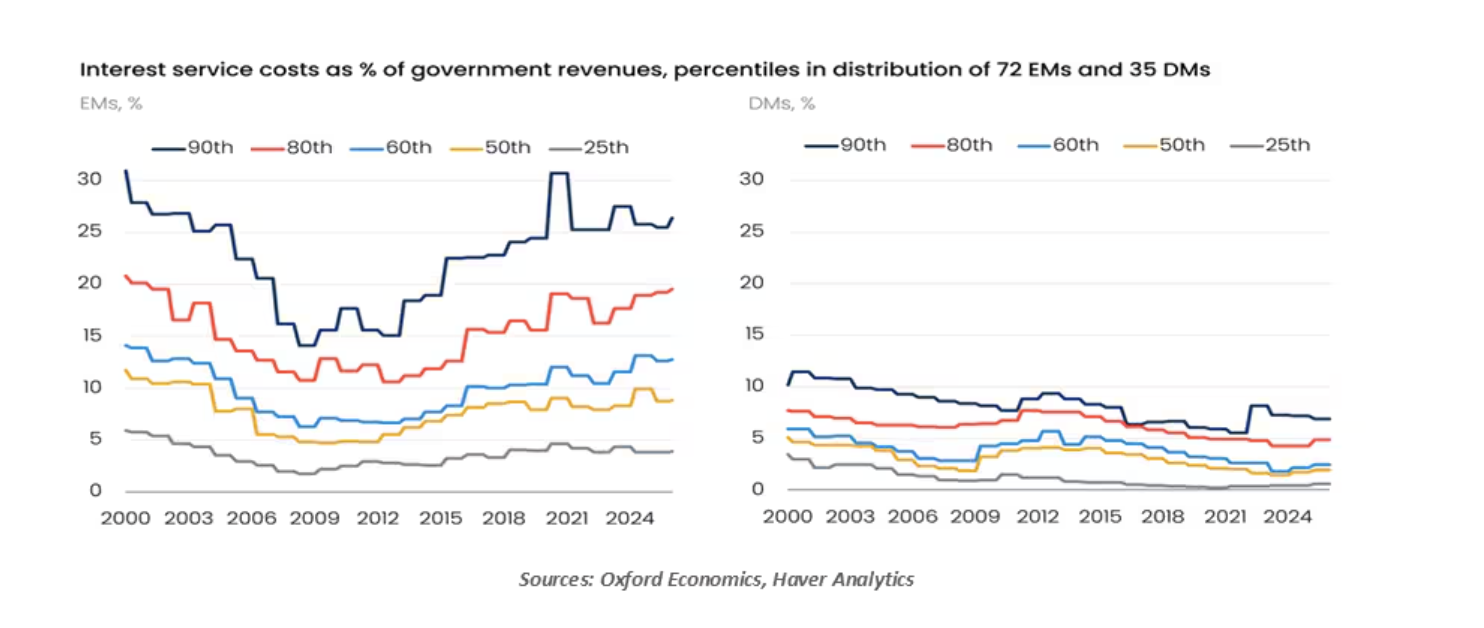
The rise has been most pronounced in emerging markets (EMs), where interest payments have risen to a two-decade high of 11.1% of government revenue, 6.1 percentage points above their 2010 level. A broad-based crisis does not appear imminent, but fiscal risks are rising in countries such as Egypt, Indonesia and the Philippines. Past episodes illustrate that isolated problems can become contagious.
Developed markets (DMs) have experienced a more modest increase in debt service. The median interest burden stands at 2.4%, still below the 4% peak reached during the eurozone sovereign debt crisis of the 2010s.
See more: US Set to Pay Most for 30-Year Debt in Quarter of a Century
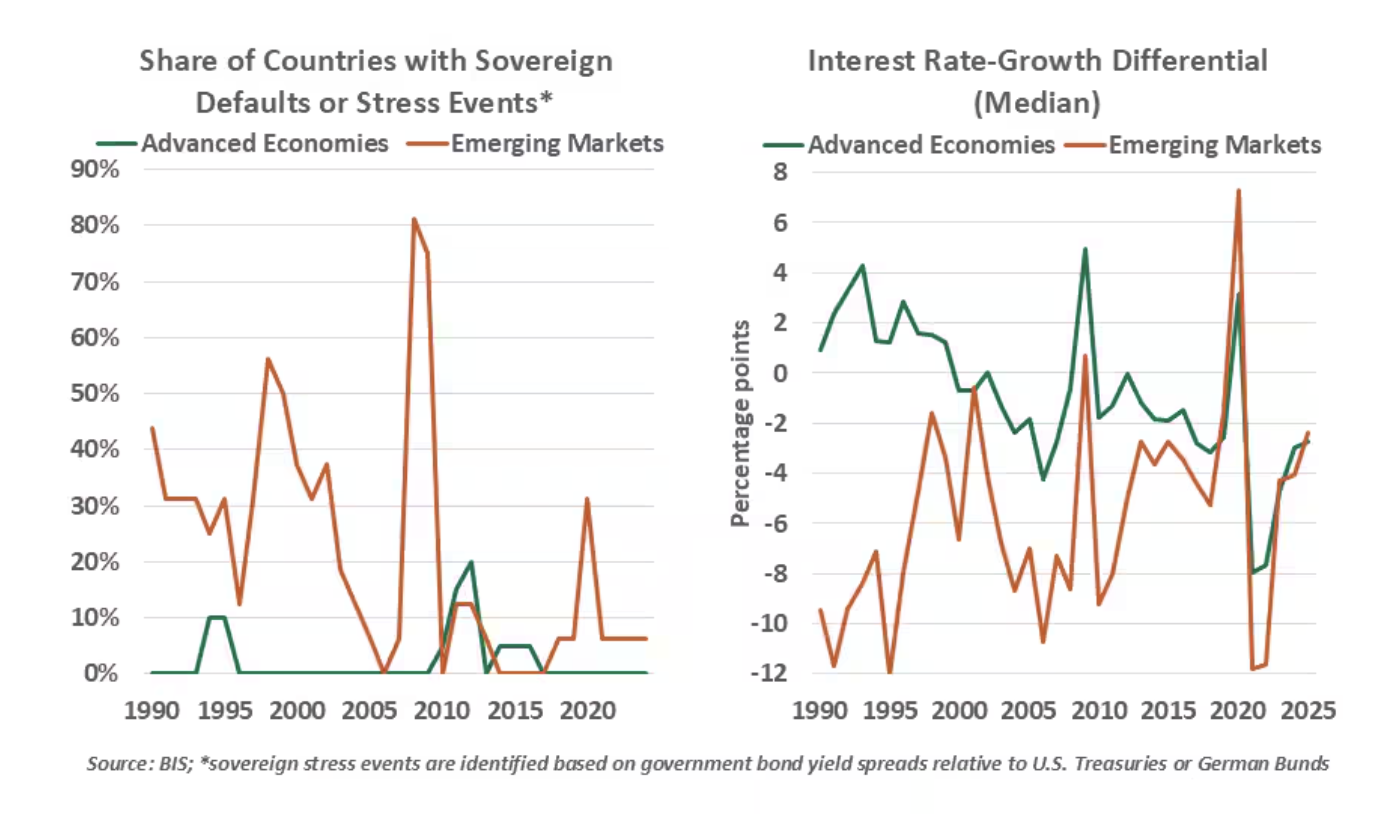
Rising carrying costs do not automatically translate into sovereign distress. The share of nations experiencing discomfort remains well below the peaks reached during previous crisis periods. Defaults are rarely driven by debt arithmetic alone; they more often reflect a breakdown in political, institutional or market functioning. Venezuela's 2017 default reflected deep political and economic dysfunction. Argentina's 2014 default stemmed largely from legal disputes with holdout creditors, while Russia's 2022 default occurred after sanctions effectively blocked debt payments.
Several factors will help major EMs deal with their debts. Many have spent recent years strengthening institutions, building policy credibility and deepening domestic financial markets. Stronger external balances and a greater reliance on local currency borrowing have reduced exposure to sudden external shocks.
As long as economic growth outpaces borrowing costs, debt burdens can be managed. Solid increases in gross domestic product (GDP) growth have helped debt-service metrics, preventing debt sustainability from worsening. But that cushion is fading. With financing costs now closer to nominal growth rates in many countries, debt ratios can rise even if governments succeed in eliminating their primary deficits. France and Italy have already crossed that threshold, while the U.K. and U.S. are edging closer.
The challenge is compounded by the refinancing cycle that lies ahead. Governments around the world are only beginning to roll over debt issued during the pandemic, when borrowing costs were close to historic lows. Nearly $4.5 trillion of sovereign bonds, representing roughly 40% of the combined emerging and developed market bond stock outstanding at the end of 2024, will mature over the next three years.
Developed economies may be more exposed to the next phase of the adjustment. DM debt has a longer average maturity than bonds issued by emerging markets; the impact of higher yields is still in the pipeline for DMs. The risks are especially apparent in Europe, where long-term spending pressures are mounting simultaneously from defense commitments, ageing populations and higher borrowing costs. The fiscal strain is shared across the continent but far from uniform.
France illustrates the political dimension of fiscal sustainability. The coming year features a difficult budget process, a presidential election and the possibility of further parliamentary instability. Even if a budget is eventually passed, meaningful fiscal consolidation appears unlikely.
The United Kingdom faces its own fiscal challenges. It has one of the largest budget deficits in the Group of Seven nations, with little improvement in sight. Debt interest payments have climbed to 3.6% of GDP, consuming around 9% of government revenues, up from 5.5% before the pandemic. With a quarter of its debt stock index-linked compared to 10% in the U.S., higher inflation has pushed borrowing costs up more sharply than in many other countries.
In Japan, debt-servicing costs already account for about a quarter of the national budget. Interest payments are projected to rise from 13 trillion yen in the 2026 fiscal year to 21.6 trillion yen in the 2029 fiscal year, according to Finance Ministry projections. Even modest increases in borrowing costs can have outsized fiscal consequences when debt levels are so high.
External shocks could further worsen fiscal pressures. A prolonged disruption to shipping through the Strait of Hormuz would raise energy prices, inflation and borrowing costs, while a stronger U.S. dollar would increase debt-servicing burdens for countries with significant dollar-denominated liabilities. El Niño could further increase spending pressures, particularly across Asia.
When countries lose market access, the International Monetary Fund (IMF) often becomes the lender of last resort. But its support usually requires painful fiscal adjustments, as Indonesia learned during the Asian Financial Crisis. A broader wave of sovereign distress could test the IMF's lending capacity, and its political support.
Debt dynamics have become less forgiving. This raises the risk of a vicious cycle in which concerns about public finances become self-fulfilling, driving borrowing costs higher and making debt unsustainable. Countries will be tempted to print money to solve their problems, but the cost to their reputations would be substantial.
Vaibhav Tandon is the Chief International Economist within the Global Risk Management division of Northern Trust.
Information is not intended to be and should not be construed as an offer, solicitation or recommendation with respect to any transaction and should not be treated as legal advice, investment advice or tax advice. Under no circumstances should you rely upon this information as a substitute for obtaining specific legal or tax advice from your own professional legal or tax advisors. Information is subject to change based on market or other conditions and is not intended to influence your investment decisions.
© 2026 Northern Trust Corporation. Head Office: 50 South La Salle Street, Chicago, Illinois 60603 U.S.A. Incorporated with limited liability in the U.S. Products and services provided by subsidiaries of Northern Trust Corporation may vary in different markets and are offered in accordance with local regulation. For legal and regulatory information about individual market offices, visit northerntrust.com/terms-and-conditions.
A message from Advisor Perspectives and VettaFi: Discover something new! Click here to register for our upcoming webcasts.
© Northern Trust
More Volatility/Downside Protection Topics >