Most people experience transportation through roads and airports. Traffic jams on highways and delays at major hubs are familiar frustrations. But the world's most important transportation network lies largely out of sight.
Nearly 90% of global trade travels by sea, linking producers and consumers through a vast web of shipping routes that underpin modern economic activity. A disruption at one of these passages can reverberate across continents.
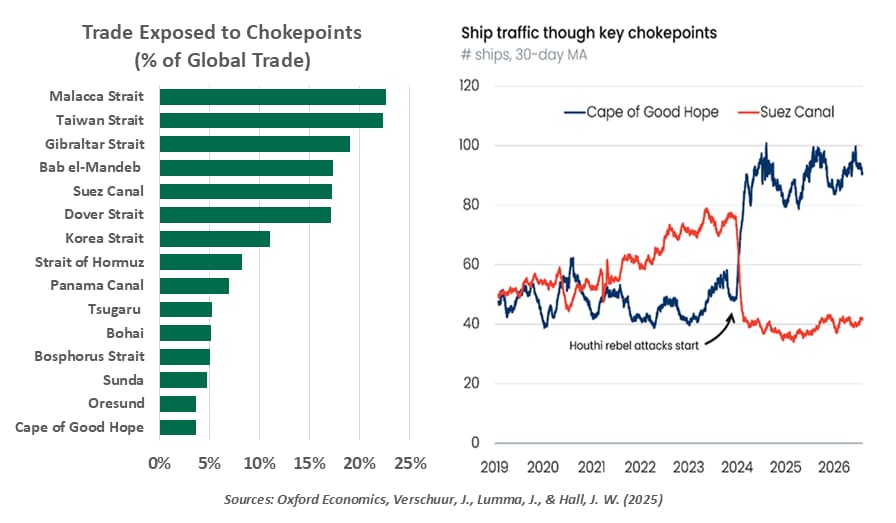
The Strait of Hormuz may be attracting the most attention today, but it is only one element of a broader network of maritime chokepoints that serve as critical arteries of global commerce. Around the world, a handful of narrow waterways carry trade volumes far out of proportion to their size, making them vital links in the global economy.
Factors that help distinguish potentially disruptive flashpoints from more manageable constraints include: the volume and composition of trade that passes through them, exposure to environmental or climatic pressures and the availability of alternative routes.
See more: Warning Lights On
The Strait of Malacca (between Malaysia and Indonesia) carries nearly 30% of global maritime oil shipments and serves as the principal link between Middle Eastern exporters and East Asia. Malacca is a critical artery, but the countries that border it are at peace and alternative routes are readily available.
The Taiwan Strait presents a broader vulnerability. The channel sits at the center of global supply chains for advanced semiconductors. Alternative routes east of Taiwan would offer little protection if the disruption were part of a wider regional conflict.
Gibraltar, Bab el-Mandeb and Suez also account for sizeable trade flows, and bypassing them often requires major detours. During the 2023-24 Red Sea crisis, many ships diverted around the Cape of Good Hope, adding weeks and thousands of kilometers to voyages between Asia and Europe. Freight and insurance costs rose while vessel availability tightened elsewhere.
The Panama Canal has repeatedly faced capacity constraints due to drought conditions. It is a critical link for trade between Asia and the U.S. East Coast, carrying everything from consumer and agricultural products to energy shipments. Similar risks exist on inland waterways. Low water levels on the Rhine and Danube are disrupting the movement of major commodities in Europe.
Several waterways function with no meaningful maritime alternative. Hormuz, the Turkish Straits, the Bosphorus and Sunda Strait have little or no practical rerouting capacity. Their share of overall trade may be smaller, but their closure could be more disruptive for the economies and commodities located behind them.
Taken together, these examples suggest that the most critical channels are not necessarily those carrying the largest trade volumes. The highest risk cases tend to combine strategic cargoes, limited alternatives and elevated geopolitical or environmental risks.
Most chokepoints operate quietly in the background of global commerce. But when one fails, the consequences can spread far beyond the waterway itself.
A message from Advisor Perspectives and VettaFi: Discover something new! Click here to register for our upcoming webcasts.
Information is not intended to be and should not be construed as an offer, solicitation or recommendation with respect to any transaction and should not be treated as legal advice, investment advice or tax advice. Under no circumstances should you rely upon this information as a substitute for obtaining specific legal or tax advice from your own professional legal or tax advisors. Information is subject to change based on market or other conditions and is not intended to influence your investment decisions.
© 2026 Northern Trust Corporation. Head Office: 50 South La Salle Street, Chicago, Illinois 60603 U.S.A. Incorporated with limited liability in the U.S. Products and services provided by subsidiaries of Northern Trust Corporation may vary in different markets and are offered in accordance with local regulation. For legal and regulatory information about individual market offices, visit northerntrust.com/terms-and-conditions.
© Northern Trust
Read more commentaries by Northern Trust