A simmering tension between monetary and fiscal policy is emerging as a key issue to watch for financial investors.
US Treasury Secretary Scott Bessent made waves with his recent announcement that the Treasury would at least double the size of its buybacks of long-term debt in the coming months. He argues that long-term yields do not reflect fundamentals, suggesting that the Treasury's intervention is aimed to restore proper market functioning. This generated a lot of commentary, most of which missed the mark, in my view. Some have compared it to past Federal Reserve (Fed) interventions, debating whether it was more similar to quantitative easing or to “Operation Twist,” and suggesting that the Treasury is effectively taking over some of the Fed's functions.
This, as I said, misses the basic point: This kind of Treasury intervention is irrelevant unless the fiscal deficit is reduced. As long as the government continues to run a deficit which is exceptionally large by peacetime standards, the Treasury needs to issue more and more debt. These kinds of interventions are less like quantitative easing than like rearranging the chairs on the deck of… Well, no, let's not go that far. But markets can see that the government shows no inclination to reduce expenditures, and when you add the cost of the conflict with Iran and the tariffs refunds, we’re on track for another large deficit this year and an even larger one next year.
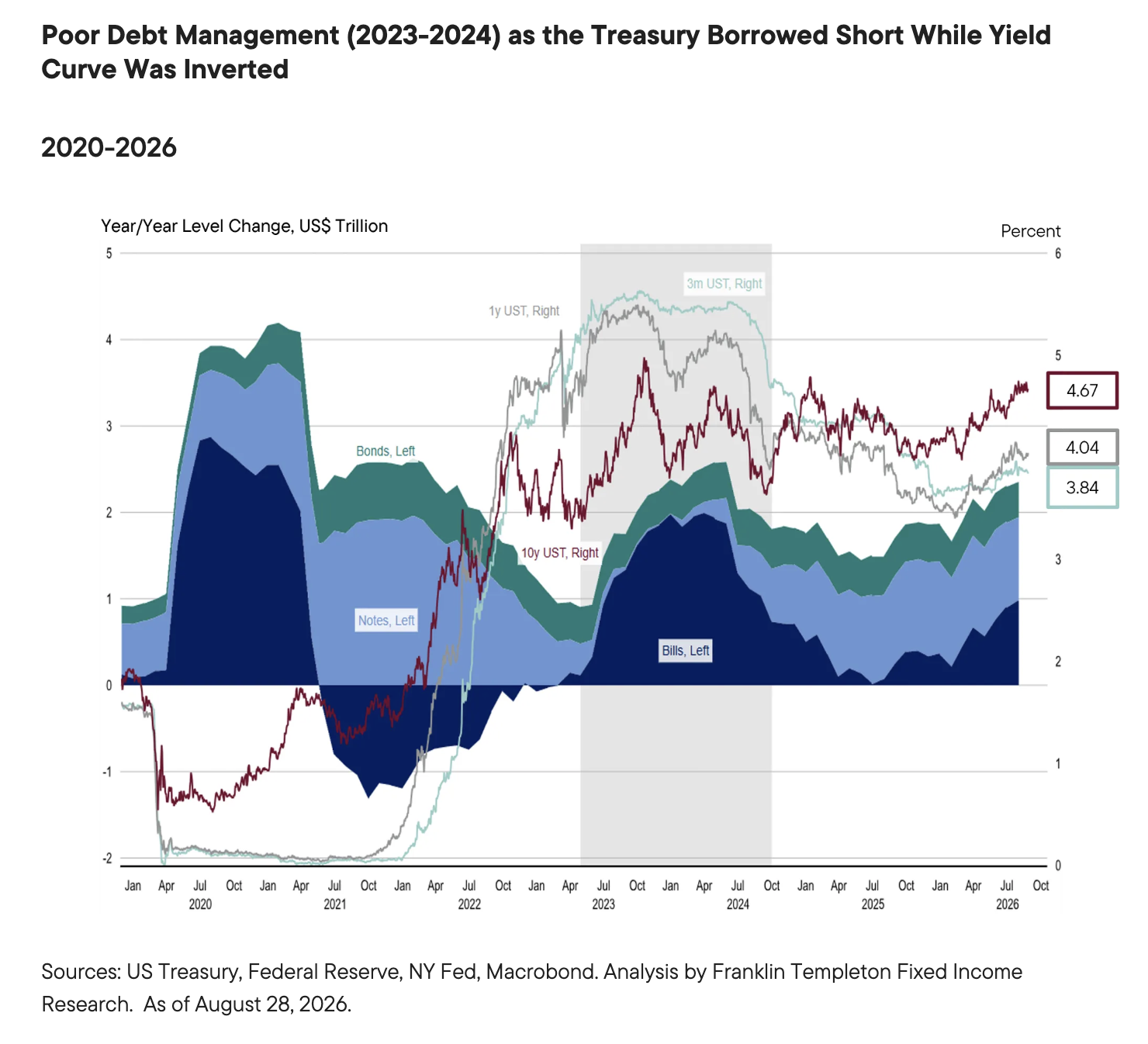
The situation is made even more vulnerable by the remarkably poor debt management of past years. The extended period of historically low interest rates after the global financial crisis and through the COVID-19 pandemic provided a golden opportunity to extend the maturity of outstanding debt, an opportunity that previous Treasury Secretaries inexplicably missed. We are now paying the consequences, with 67% of outstanding debt at a maturity of less than five years and 54% under three years.
See more: Gilligan’s Island and the Limit of Economic Innovation
The underlying reason is that, for the past 15 years or so, monetary policy has too often carried water for fiscal policy. Judging from the speech that Fed Chair Kevin Warsh delivered at Jackson Hole, this will no longer be the case.
Warsh was under pressure to provide greater clarity on the Fed's future conduct of monetary policy. Many analysts, commentators, and market participants argued that as Warsh steers the Fed away from forward guidance, he needs to at least clarify the central bank's reaction function.
He deflected this request in an elegant and convincing way, arguing that the Fed's understanding of the economy is nowhere near precise enough to allow monetary policy to be boiled down to a simple mechanical rule. “The factors most relevant to the proper conduct of monetary policy change over time,” he noted, and therefore cannot all be summarized in a mathematical rule determined ahead of time. And he reiterated that forward guidance outside of a crisis situation ties the central bank's hands and results in inferior policy outcomes—like in the delayed reaction to the 2021 inflation surge.
His speech, however, provided forceful clarity on a number of important points.
First, he noted that while the artificial intelligence (AI) revolution might have portentous consequences for future productivity, growth, and inflation pressures, it will have no bearing on the Fed's near-term policy decisions. This should dispel fears that innovation optimism could be used as cover for a dovish policy stance.
Second, he stressed that 2% on the personal consumption expenditure (PCE) deflator is “a firm fixed target” on which the Fed must deliver. The central bank will endeavor to develop more reliable and timely measures of inflation, but this will not be used to explain away the inflation problem.
Third, he stated that the Fed's predominant focus right now must be on prices, as inflation remains stubbornly above target, whereas the labor market appears to be at full employment against the background of a very resilient economy. Moreover, he argued that financial markets, including credit, loans and equities, paint a picture of still relatively easy financial conditions.
He boiled it all down to an equally clear conclusion: Unless the Fed can be “confident that underlying inflation is moving to our objective, clearly and at sufficient speed,” it needs to act.
In a nutshell: The Fed's predominant concern right now should be inflation, and at the moment there is no convincing evidence that underlying inflation is converging back to target fast enough. Unless that changes, the Fed's responsibility is to act, and its primary instrument should be the policy interest rate.
It's not forward guidance, but it does raise the stakes for the next Fed policy meetings. Unless the inflation picture improves significantly, it will be hard for the Fed to justify not raising rates.
Financial markets have taken this hawkish stance at face value. The immediate reaction was a flattening of the Treasury yield curve, with a meaningful tick up in short-term yields.
The bearish flattening suggests that investors are keeping a keen eye on fiscal policy. Warsh noted that among the unfiltered signals the Fed would like to get from financial markets are “the prices and trading volumes of Treasury securities.” This statement stands in sharp contrast to Bessent’s claim that yields on long-term US Treasuries do not reflect fundamentals. Warsh also asserted that “money matters,” a pointed reminder of his position that the Fed's balance sheet should be reduced, curtailing the Fed's position as a holder of government debt.
If the government wants to reduce the cost of its debt, it will have to take a hard look at its own fundamentals and bring the fiscal deficit down to more sustainable levels. Until then, elevated government borrowing requirements combined with growing debt issuance to finance AI investment are likely to maintain persistent upward pressure on yields.
WHAT ARE THE RISKS?
All investments involve risks, including possible loss of principal.
Fixed income securities involve interest rate, credit, inflation and reinvestment risks, and possible loss of principal. As interest rates rise, the value of fixed income securities falls. Low-rated, high-yield bonds are subject to greater price volatility, illiquidity and possibility of default.
Equity securities are subject to price fluctuation and possible loss of principal.
There is no assurance that any estimate, forecast or projection will be realized.
WF: 12318161
IMPORTANT LEGAL INFORMATION
This material is intended to be of general interest only and should not be construed as individual investment advice or a recommendation or solicitation to buy, sell or hold any security or to adopt any investment strategy. It does not constitute legal or tax advice. This material may not be reproduced, distributed or published without prior written permission from Franklin Templeton.
The views expressed are those of the investment manager and the comments, opinions and analyses are rendered as at publication date and may change without notice. The underlying assumptions and these views are subject to change based on market and other conditions and may differ from other portfolio managers or of the firm as a whole. The information provided in this material is not intended as a complete analysis of every material fact regarding any country, region or market. There is no assurance that any prediction, projection or forecast on the economy, stock market, bond market or the economic trends of the markets will be realized. The value of investments and the income from them can go down as well as up and you may not get back the full amount that you invested. Past performance is not necessarily indicative nor a guarantee of future performance. All investments involve risks, including possible loss of principal.
Any research and analysis contained in this material has been procured by Franklin Templeton for its own purposes and may be acted upon in that connection and, as such, is provided to you incidentally. Data from third party sources may have been used in the preparation of this material and Franklin Templeton ("FT") has not independently verified, validated or audited such data. Although information has been obtained from sources that Franklin Templeton believes to be reliable, no guarantee can be given as to its accuracy and such information may be incomplete or condensed and may be subject to change at any time without notice. The mention of any individual securities should neither constitute nor be construed as a recommendation to purchase, hold or sell any securities, and the information provided regarding such individual securities (if any) is not a sufficient basis upon which to make an investment decision. FT accepts no liability whatsoever for any loss arising from use of this information and reliance upon the comments, opinions and analyses in the material is at the sole discretion of the user.
Franklin Templeton has environmental, social and governance (ESG) capabilities; however, not all strategies or products for a strategy consider “ESG” as part of their investment process.
Products, services and information may not be available in all jurisdictions and are offered outside the U.S. by other FT affiliates and/or their distributors as local laws and regulation permits. Please consult your own financial professional or Franklin Templeton institutional contact for further information on availability of products and services in your jurisdiction.
Issued in the U.S. by Franklin Templeton, One Franklin Parkway, San Mateo, California 94403-1906, (800) DIAL BEN/342-5236, franklintempleton.com. Investments are not FDIC insured; may lose value; and are not bank guaranteed.
You need Adobe Acrobat Reader to view and print PDF documents. Download a free version from Adobe's website.
CFA® and Chartered Financial Analyst® are trademarks owned by CFA Institute.
A message from Advisor Perspectives and VettaFi: Discover something new! Click here to register for our upcoming webcasts.
© Franklin Templeton
Read more commentaries by Franklin Templeton