I’m writing this week from London, the start of a four-country tour of Europe to see clients. I typically don’t have a lot of free time while on these journeys, but I did sneak away on the weekend for an economics field trip.
The destination was the British Museum, which contains the former reading room of the British Library. It is a circular structure ringed with stacks of books, a fitting setting for scholarship. Among those who took advantage of the facility was Karl Marx, an economist whose seminal work Das Kapital is required reading for many students in the field.
Marx proposed that concentrations of wealth and worker discontent would pave the way to capitalism’s end. We have both of those conditions around the world in the present day, and populism is rising.
As countries think about how they might address inequality, they must answer some key questions. How significant is economic inequality? What is the root cause of divergent fortunes? Would redress help or hinder economic growth? Some reflections on these topics follow.
There are a series of measures that attempt to gauge the level of unevenness in outcomes within societies. Some are based on incomes, and others are based on wealth.
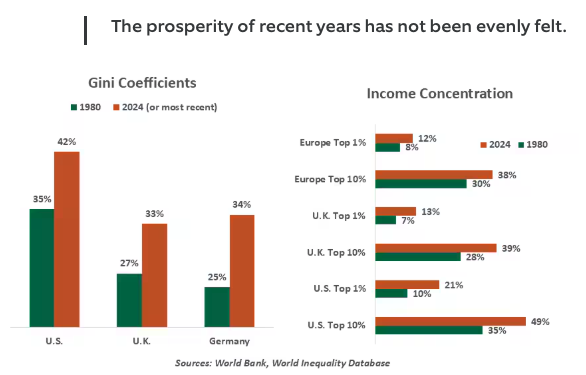
One of the most common ways of measuring income inequality is with a “Gini coefficient,” which is based on the shape of a country’s income distribution. A higher Gini score corresponds to greater concentration. Cross-sectional perspectives, which look at the relative fortunes of those at the top and bottom of the ladder, are also instructive. Viewed through either lens, inequality has risen significantly in recent decades.
The concentration of wealth has also gone to greater extremes. According to the World Inequality Database, the top 10% of the population holds 70% of wealth in the United States, and 60% in Europe. The top 1% of the population in the U.S. holds 35% of total wealth, and around 25% in Europe. All of these levels are significantly larger than they were a generation ago.
There are certainly challenges in measuring income and wealth that affect these outcomes. Different authors have approached the exercise in different ways, using different assumptions. Debate over the calculations has been intense, and partisan. But there is little question that financial unevenness has risen.
There are three leading explanations for these developments. The first is the impact of globalization, which has tended to reward skilled workers at the expense of those carrying more basic backgrounds. There are displaced industrial workers in many countries who have struggled to regain their footing on the economic ladder.
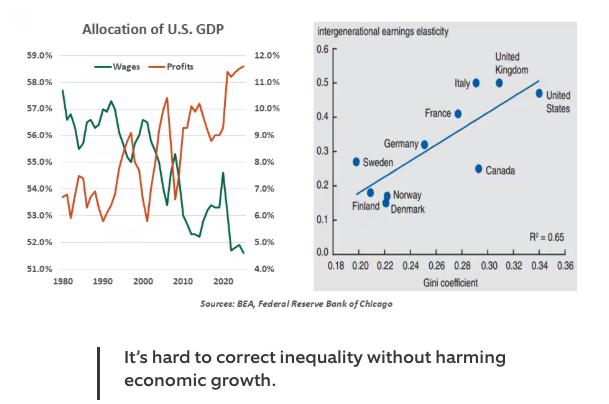
The second is technology. Factory robotics have curtailed the need for assembly-line workers, and e-commerce has disrupted traditional channels and providers. In the years ahead, AI will have a heavy bearing on employment in service industries. Those that engineer transitions are richly rewarded, while those affected by them have often struggled. In the United States today, the profit share of gross domestic product (GDP) is at a multi-decade high, while the wage share of GDP is at a multi-decade low
The third is changing policy. Alterations to competitive restrictions, labor laws and tax codes are all thought to have played a role in accelerating inequality in many countries.
To be sure, globalization, technology and policy changes have aided overall economic growth. And while threatening to some classes of workers, the increased access to goods at more modest prices has helped living standards. But recent studies suggest that rising inequality may limit the strength and duration of economic expansions.
Studies from the IMF and the OECD have found that economic growth is generally lower in countries with higher levels of economic inequality. Lower income households have high propensities to consume; when their fortunes decline, so does growth in consumption. They also tend to invest less in human capital, which impairs productivity.
High levels of economic inequality are associated with much lower levels of economic mobility, meaning that those who start off in the lower earnings quintiles struggle to move into higher tiers. That outcome runs counter to the ethic held by many nations that individuals should be able to climb the economic ladder through hard work.
Societies with high levels of inequality are also prone to volatile politics, and even unrest. Today, we are seeing the signs of economic anxiety in parties to the left and to the right of center, across a range of countries. Should these constituencies gain more control over policy in the years ahead, populist policies may tend to hinder economic growth. As an example, tax changes aimed at dividing the pie more equitably could diminish the incentives that brought the pie to its current size.
It is worth noting that a certain amount of inequality is endemic to any economic system. Those willing to work harder and take risks should, over time, do better. Many economists therefore are more interested in reinforcing equality of opportunity, as opposed to correcting inequality of outcomes.
Education can be a means to this end. Cultures that continually invest in education preserve competitiveness and provide opportunity. AI, however, has the potential to change the relationship between schooling and economic fortune. Designing a retraining program for displaced workers in the current day will be very difficult.
The concept of equality is central to the visions of many nations. But around the world, income inequality is rising and equality of opportunity is falling. Reversing this negative cycle will be essential to keeping Marx in his place.
Information is not intended to be and should not be construed as an offer, solicitation or recommendation with respect to any transaction and should not be treated as legal advice, investment advice or tax advice. Under no circumstances should you rely upon this information as a substitute for obtaining specific legal or tax advice from your own professional legal or tax advisors. Information is subject to change based on market or other conditions and is not intended to influence your investment decisions.