Key takeaways
-
AI issuance has yet to crowd out other corporate borrowers. Last week, we argued that AI bond supply doesn’t appear to be directly crowding out U.S. Treasuries through portfolio rebalancing. The natural next question is whether AI issuance is crowding out other corporate borrowers, and again, the data suggest this isn’t the case, at least not yet.
-
So far, the pricing evidence points to repricing, not displacement. AI-related borrowers have accounted for nearly a quarter of nonfinancial U.S. dollar (USD) supply year-to-date, yet spreads for non-AI issuers have not widened meaningfully. Instead, hyperscaler spreads have widened, suggesting the market is absorbing the AI supply shock at its source.
-
The quantity evidence is more nuanced, but it’s not a clean crowding-out story. Long-duration net supply from non-AI issuers has declined, but that may be a natural response to higher long-dated Treasury yields: When long-end funding becomes more expensive, companies tend to issue less long-end debt. If anything, this points to Treasury yields shaping maturity choice, not hyperscaler supply pushing other borrowers out.
In our most recent “The Credit Market Lens,” we pushed back against one version of the AI crowding-out story. We did note that a large investment boom can still put upward pressure on equilibrium real yields through the saving-investment channel. However, the evidence for a narrower portfolio-rebalancing channel – that is, AI bond supply directly crowding out U.S. Treasuries – looked weak across nominal yields, term premia, and swap spreads, at least for now.
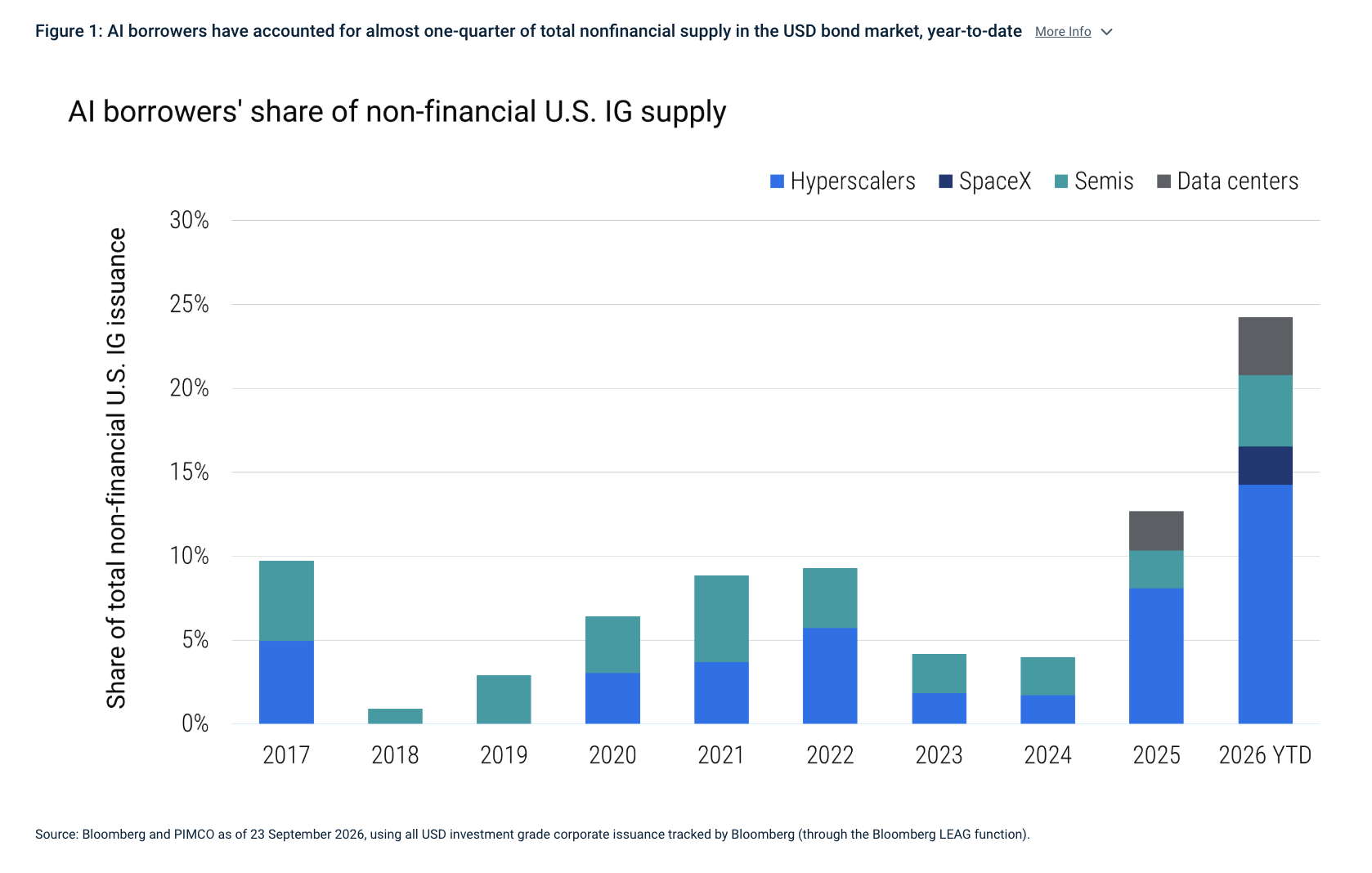
This note asks the same question one layer down in corporate credit. If AI issuance is not visibly crowding out Treasuries, is it crowding out other corporate borrowers? As shown in Figure 1, AI borrowers have accounted for almost one-quarter of total nonfinancial supply in the USD bond market, up from less than 13% last year and 4% in 2024.
To assess whether that surge is crowding out other corporate borrowers, we look at both price and quantity.
See more: When Strong Earnings Meet Crowded Markets
Pricing data: Spread and curve measures suggest repricing, not displacement
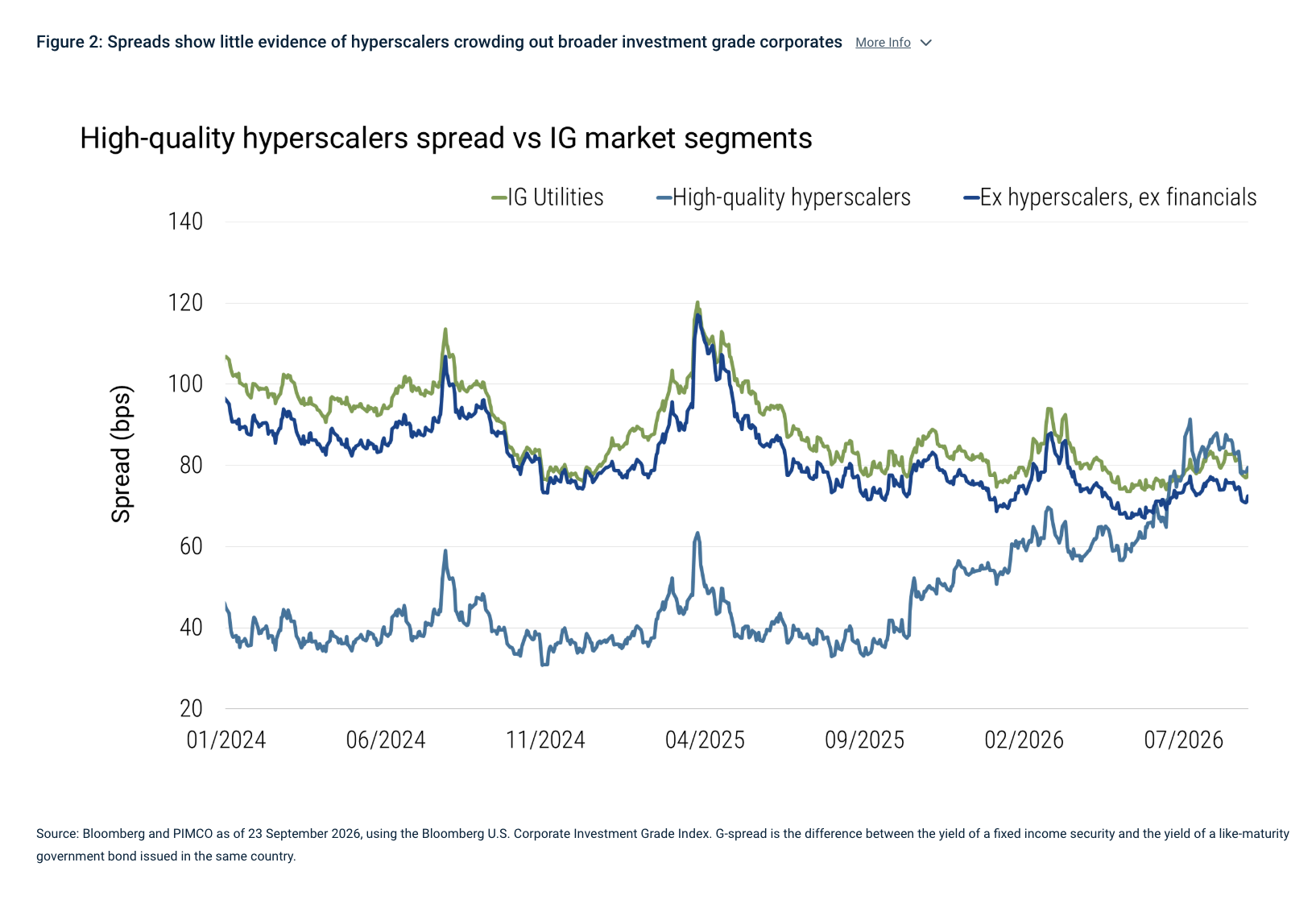
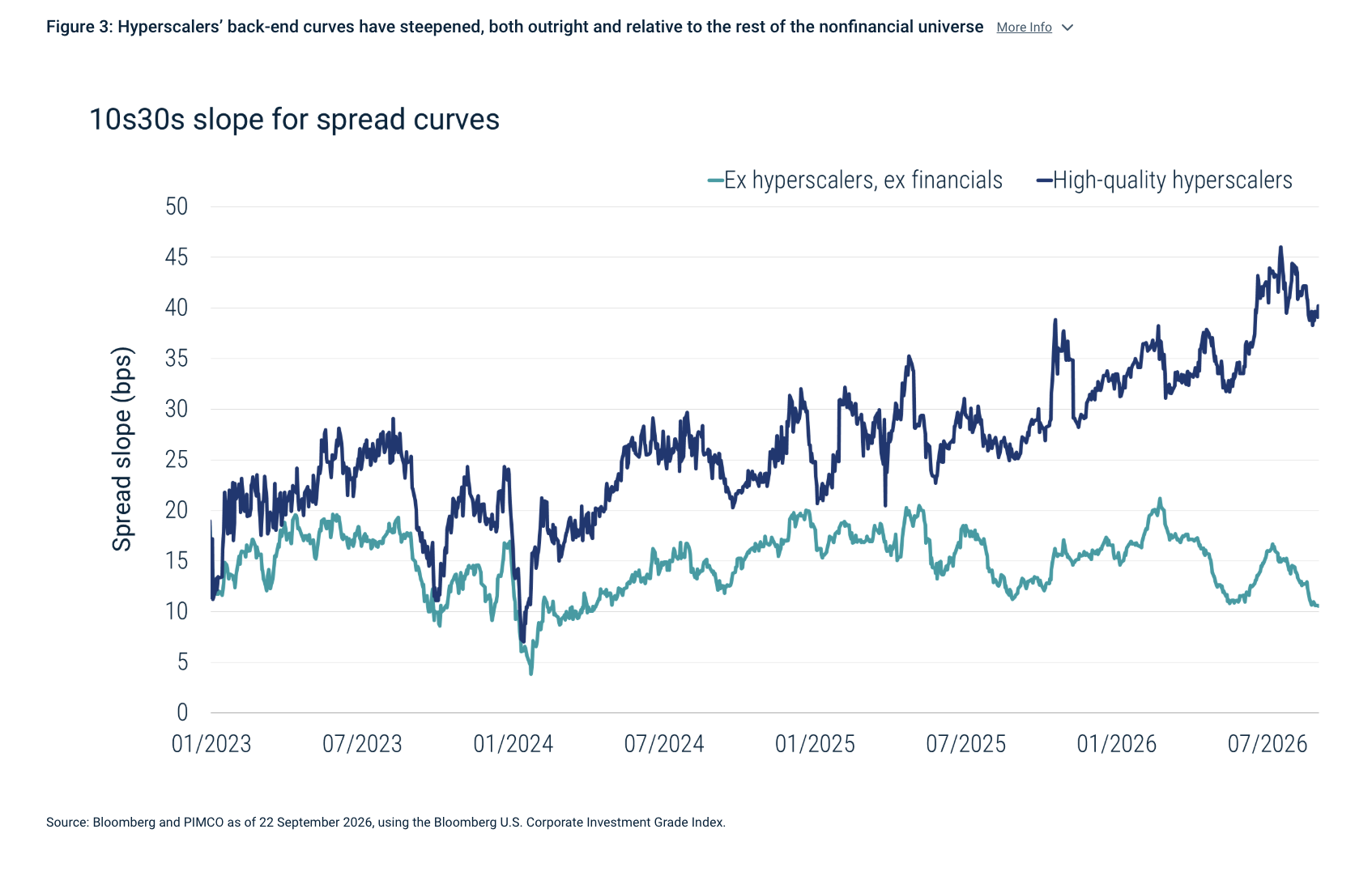
The pricing evidence shows no sign of crowding out. If non-AI issuers were being rationed out of long-duration markets by hyperscaler supply, we would expect to see their spreads widen or their curves steepen as the market demanded compensation for that displacement. We see neither. Spreads for nonfinancial issuers excluding hyperscalers and NVIDIA have not widened despite the surge in AI issuance (see Figure 2). Similarly, the back end of hyperscalers’ spread curves has steepened materially, both outright and relative to the rest of the nonfinancial universe, where curves have flattened (see Figure 3). In other words, the widening of hyperscaler spreads appears to have been the primary mechanism through which the AI “excess supply” has been absorbed.
That repricing has created some interesting relative value “anomalies”: High quality hyperscalers (those rated A or higher) now trade wider than utilities despite meaningfully stronger balance sheets on spot leverage, cash flow, and liquidity metrics (again, Figure 2). Also, the Bloomberg AA Corporate Index, which is increasingly dominated by high quality hyperscalers, trades at one of the thinnest spread premia to the broader IG market, as measured by the Bloomberg U.S. Corporate Investment Grade Index.
Quantity data: Unable or unwilling?
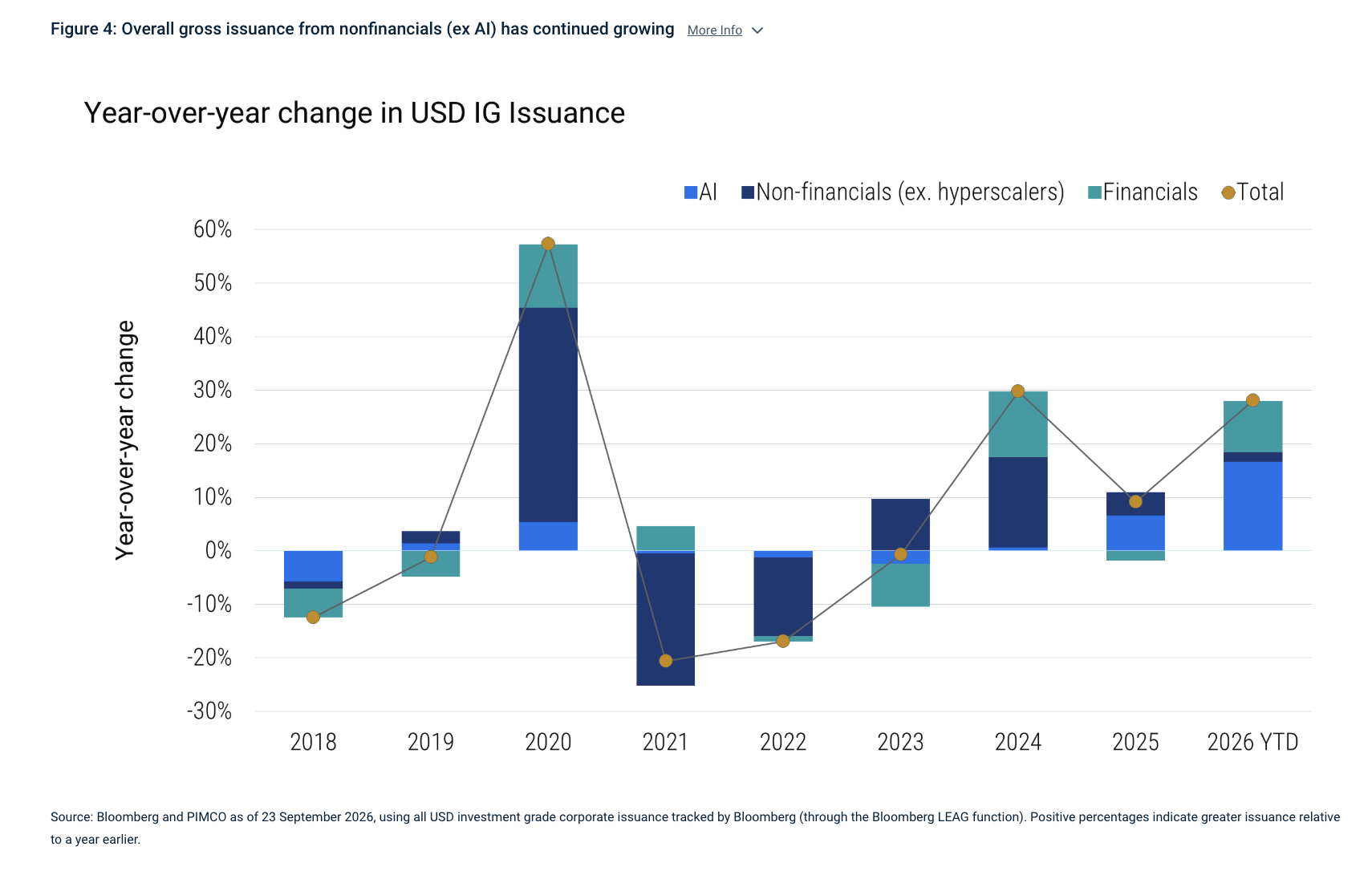
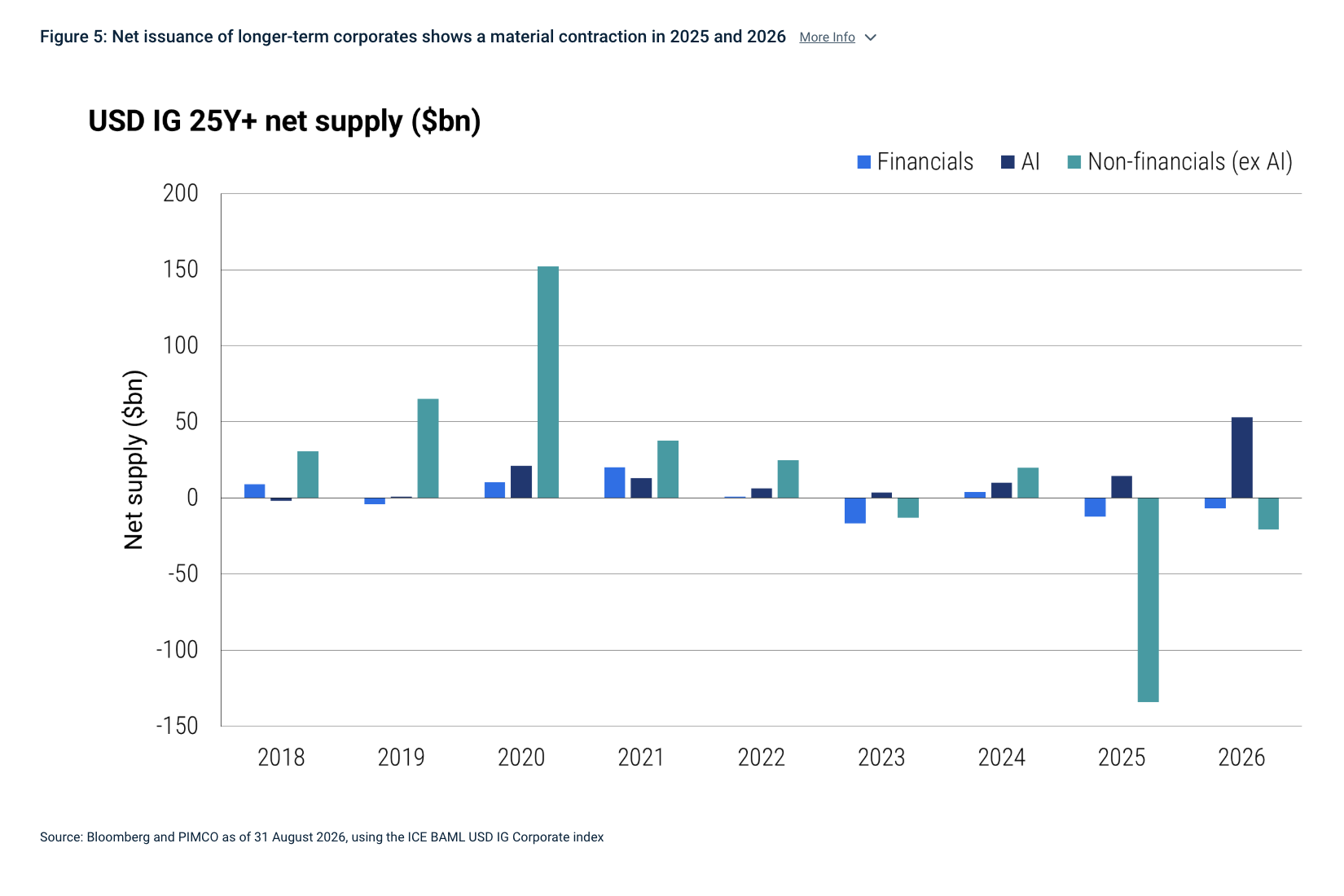
On the quantity side, the evidence countering the AI crowding-out story is more nuanced. Overall gross issuance from nonfinancials (ex AI issuers) is up from a year earlier, continuing a multi-year trend (see Figure 4). But net issuance for long-maturity bonds shows a material contraction in 2025 as well as year-to-date (see Figure 5).
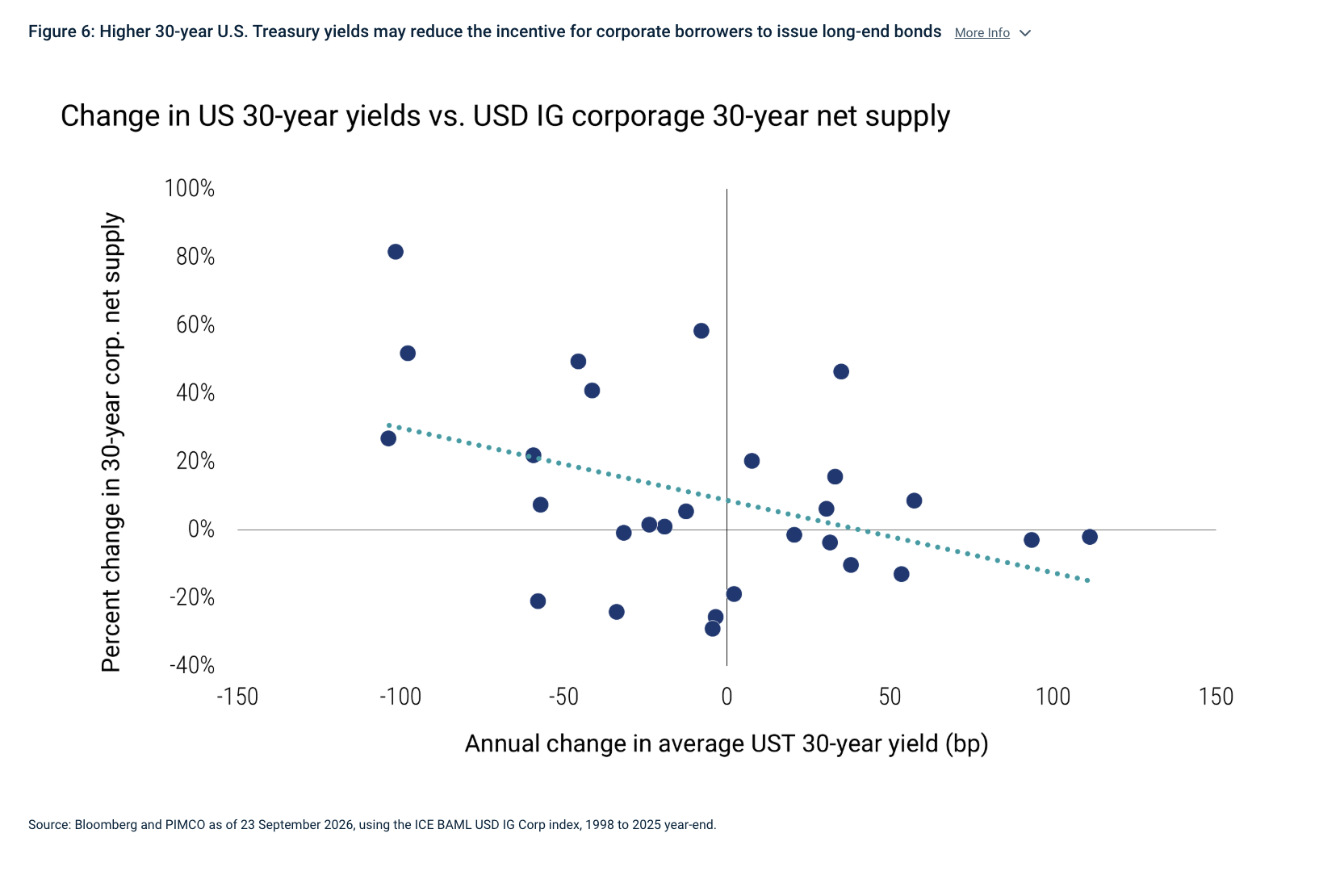
This pattern could look like crowding out at first glance, but quantities alone cannot distinguish between an inability to issue and an unwillingness to issue. The more prosaic explanation is that most companies are not passive takers of the maturity structure available to them. They time it. When long-term borrowing looks relatively cheap, they term out their debt issuance, and when it becomes more expensive, they favor the shorter maturities. This relationship is well established in the academic literature,Footnote1 and Figure 6 shows the same relationship in our own data: Rising long-dated yields have tended to coincide with declining long-duration net corporate supply.
Corporate CFOs and treasurers don’t have some perfect model of expected excess returns. For them, this maturity choice is a real corporate finance decision shaped by the trade-off between locking in funding and preserving flexibility.
The academic literature also shows that, at the aggregate level, corporate borrowers have tended to adjust the amount of duration they supply when the government changes the amount, or price, of duration in the market.Footnote2
Simply put, companies manage duration actively, so a decline in long-end issuance does not automatically mean they have been crowded out, especially in the current environment where long-dated yields have risen materially. One might argue this reflects Treasuries crowding corporate borrowers toward shorter maturities (a discussion for another time), but it is not evidence that hyperscaler issuance is driving this shift.
Bottom line
Within corporate credit, the overall picture is more nuanced than the simple crowding-out narrative that AI-related debt, especially hyperscaler debt, is overwhelming other issues. We just don’t see the evidence.
So far, the market adjustment has been concentrated primarily where supply originates – the hyperscalers themselves – rather than crowding out other corporate borrowers. Where the maturity structure of non-AI issuance has shifted, the evidence points to Treasury curve dynamics and opportunistic maturity timing, not hyperscaler-specific displacement, as the driver.
Michael Puempel and Gabriel Cazaubieilh contributed to this report.
Footnotes
1 See Baker, Greenwood, and Wurgler (2003), “The maturity of debt issues and predictable variation in bond returns,” Journal of Financial Economics, 261-291, Volume 70, Issue 2 Return to content↩
2 Greenwood, Hanson, and Stein (2015), “A Comparative-Advantage Approach to Government Debt Maturity,” Journal of Finance, 1683-1722, Volume 70, Issue 4 Return to content↩
Disclosures
Statements concerning financial market trends or portfolio strategies are based on current market conditions, which will fluctuate. Outlook and strategies are subject to change without notice.
Past performance is not a guarantee or a reliable indicator of future results. Forecasts, estimates and certain information contained herein are based upon proprietary research and should not be considered as investment advice. There is no guarantee that stated results will be achieved.
Investments with exposure to the artificial intelligence sector may involve heightened risks, including rapid technological change, competitive disruption, elevated valuations, regulatory uncertainty, data privacy and cybersecurity concerns, infrastructure dependencies, and reliance on third-party models or platforms. AI-related opportunities may not develop as expected, fail to produce anticipated productivity or revenue benefits, or be concentrated among a limited number of issuers, and could result in increased volatility or loss of capital. U.S. government securities such as Treasury bills are backed by the full faith of the government. Corporate debt securities are subject to the risk of the issuer’s inability to meet principal and interest payments and may also be subject to price volatility due to interest rate sensitivity, market perception of the creditworthiness of the issuer and general market liquidity.
The credit quality of a particular security or group of securities does not ensure the stability or safety of the overall portfolio. It is not possible to invest directly in an unmanaged index.
PIMCO as a general matter provides services to qualified institutions, financial intermediaries and institutional investors. Individual investors should contact their own financial professional to determine the most appropriate investment options for their financial situation. This material contains the opinions of the author and such opinions are subject to change without notice. This material has been distributed for informational purposes only and should not be considered as investment advice or a recommendation of any particular security, strategy or investment product. Information contained herein has been obtained from sources believed to be reliable, but not guaranteed. No part of this material may be reproduced in any form, or referred to in any other publication, without express written permission. PIMCO is a trademark of Allianz Asset Management of America LLC in the United States and throughout the world.
CMR2026-0925-5964393
A message from Advisor Perspectives and VettaFi: Discover something new! Click here to register for our upcoming webcasts.
© PIMCO
Read more commentaries by PIMCO