In recent months, major central banks have placed a greater emphasis on broader financial conditions when describing the stance of monetary policy.
Chairman Kevin Warsh characterized the Federal Reserve’s September rate hike as “removing a dose of accommodation so that financial and credit conditions would be more consistent with [the Fed’s] objectives.” President Christine Lagarde framed the European Central Bank’s decision in September around its “assessment of financial and monetary conditions.” At the recent G20 summit, Bank of Japan Governor Kazuo Ueda explicitly linked the policy rate path to financial conditions, noting that the BOJ “hope[s] to continue raising interest rates as financial conditions remain accommodative.” Finally, Governor Michele Bullock argued this week that the Reserve Bank of Australia “need[s] to make sure we have financial conditions tight enough to bring inflation down.”
For investors, this shift in emphasis raises important questions: How are financial conditions measured? Are they supporting or restricting economic growth? And what does this mean for monetary policy going forward?
To briefly answer the last question first – equity market performance and its impact on wealth and spending has contributed to easier-than-ideal financial conditions. However, higher interest rates since June for U.S. Treasuries, mortgages, and corporate debt should help cool off what would otherwise be a stronger equity impulse to growth. More importantly, the tightening in financial conditions needed to bring inflation more quickly to target appears nowhere near the adjustment required in 2022.
See more: Have a Process for Decisions on Major Changes at Your Firm
Measuring how monetary policy transmits to markets
Over the last decade, the Fed has often described its policy stance by comparing short-term interest rates with the equilibrium neutral rate – which economists call r* or r-star – consistent with economic output at potential and inflation at the Fed’s 2% target. However, because r* is unobservable and estimates are highly uncertain, there are practical limitations to using it as a real-time indicator. (For more details, see last week’s Macro Signposts.)
The short-term interest rate controlled by the Fed is only one component of financial conditions, and the transmission of monetary policy implicitly depends on how changes in short-term interest rates influence a range of other asset prices.
The Fed has long recognized these transmission channels. In the wake of the pandemic, equity and house prices have featured prominently in discussions of consumption and wealth effects. Credit spreads were in the spotlight during the global financial crisis and COVID-19 pandemic as policymakers grappled with the “financial accelerator mechanism” – that is, when asset price dislocations exacerbate an economic downturn. The recent emphasis on broader financial conditions simply makes their role more explicit in current monetary policy deliberations.
To summarize these influences, researchers have developed financial conditions indices, or FCIs, that combine interest rates and asset prices using weights intended to capture their relative importance for the economy. But how should those weights be determined?
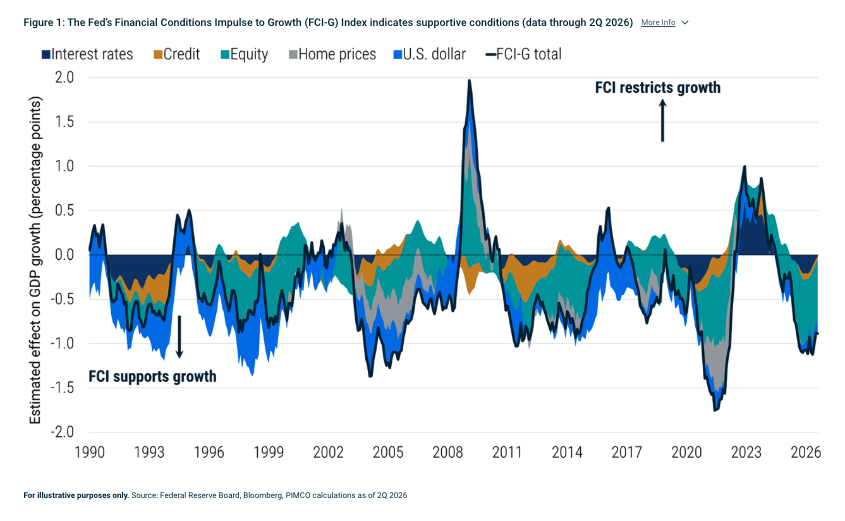
One approach developed by economists at the Federal Reserve Board is the Financial Conditions Impulse on Growth (FCI-G) index,Footnote1 which weights seven financial variables according to their estimated effects on GDP growth. Those seven variables are the fed funds rate, 10-year U.S. Treasury yield, 30-year fixed mortgage rate, BBB corporate bond yield, stock prices, house prices, and the broad U.S. dollar.
Importantly, FCI-G measures the impulse from changes in financial conditions on subsequent GDP growth, not whether the absolute level of financial conditions is accommodative or restrictive. Positive readings of FCI-G indicate headwinds to growth: A reading of +1 indicates that financial conditions are estimated to subtract 1 percentage point (ppt) from GDP growth over the following year. Conversely, negative readings represent tailwinds to growth.
The latest reading of FCI-G in 2Q 2026 is −0.9, which implies that at the end of the second quarter, changes in financial conditions over the last several years were set to add an estimated 0.9 ppts to U.S. growth over the coming year. This is substantially more supportive than what we saw in 2022–2023, when aggressive hikes in the policy rate contributed to a tightening in financial conditions, which subtracted a roughly estimated 0.5 to 1 ppt from growth. Our decomposition of FCI-G in Figure 1 suggests that equity market performance has provided the largest boost to overall U.S. growth over the past year.
FCI targeting: theory and practice
In our view, Chairman Warsh’s comments in September suggest the Fed does not want to actively ease financial conditions by failing to deliver a rate hike that was already embedded in market pricing, as doing so could unintentionally add to inflationary pressures. But that raises a more fundamental question: How much support or restraint from financial conditions is consistent with inflation returning to the Fed’s 2% target?
FCI-G alone cannot answer this question, as it does not tell us what level of financial conditions is consistent with an economy growing at potential. Answering that question requires a target for financial conditions that varies over time with economic fundamentals.
One way to construct such a target is to calculate the change in asset prices that underlies FCI measures required to close the output gap. That gap is itself uncertain: While the U.S. labor market is widely viewed as operating at potential, estimates that also incorporate investment and wealth effects suggest that output is currently about 1 to 1.5 ppts above potential. Inserting those estimates into the Phillips curve – which translates the output gap into inflationary pressures – implies a relatively minor inflationary impulse of roughly 0.1 to 0.3 ppts.
Since the economy’s productive capacity is continually expanding and household spending adjusts only gradually, some support from financial conditions is normally required simply to keep demand growing in line with supply. A permanent negative supply shock, by contrast, would imply that tighter financial conditions are needed to better balance supply and demand. AI is a complicating factor because it potentially represents both a positive demand shock through higher investment and a positive supply shock through higher productivity.
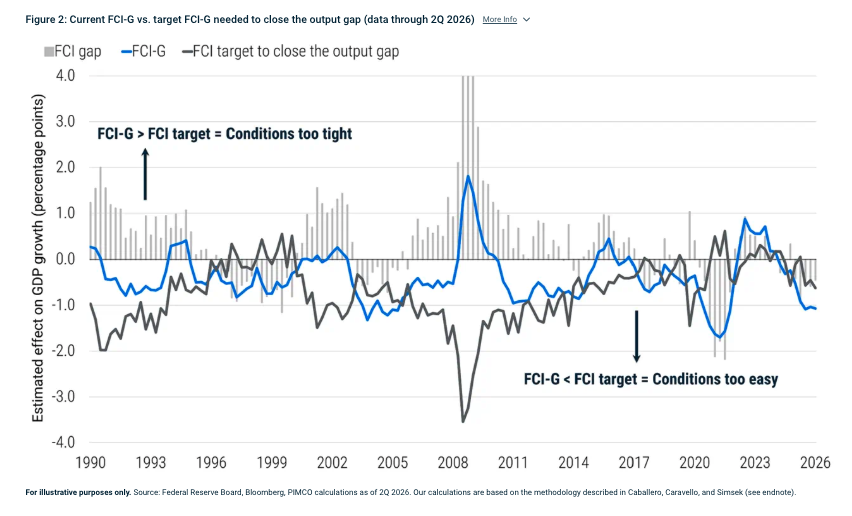
Recently, economists at MIT and YaleFootnote2 have developed a methodology to estimate the target level of FCI consistent with closing the output gap. Adapting their methodology, we find that financial conditions were modestly easier than the theoretical ideal as of the end of 2Q (see Figure 2).
According to these measures, financial conditions were around 50 basis points (bps) too easy at the end of 2Q, arguing that the Fed should shift policy to lean against the earlier easing. In reality, the required adjustment could occur through myriad combinations of asset price changes and over different time frames.
To illustrate the magnitude, the estimated realignment in financial conditions would be equivalent to a 70-bp increase in the 10-year Treasury yield (that passes through one-for-one to mortgage rates and corporate yields), a 9% decline in equities, a 4% increase in the broad trade-weighted U.S. dollar, or some combination of those and changes in the other components of FCI-G. Importantly, these figures are not forecasts, but rather illustrative equivalents.
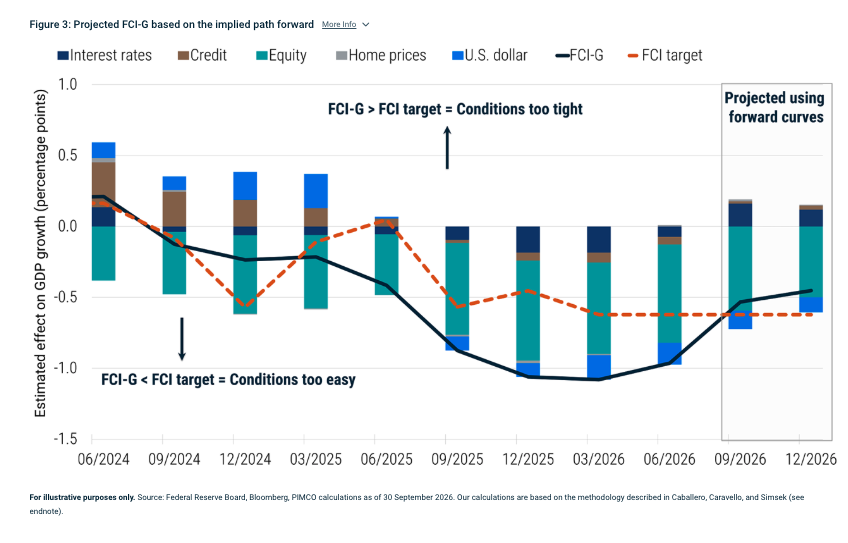
As of this writing, the 10-year Treasury yield has risen by roughly 80 basis points since June, suggesting that the rates market is doing much of the work needed to cool the economy. Indeed, extending the FCI-G series with the latest market data, and assuming markets follow the paths priced into their respective futures curves, the rates market hypothetically has already more than closed the gap (see Figure 3).
More fundamentally, financial conditions respond to many forces that the Fed does not control. Investor risk tolerance can reset abruptly following a geopolitical shock, growth scare, or fiscal surprise. Currently, financial conditions are supported by optimism around AI and prospective productivity growth, but that could change in the future. So, the policy rate needed today to recalibrate financial conditions may not be the same policy rate needed tomorrow. The fact that rates have done most of the tightening so far may give way to other asset classes sharing some of the burden in the future.
Implications
Our analysis continues to suggest that the Fed’s recent rate increase is better viewed as a recalibration of policy than the beginning of a prolonged hiking cycle.
U.S. financial conditions may have been somewhat easier than ideal as of 2Q – supporting an economy operating modestly above potential – providing a rationale for the Fed to remove “a dose of accommodation.” But the required adjustment appears relatively modest, particularly compared with 2022. Moreover, the rise in 10-year Treasury yields since June suggests that markets may have already delivered much of the tightening needed.
If the Fed is increasingly focused on broader financial conditions rather than the distance between the policy rate and an uncertain estimate of neutral, it need not rely exclusively on repeated rate hikes to remove accommodation. Higher long-term yields, softer equity prices, wider credit spreads, or a stronger dollar can do some of the work.
Finally, viewed through the lens of financial conditions, AI could be a transformative force for the Fed’s policy framework. Elevated investment demand – now coupled with positive wealth effects that are necessitating tighter financial conditions – could eventually give way to a positive supply impact from higher productivity growth that could allow for easier financial conditions without inflationary implications.
Footnotes
- Andrea Ajello, Michele Cavallo, Giovanni Favara, William B. Peterman, John W. Schindler IV, and Nitish R. Sinha. “A New Index to Measure U.S. Financial Conditions.” FEDS Notes. Washington: Board of Governors of the Federal Reserve System (30 June 2023). The Federal Reserve page notes that the FCI-G materials were updated 21 September 2026. Return to content↩
- Ricardo J. Caballero, Tomás E. Caravello, and Alp Simsek. “FCI-star.” NBER Working Paper No. 33952 (June 2025, revised January 2026). Return to content↩
Disclosures
A word about risk: All investments contain risk and may lose value. Investing in the bond market is subject to risks, including market, interest rate, issuer, credit, inflation risk, and liquidity risk. The value of most bonds and bond strategies are impacted by changes in interest rates. Bonds and bond strategies with longer durations tend to be more sensitive and volatile than those with shorter durations; bond prices generally fall as interest rates rise, and low interest rate environments increase this risk. Reductions in bond counterparty capacity may contribute to decreased market liquidity and increased price volatility. Bond investments may be worth more or less than the original cost when redeemed. Equities may decline in value due to both real and perceived general market, economic and industry conditions. Sovereign securities are generally backed by the issuing government. Obligations of U.S. government agencies and authorities are supported by varying degrees, but are generally not backed by the full faith of the U.S. government. Portfolios that invest in such securities are not guaranteed and will fluctuate in value.
Statements concerning financial market trends or portfolio strategies are based on current market conditions, which will fluctuate. There is no guarantee that these investment strategies will work under all market conditions or are appropriate for all investors and each investor should evaluate their ability to invest for the long term, especially during periods of downturn in the market. Outlook and strategies are subject to change without notice.
PIMCO as a general matter provides services to qualified institutions, financial intermediaries and institutional investors. Individual investors should contact their own financial professional to determine the most appropriate investment options for their financial situation. This material contains the opinions of the manager and such opinions are subject to change without notice. This material has been distributed for informational purposes only and should not be considered as investment advice or a recommendation of any particular security, strategy or investment product. Information contained herein has been obtained from sources believed to be reliable, but not guaranteed. No part of this material may be reproduced in any form, or referred to in any other publication, without express written permission. PIMCO is a trademark of Allianz Asset Management of America LLC in the United States and throughout the world.
CMR2026-0930-5976357
A message from Advisor Perspectives and VettaFi: Discover something new! Click here to register for our upcoming webcasts.
© PIMCO
More Asian/European Markets Topics >