Key takeaways:
- State policies – rather than Congress – may be more directly impactful for data centers
- A diplomatic settlement with Iran is a realistic scenario, but it may take time
- We see room for bipartisan compromise on a limited set of issues
Election Day delivered a decisive shift in the political landscape. Democrats regained control of both the House and Senate and captured several key governorships. Affordability concerns, unease about the economy and dissatisfaction with the war in Iran all played a role, consistent with polling heading into the vote.
Still, the size of the Democratic gains exceeded what seemed plausible just a few months ago. Nowhere was that more apparent than in the Senate, where Democrats flipped at least seven seats, including victories in deep-red Texas, South Carolina and Kansas, while also securing a sizeable House majority.
The election may be over, but for investors, the important questions are just beginning, as evidenced by the increased market volatility we have seen since Election Day. Below, we tackle five of the biggest questions for the economy and financial markets.
What is the outlook for the data center buildout?
This is probably the top market question coming out of the election. New governors who campaigned on stricter data center regulation, notably in Texas, Ohio and Georgia, could make projects harder to approve. But new restrictions or moratoriums generally wouldn’t stop projects already underway, making any potential slowdown more of a 2028 and beyond story. The capacity currently under construction is enormous, approximately 150% of what’s operational today. So, the AI megatrend isn’t over. With underlying demand for AI solutions still robust, the bigger question may be where data centers get built and at what cost. If construction slows, it could weigh on demand for chipmakers. On the flip side, hyperscalers, which dominate existing data center capacity, could benefit from a supply-constrained environment and less pressure on balance sheets.
See more: Beyond the Ballots: What Matters for Markets
At the federal level, another key question is whether Democrats revisit 100% expensing for data center capital investment. What we’re watching most closely, however, is the trajectory of AI capex. It has accounted for a significant portion of economic growth over the past year, so any meaningful slowdown could be an important warning sign. Given our view that the AI ecosystem can navigate these post-election regulatory challenges, we remain overweight technology, particularly following the sector’s recent pullback.
What is the outlook for the war with Iran?
Markets now see the election as reducing the risk of further escalation, and that’s reflected in the retreat in oil prices. But we’d be careful about declaring the conflict resolved. Foreign policy and military decisions remain largely under the control of the White House, not Congress. The US and Iran remain far apart, US forces remain in the region, and the window before Democrats take control of Congress in January could prove important. The oil market’s risk premium has faded, but geopolitical risk hasn’t disappeared.
Our non-consensus 12-month WTI target remains $65, based on our view that the Iran conflict ultimately finds an off-ramp over the next six months. Any sign of an earlier resolution could accelerate oil’s decline. That’s why we remain underweight energy while favoring consumer discretionary and industrials, particularly transports.
Does the outcome change the outlook for taxes?
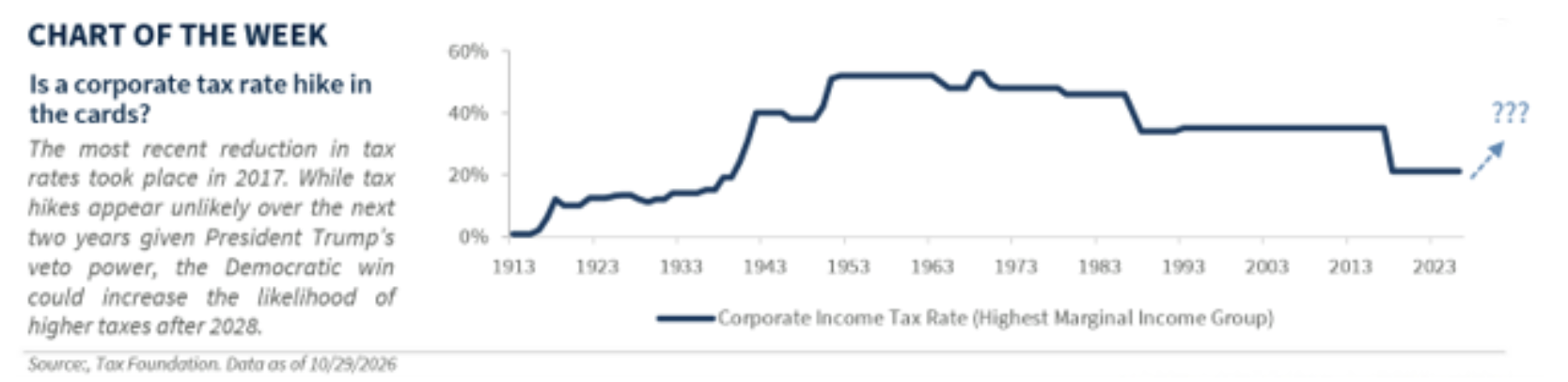
Probably not over the next two years. Democrats made significant gains, but President Trump retains the veto pen, and overriding a veto requires two-thirds of both the House and Senate. Sweeping tax changes therefore look unlikely until 2029 at the earliest. As both parties pivot toward 2028, we’ll be watching whether more populist policy proposals gain momentum.
If Democrats sweep in 2028, tax rates on capital gains, dividends, estates, corporate earnings and ordinary income for high earners could move higher. With today’s low tax rates supporting consumer spending, particularly among high earners, as well as corporate earnings, tax policy could become an increasingly important market issue as the 2028 election approaches.
Can Republicans raise the debt limit in the next six weeks?
Republicans have a narrow six-week window before Democrats take control of Congress. They could address the debt ceiling during the lame duck session, potentially alongside year-end government funding, but securing the votes won’t be easy. If they can’t, the debt ceiling could emerge as one of the market’s biggest Washington risks in 2027, raising the prospect of more brinksmanship. The national debt continues to rise, but that doesn’t mean Treasury yields have to follow. With growth slowing modestly and inflation cooling, we expect the 10-year yield to move toward 4.5% to 4.75% over the next 12 months. The key gauge we’re watching is Treasury auction demand, and with bid-to-cover ratios near 2.5x, demand remains healthy.
To what extent will Trump reach across the aisle?
This may be the sleeper story. Moderate Democrats performed well, suggesting voters want more compromise, particularly on affordability. While gridlock remains the consensus view, could “Trump the Dealmaker” actually lead to more getting done in DC?
We see defense spending, health care, energy permitting and clean energy as potential areas for bipartisan deals. The catch is that compromise rarely means fiscal discipline. If both sides get some of what they want on spending, the deficit could widen further. With defense and health care among the areas where compromise could support earnings growth, this reinforces our overweight to industrials, while valuations keep us neutral on health care.
High-yield bonds are not suitable for all investors. The risk of default may increase due to changes in the issuer's credit quality. Price changes may occur due to changes in interest rates and the liquidity of the bond. When appropriate, these bonds should only comprise a modest portion of a portfolio.
All expressions of opinion reflect the judgment of the author(s) and the Investment Strategy Committee and are subject to change. This information should not be construed as a recommendation. The foregoing content is subject to change at any time without notice. Content provided herein is for informational purposes only. There is no guarantee that these statements, opinions or forecasts provided herein will prove to be correct. Past performance is not a guarantee of future results. Indices and peer groups are not available for direct investment. Any investor who attempts to mimic the performance of an index or peer group would incur fees and expenses that would reduce returns. No investment strategy can guarantee success.
Economic and market conditions are subject to change. Investing involves risks including the possible loss of capital.
The information has been obtained from sources considered to be reliable, but we do not guarantee that the foregoing material is accurate or complete. Diversification and asset allocation do not ensure a profit or protect against a loss.
The S&P 500 Total Return Index: The index is widely regarded as the best single gauge of large-cap U.S. equities. There is over USD 7.8 trillion benchmarked to the index, with index assets comprising approximately USD 2.2 trillion of this total. The index includes 500 leading companies and captures approximately 80% coverage of available market capitalization.
Sector investments are companies focused on a specific economic sector and are presented here for illustrative purposes only. Sectors, including technology, are subject to varying levels of competition, economic sensitivity, and political and regulatory risks. Investing in any individual sector involves limited diversification.
Links are being provided for information purposes only. Raymond James is not affiliated with and does not endorse, authorize or sponsor any of the listed websites or their respective sponsors. Raymond James is not responsible for the content of any website or the collection or use of information regarding any website's users and/or members.
Raymond James & Associates, Inc., member New York Stock Exchange / SIPC, and Raymond James Financial Services, Inc., member FINRA / SIPC, are subsidiaries of Raymond James Financial, Inc.
Raymond James® and Raymond James Financial® and power of personal® are registered trademarks of Raymond James Financial, Inc.
A message from Advisor Perspectives and VettaFi: Discover something new! Click here to register for our upcoming webcasts.
© Raymond James
More Innovative ETFs Topics >