Key takeaways
-
AI is changing the economics of drug development. Practical applications are already helping companies reduce costs and accelerate research, with potentially greater benefits ahead.
-
China is expanding the global pool of promising science. More competition, but also more innovation—and a growing source of assets for pharmaceutical pipelines.
-
Biotech's fundamentals are improving faster than sentiment. Research spending, new medicines and deal-making are all picking up.
A Stronger Foundation for 2027
In recent months, we’ve spent lot of time with biotech management teams, attending conferences and meeting with companies and clients across the United States, Asia and beyond. Despite continued periods of volatility in biotech equities, what we've heard has reinforced our view that the industry is entering 2027 in a stronger position than it has been in for several years.
The US midterm elections and the latest sell-off in AI-related stocks have added to market uncertainty. But neither has materially changed what we're hearing from biotech companies or the fundamental developments shaping our outlook. Policy, financing conditions and valuations will remain important, but the underlying industry trends give us reason for optimism.
Three developments stand out. Artificial intelligence (AI) is beginning to change the economics of drug discovery and development. China's rapidly advancing biotech industry is expanding the global pool of promising science while raising the competitive bar. And capital is returning to research as new therapies advance and large pharmaceutical companies look to replenish their pipelines.
These are not simply long-term possibilities. We're already seeing evidence of change in how companies allocate research dollars, develop medicines and compete for capital. The implications extend well beyond the next product launch or clinical trial.
For investors, the question is whether share prices adequately reflect an industry whose ability to turn science into medicine is improving. In a number of cases, our analysis suggests they do not.
See more: AI: Where Will the Money Come From?
1 | AI Is Changing the Economics of Drug Development
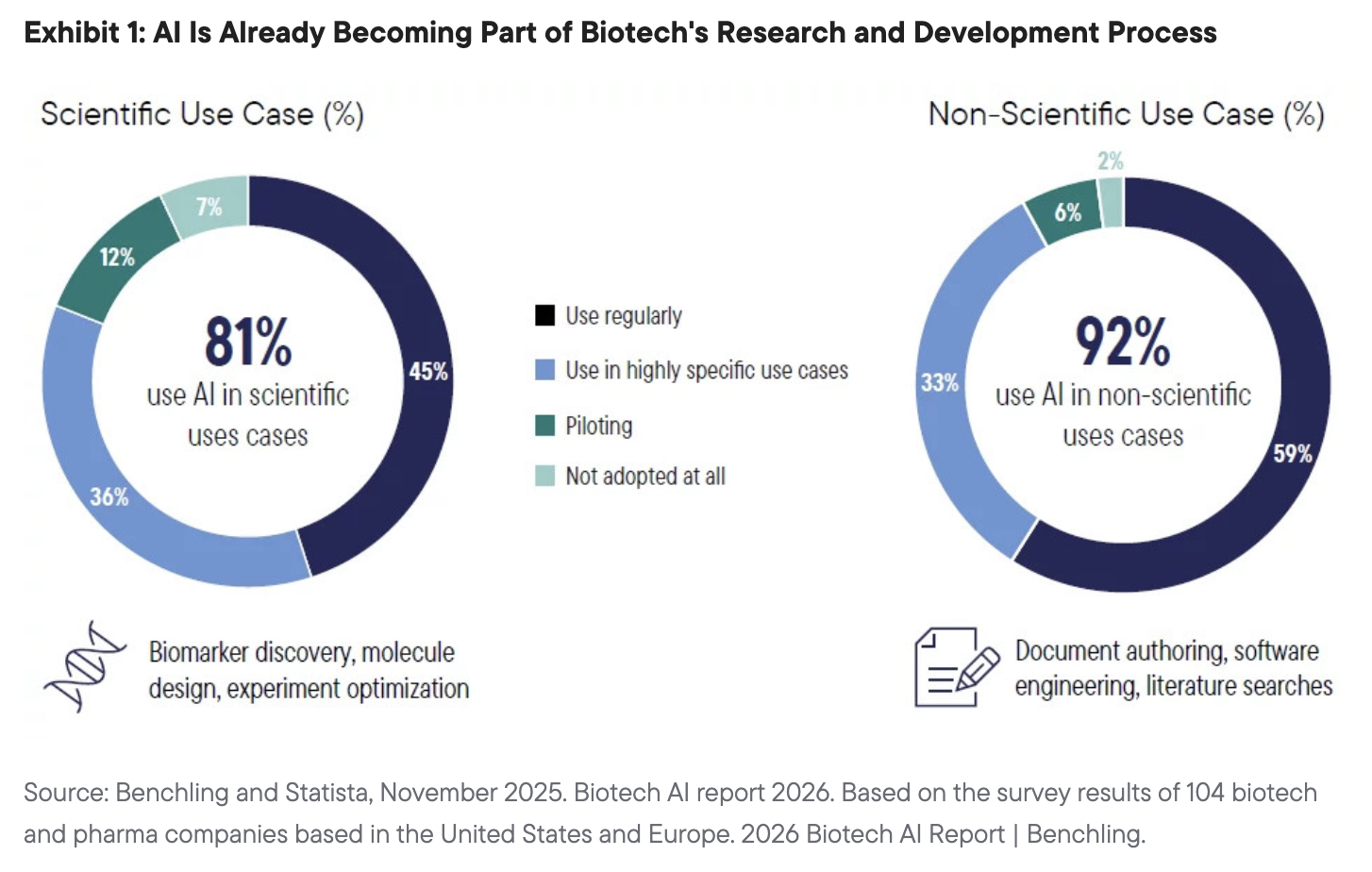
The AI conversations we had were wide-ranging. Some companies pitched drugs designed entirely by AI; others described how the technology is already changing the day-to-day work of finding and developing medicines.
The everyday applications are already paying off. One drug developer is using AI to work out which laboratory experiments are worth pursuing, allowing its scientists to test fewer candidate molecules before finding the right one. Yet AI could ultimately generate more lab work, not less. As the technology generates promising ideas quickly, the bottleneck shifts from identifying potential drug candidates to testing them in the real world. More ideas to validate means more experiments and, ultimately, more drug programs moving forward. Several others are using it to help draft the thousands of pages of documentation that regulators require—still reviewed by humans but produced far more quickly.
What it Means for Investors
Bringing a new medicine all the way to patients takes years, and many candidates that enter testing never make it to the finish line. Anything that shortens that journey or improves the odds of success changes the economics of biotech, especially for smaller companies, where a single failed trial can be the difference between survival and not.
The nearer term benefits of AI are now showing up as lower costs and quicker timelines, while the opportunity in AI-designer drugs is no longer a distant prospect. AI-designed molecules have already reached late-stage trials, although none has yet been approved. For the newest platforms—those using AI to identify entirely new disease targets rather than design molecules against known ones—initial human validation could come within two to three years. But the decisive test, whether these medicines work in patients, still lies ahead.
2 | China Is Expanding the Global Pool of Promising Science
If there was one topic that came up in nearly every conversation, it was China.
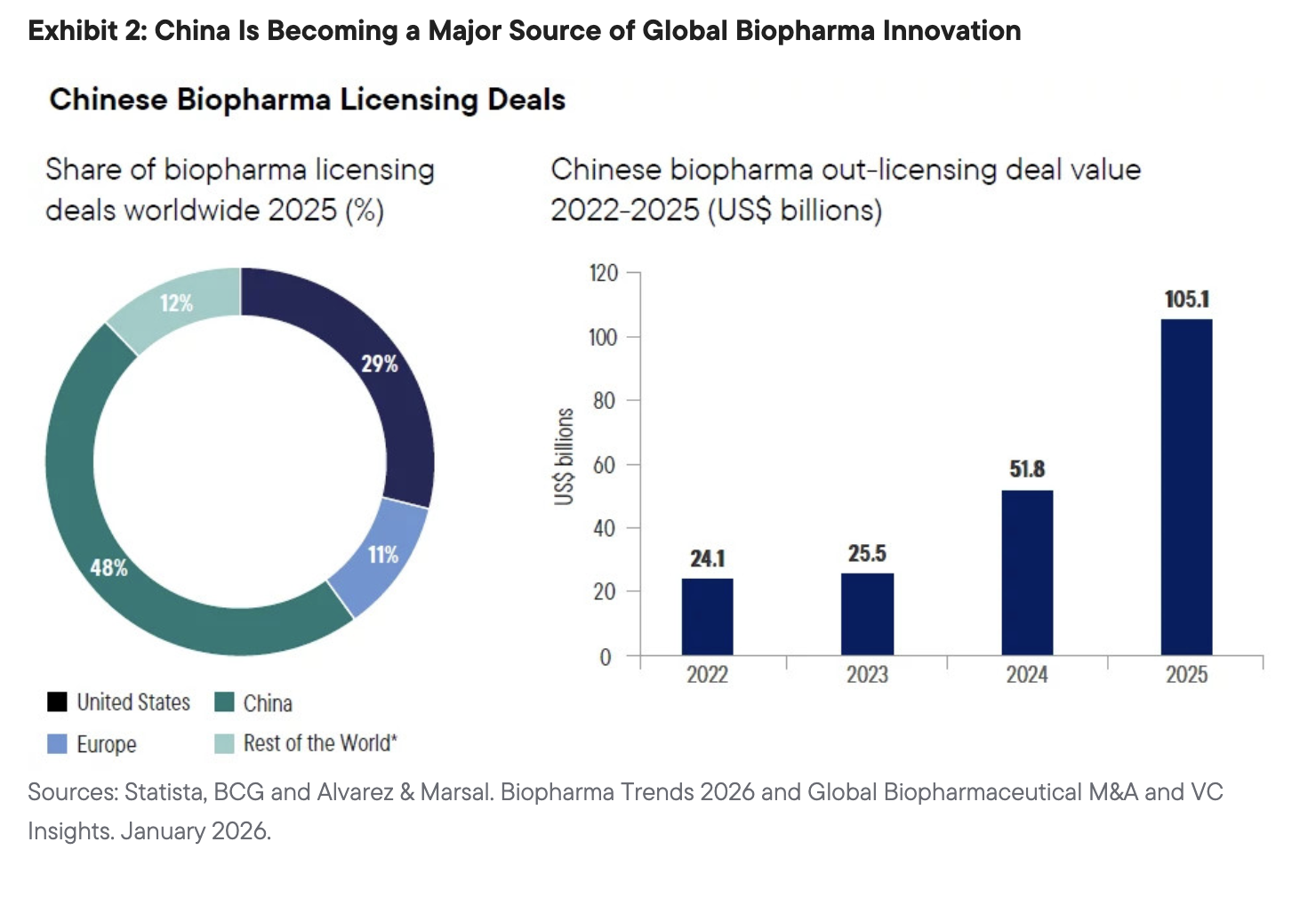
Chinese biotech companies are producing increasingly sophisticated science, moving drug candidates into human trials faster than many Western peers, and becoming central to early-stage drug development worldwide. In September, the Chinese government rolled out a five-year plan to build on that position.
For the sector as a whole, we see this as more opportunity than threat. Large pharmaceutical companies facing patent expirations have been increasingly willing to license assets originated in China—a cost-effective way to refill their pipelines, and one that validates the quality of the underlying science. More high-quality science, wherever it originates, means more promising medicines in the industry’s pipelines and more opportunities for the companies that execute well.
China also remains an important market for Western laboratory suppliers. Several told us spending there is recovering strongly, ahead of some expectations, though still below its 2021–2022 peak.
What it Means for Investors
Competition is changing what investors can see. Several companies described China as a reason to be more selective about what they disclose, particularly on early-stage research. One executive walked us through several programs the company has chosen not to detail publicly until its intellectual property is more secure or the work is closer to human trials.
A company’s pipeline slide used to be a fair guide to its pipeline. Increasingly, the most promising early-stage work is being held back. For companies with a proven record of discovery, that can mean upside the market has not priced. In our view, it rewards fundamental investors who can look beyond the disclosed pipeline to assess the quality of the science, the strength of the platform and a company’s ability to turn discovery into viable drugs.
3 | Biotech's Fundamentals Are Improving Faster than Sentiment
Budgets are still scrutinized; public financing remains selective and concerns about drug pricing have not disappeared.
Yet several underlying indicators suggest conditions are improving.
Research spending is strengthening. Laboratory suppliers, whose order books give an early read on research activity, are seeing demand pick up—led by drug research and development rather than manufacturing. One large supplier has orders running ahead of sales; another raised its outlook on a stronger backlog. Budgets remain tight, but improving visibility into 2027 could unlock more, and private funding remains available even as public markets stay selective.
The science keeps advancing, and established therapies are reaching more patients. Cell therapies developed for cancer are showing promise in lupus and other autoimmune diseases, while a treatment that could allow some bladder cancer patients to avoid bladder removal is approaching regulatory filing. Meanwhile GLP-1 drugs—originally developed to control blood sugar in type 2 diabetes and now widely used for weight management—are becoming accessible to millions of lower-income Americans through Medicaid.
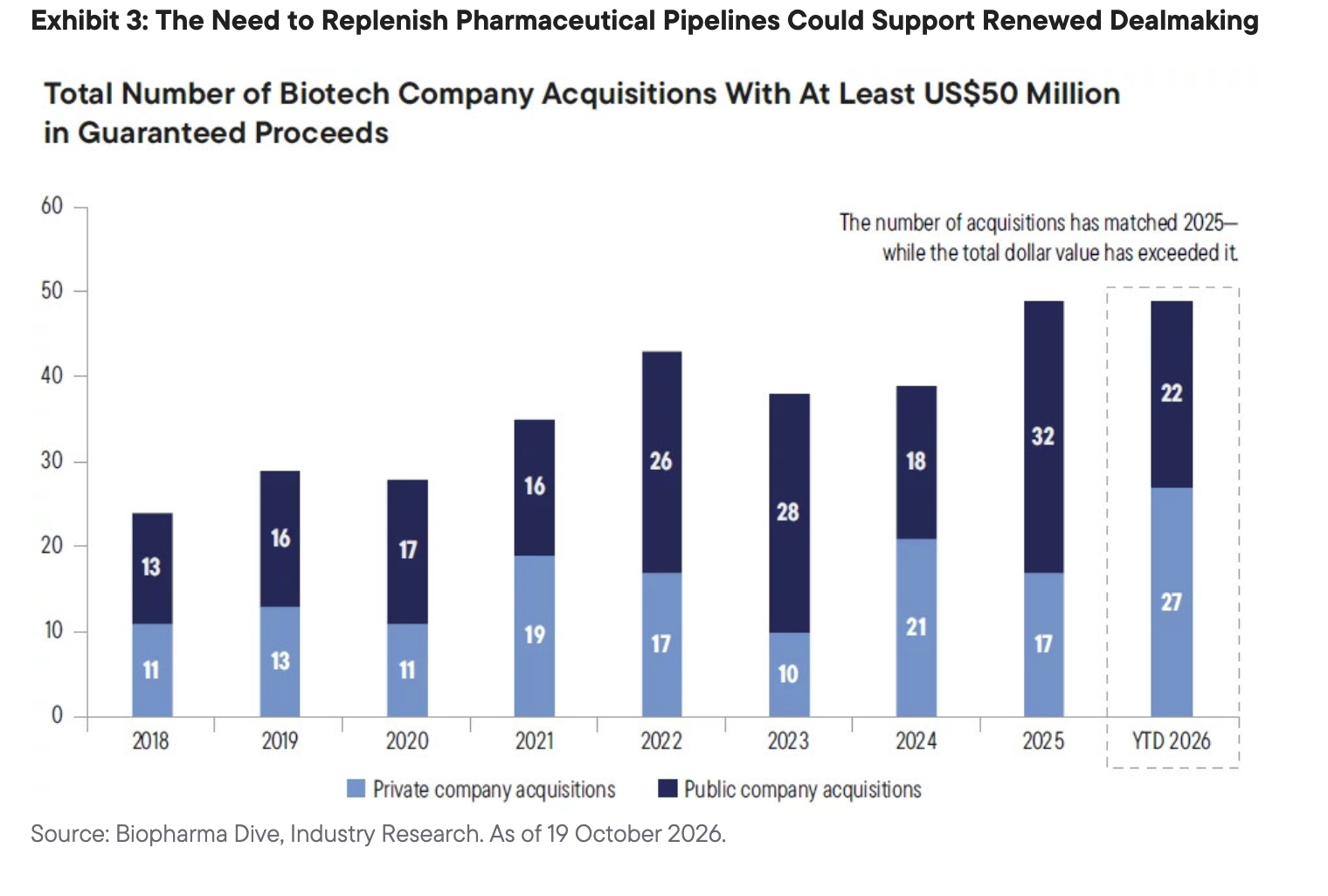
Mergers and Acquisitions (M&A) are back on the agenda. The dollar value of biopharma M&A activity has already surpassed the full-year 2025 total,1 although the pace slowed in September and October as buyers became more selective ahead of the US midterm elections. With the election now behind us, one source of uncertainty has been resolved, although the policy outlook and financing environment will continue to influence dealmaking. Still the underlying drivers of dealmaking remain intact. Two factors support this. First, facing significant patent expirations, large pharmaceutical companies continue to look to biotech to replenish their pipelines, providing a potential source of capital and support for valuations across the sector. Second, a cohort of mid-sized biotech’s with cash from successful product launches are also seeking new pipeline assets and have broadened the base of potential acquirers.
What it Means for Investors
Drug pricing worries are real. US government programs are expected to pay less for some medicines, and Germany is debating health spending cuts. But the companies we spoke with described the expected impact as manageable, and investor expectations already appear cautious—many forecasts exclude uncertain overseas revenues altogether.
In our view, that creates a low bar. If the news is merely “less bad” than feared, estimates go up. Add rising research spending, a steady flow of new medicines and renewed deal activity, and you have an industry whose fundamentals are improving faster than the market outlook.
Biotech Enters 2027 With Building Momentum
Smarter tools, tougher competition and returning capital—each of these would be a positive on its own. Together, they describe an industry getting better at the thing it exists to do.
Biotech rarely moves in a straight line, and 2026’s volatility is a reminder of how quickly sentiment can change. But our conversations with companies have left us with a clear view: Real progress is being made, and in a number of cases, we don't think share prices fully reflect it. There will be setbacks, and not every company will get it right. But heading into 2027, we see good reasons to be optimistic—and opportunities for fundamental investors willing to look beyond the market's latest swings.
Endnotes
- Sources: JPMorgan and DealForma.com database as of 30 September 2026; Q3 2026 Biopharma Licensing and Venture Report.
WHAT ARE THE RISKS?
All investments involve risks, including possible loss of principal.
Equity securities are subject to price fluctuation and possible loss of principal.
Small- and mid-cap stocks involve greater risks and volatility than large-cap stocks.
Investment strategies which incorporate the identification of thematic investment opportunities, and their performance, may be negatively impacted if the investment manager does not correctly identify such opportunities or if the theme develops in an unexpected manner. Focusing investments in the health care and biotechnology sectors carries much greater risks of adverse developments and price movements in such industries than a strategy that invests in a wider variety of industries.
Any companies and/or case studies referenced herein are used solely for illustrative purposes; any investment may or may not be currently held by any portfolio advised by Franklin Templeton. The information provided is not a recommendation or individual investment advice for any particular security, strategy, or investment product and is not an indication of the trading intent of any Franklin Templeton managed portfolio.
Important Information
This material is intended to be of general interest only and should not be construed as individual investment advice or a recommendation or solicitation to buy, sell or hold any security or to adopt any investment strategy. It does not constitute legal or tax advice. This material may not be reproduced, distributed or published without prior written permission from Franklin Templeton.
The views expressed are those of the investment manager and the comments, opinions and analyses are rendered as at publication date and may change without notice. The underlying assumptions and these views are subject to change based on market and other conditions and may differ from other portfolio managers or of the firm as a whole. The information provided in this material is not intended as a complete analysis of every material fact regarding any country, region or market. There is no assurance that any prediction, projection or forecast on the economy, stock market, bond market or the economic trends of the markets will be realized. The value of investments and the income from them can go down as well as up and you may not get back the full amount that you invested. Past performance is not necessarily indicative nor a guarantee of future performance. All investments involve risks, including possible loss of principal.
Any research and analysis contained in this material has been procured by Franklin Templeton for its own purposes and may be acted upon in that connection and, as such, is provided to you incidentally. Data from third party sources may have been used in the preparation of this material and Franklin Templeton ("FT") has not independently verified, validated or audited such data. Although information has been obtained from sources that Franklin Templeton believes to be reliable, no guarantee can be given as to its accuracy and such information may be incomplete or condensed and may be subject to change at any time without notice. The mention of any individual securities should neither constitute nor be construed as a recommendation to purchase, hold or sell any securities, and the information provided regarding such individual securities (if any) is not a sufficient basis upon which to make an investment decision. FT accepts no liability whatsoever for any loss arising from use of this information and reliance upon the comments, opinions and analyses in the material is at the sole discretion of the user.
Franklin Templeton has environmental, social and governance (ESG) capabilities; however, not all strategies or products for a strategy consider “ESG” as part of their investment process.
Products, services and information may not be available in all jurisdictions and are offered outside the U.S. by other FT affiliates and/or their distributors as local laws and regulation permits. Please consult your own financial professional or Franklin Templeton institutional contact for further information on availability of products and services in your jurisdiction.
Issued in the U.S. by Franklin Templeton, One Franklin Parkway, San Mateo, California 94403-1906, (800) DIAL BEN/342-5236, franklintempleton.com. Investments are not FDIC insured; may lose value; and are not bank guaranteed.
You need Adobe Acrobat Reader to view and print PDF documents. Download a free version from Adobe's website.
CFA® and Chartered Financial Analyst® are trademarks owned by CFA Institute.
A message from Advisor Perspectives and VettaFi: Discover something new! Click here to register for our upcoming webcasts.
© Franklin Templeton
More ETF Topics >