Key takeaways
- An OCIO provider should understand your organization's objectives beyond the investment program. Strategic recommendations should reflect broader institutional priorities and financial obligations.
- Active management requires ongoing oversight. Providers should optimize risk-adjusted returns by monitoring aggregate exposures and adjusting positions as market conditions and investment needs evolve.
- The true value of an OCIO relationship extends beyond investment performance and advisory fees. Manager access, total program costs, implementation efficiency and risk management outcomes all contribute to the assessment.
- An effective OCIO relationship should reduce operational demands on an organization’s staff. Clear delegation, reporting and day-to-day oversight can free internal resources to focus on strategic decisions.
- The right OCIO arrangement should offer flexibility in how a relationship is structured. Full outsourcing, hybrid arrangements and targeted investment support can accommodate different institutional needs and governance preferences.
See more: Three Questions CFOs Should Ask About Their Investment Program
It's time to score your OCIO provider: Five questions worth asking
I speak with institutional investors every day. Some are considering outsourcing for the first time, while others are evaluating their current OCIO relationship or exploring a different approach entirely. The circumstances vary, but a question I hear often is: As our organization evolves and our needs change, how do we know if we have the right investment partner?
A pension plan may be in a stronger funding position, an endowment may be reassessing its liquidity needs, or an investment committee may be reconsidering which responsibilities to retain internally. In my experience, these changing dynamics don't always lead to a review of the existing OCIO relationship, even though they can have meaningful implications for how the investment program is managed.
When I talk with investors about evaluating their OCIO provider, I encourage them to look beyond performance and consider five questions.
1. Does your OCIO provider understand you or just your portfolio?
A strong OCIO relationship starts with understanding what the investment program needs to accomplish for the broader organization. That includes investment performance, but also how the portfolio supports financial obligations, manages risk and preserves flexibility as priorities change. Your provider should be bringing forward ideas that reflect those objectives and the trade-offs involved in achieving them.
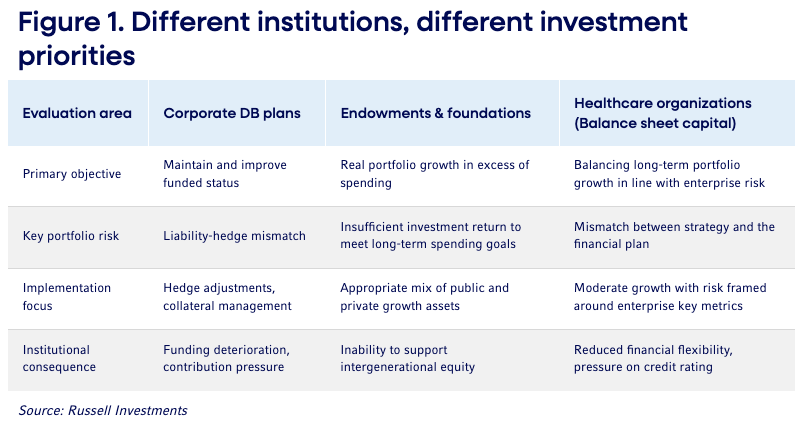
Consider a corporate defined benefit (DB) plan approaching full funding. Protecting funding gains may become more important than pursuing additional returns. If its liability hedge hasn't kept pace with changes in funded status, interest-rate movements could reverse some of that progress. Endowments face different considerations: slower private-market distributions and ongoing capital calls can constrain their ability to rebalance or meet spending requirements during a drawdown.
These are the kinds of issues your provider should be bringing to your attention and helping you think through. The value of that advice comes from understanding how investment decisions affect the organization and reviewing adjustments to strategy as its needs evolve.
2. Is your OCIO provider actively managing your investments and risks?
Managing investments requires a view across the entire portfolio. Market conditions, investment manager positioning and the interaction between holdings all have an impact on exposures at the total portfolio level. Your provider should be actively monitoring these exposures, identifying emerging risks and opportunities, and adjusting the portfolio within policy guidelines when warranted.
Consider an institution with five equity managers. Each may be managing its mandate appropriately, yet their combined holdings could leave the portfolio with a higher-than-intended concentration in a particular technology stock or sector. Having investment risk analytics that look through underlying holdings can help identify these potential overlapping positions, factor concentrations and unintended exposures across managers.
The value of this capability comes from what happens next. A provider should have the technology and investment expertise to investigate how adjustments may impact total portfolio risk and return, in addition to other implications, and conclude whether action is needed. This includes ongoing manager oversight and the ability to distinguish risks worth retaining from those that no longer align with the institution's objectives.
3. Do you know what you're really paying for?
The cost of an investment program goes well beyond the OCIO advisory fee. Underlying manager fees, custody, trading and implementation expenses all affect net returns. Two providers offering similar investment strategies may have very different total costs depending on how their portfolios are structured and managed.
It's also worth considering what you're getting for those costs. Does your provider offer access to investment managers, research and specialized capabilities that would be difficult or costly to maintain internally? Are they using their scale to negotiate competitive manager fees, coordinate trading and reduce unnecessary implementation expenses?
Ultimately, the value of an OCIO relationship comes down to the investment outcomes delivered relative to the total cost of the program. Your provider should be able to demonstrate that value through performance, risk management and the efficiency of implementation, with enough transparency to understand where your money is going.
4. Has outsourcing actually taken work off your plate?
One of the key benefits of an OCIO relationship is allowing your organization to focus more of its time and resources on its core purpose. Whether that's running a business, advancing a mission or delivering patient care, managing an investment portfolio shouldn't pull resources away from the work your organization exists to do.
Consider how much time your internal team still spends coordinating with managers, overseeing portfolio transitions, preparing reports or handling day-to-day investment operations. A well-structured OCIO relationship should take on much of that work while ensuring investment decisions remain aligned with your organization's objectives.
In my conversations with institutional investors, I often hear how valuable this support can be. It may mean preparing tailored, actionable reporting for investment committees and boards, coordinating with actuaries and auditors, or managing the subscription process involved with private-market investments. These responsibilities can consume considerable time internally, particularly when multiple parties need to be involved.
The question is whether your OCIO provider is genuinely creating capacity for your organization to deliver on its priorities and commitments to stakeholders, or whether your team is still carrying responsibilities you expected the relationship to address.
5. Is your OCIO provider flexible enough to meet your needs?
Not every institution needs the same degree of outsourcing. Some want a provider to manage the full investment program, while others have established internal teams and need support in specific areas.
A corporate DB plan, for example, may retain responsibility for strategic asset allocation while seeking external support for liability hedging or portfolio implementation. An endowment may maintain internal manager-selection capabilities for their public markets portfolio, but use specialist support for the private markets portfolio, liquidity management or private-market pacing. These arrangements can evolve. An institution may initially outsource a specific capability and later expand or narrow the mandate as its objectives, governance preferences and internal capabilities change.
The important question is whether the provider can support the institution's preferred operating model, with clear decision rights and accountability. Investors should be able to access the capabilities they need without assuming that full delegation is the only option.
Investor implications
An OCIO review doesn't have to end with a provider change. It may reveal opportunities to adjust investment guidelines, improve how portfolio changes are implemented or reconsider which responsibilities belong with internal teams and external partners.
For some institutions, the priority may be accessing new asset classes or better managing liquidity or liability risk. Others may find that execution costs or unclear decision rights are getting in the way of their investment objectives.
What's important is understanding where the gaps are, what implication they could have and whether the current relationship is equipped to address them. The right investment partner should help you make those decisions with a clear understanding of the trade-offs involved.
A message from Advisor Perspectives and VettaFi: Discover something new! Click here to register for our upcoming webcasts.
The information, analyses and opinions set forth herein are intended to serve as general information only and should not be relied upon by any individual or entity as advice or recommendations specific to that individual entity. Anyone using this material should consult with their own attorney, accountant, financial or tax adviser or consultants on whom they rely for investment advice specific to their own circumstances.
Products and services described on this website are intended for United States residents only. Nothing contained in this material is intended to constitute legal, tax, securities, or investment advice, nor an opinion regarding the appropriateness of any investment, nor a solicitation of any type. The general information contained on this website should not be acted upon without obtaining specific legal, tax, and investment advice from a licensed professional. Persons outside the United States may find more information about products and services available within their jurisdictions by going to Russell Investments' Worldwide site.
Russell Investments is committed to ensuring digital accessibility for people with disabilities. We are continually improving the user experience for everyone, and applying the relevant accessibility standards.
Russell Investments' ownership is composed of a majority stake held by funds managed by TA Associates Management, L.P., with a significant minority stake held by funds managed by Reverence Capital Partners, L.P. Certain of Russell Investments' employees and Hamilton Lane Advisors, LLC also hold minority, non-controlling, ownership stakes.
On July 2, 2026, Russell Investments Group, Ltd. (“Russell Investments”) entered into a definitive agreement and plan of merger (the “Transaction”) pursuant to which Russell Investments will be acquired by a consortium led by B Capital Group Management, L.P. that includes California Public Employees Retirement System. The Transaction is expected to close by the end of Q1 2027, subject to the receipt of regulatory approvals and other customary closing conditions.
Frank Russell Company is the owner of the Russell trademarks contained in this material and all trademark rights related to the Russell trademarks, which the members of the Russell Investments group of companies are permitted to use under license from Frank Russell Company. The members of the Russell Investments group of companies are not affiliated in any manner with Frank Russell Company or any entity operating under the "FTSE RUSSELL" brand.
© Russell Investments Group, LLC. 1995-2026. All rights reserved. This material is proprietary and may not be reproduced, transferred, or distributed in any form without prior written permission from Russell Investments. It is delivered on an "as is" basis without warranty.
© Russell Investments
More Volatility/Downside Protection Topics >