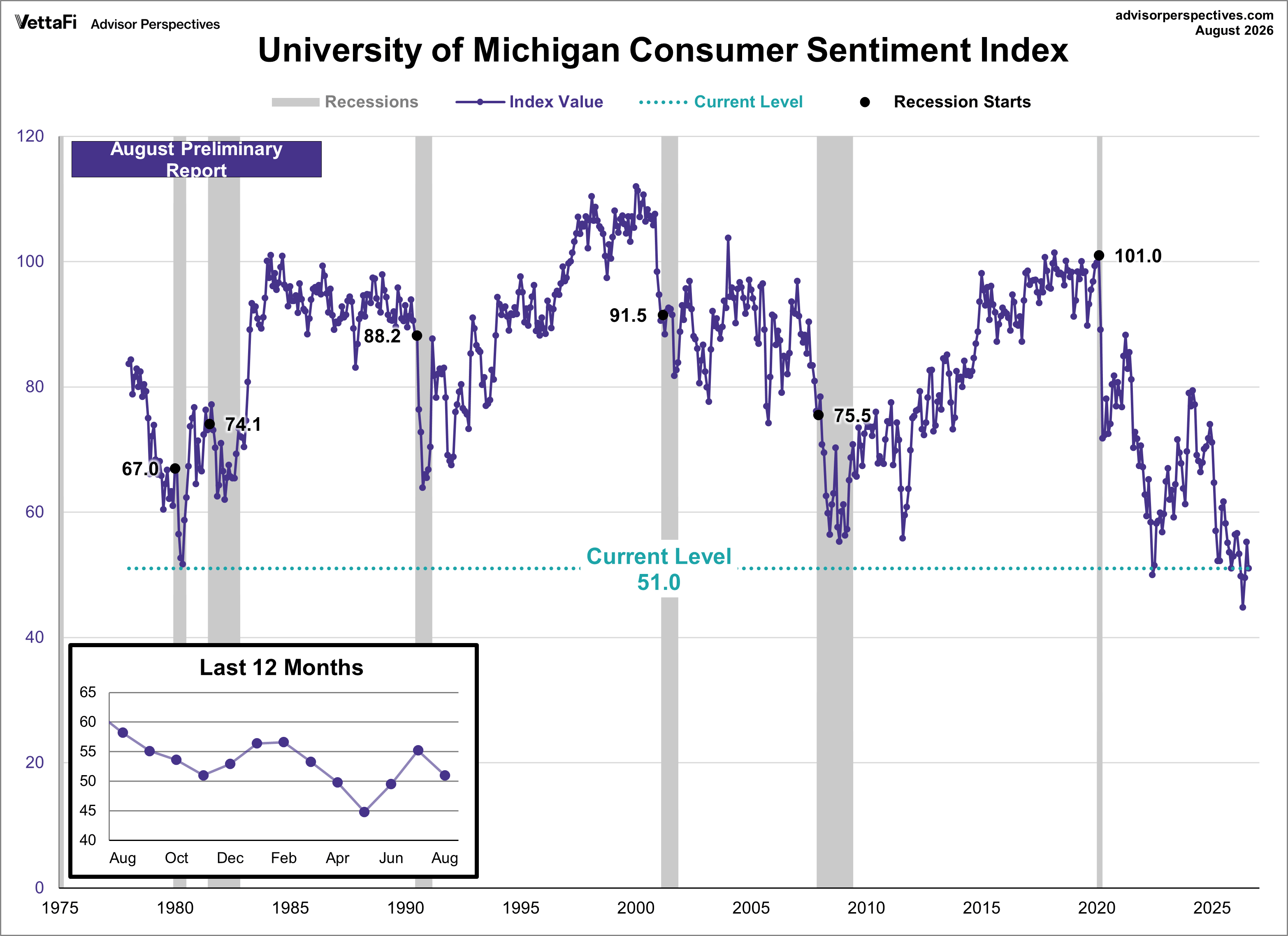
Consumer sentiment falls in August after two previous months of improvement. The preliminary August reading for the University of Michigan Consumer Sentiment Index came in at 51. This marks a 7.6% (4.2 points) decrease from July and below the forecast of 54.7. Consumer sentiment sits 12.4% below where it was a year ago and is currently below the 1st percentile in the series' history.
Key Takeaways
-
The University of Michigan Consumer Sentiment Index preliminary reading fell to 51 in August, a 7.6% decrease from July.
- The Current Economic Conditions Index fell 16.0% to 51.8, while the Consumer Expectations Index fell 9.5% to 50.6.
- Year-ahead inflation expectations increased from 4.3% from 4.2% in July.
Joanne Hsu, the director of surveys, made the following comments:
Consumer sentiment fell about 8% this August, ending two consecutive months of improvement. While views of personal finances saw only minor declines, expected business conditions sank 11% for the short run and 17% for the long run. Decreases in sentiment were seen across the political spectrum, with Republicans exhibiting the strongest month-to-month decline in August. Sentiment among Republicans is now 19% below readings just prior to the Iran conflict and the lowest since the 2024 election. Although the early-month weakening in sentiment was pervasive across various demographic groups, notably large reductions were seen among older consumers, lower-income consumers, and those without a college degree. These groups are all particularly vulnerable to any erosion of purchasing power stemming from inflation. Across all consumers, only 8% expect their income growth to exceed inflation in the year ahead, down from 18% in December 2024, a reflection of the belief that high prices will continue to be burdensome.
Background on the University of Michigan Consumer Sentiment Index
The Michigan Consumer Sentiment Index is a monthly survey of consumer confidence levels in the U.S. with regards to the economy, personal finances, business conditions, and buying conditions, conducted by the University of Michigan. There are two reports released each month; a preliminary report released mid-month and a final report released at the end of the month.
The chart below provides a long-term perspective on this widely watched indicator. We have highlighted the index's value at the start of each recession. The current level of 51 is below the index's value at the start of all six recessions since its inception.

To put today’s report in historical context, consumer sentiment is currently 39.1% below its average reading of 83.7 (arithmetic mean) and 38.1% below its geometric mean of 82.4, based on data dating back to 1978.
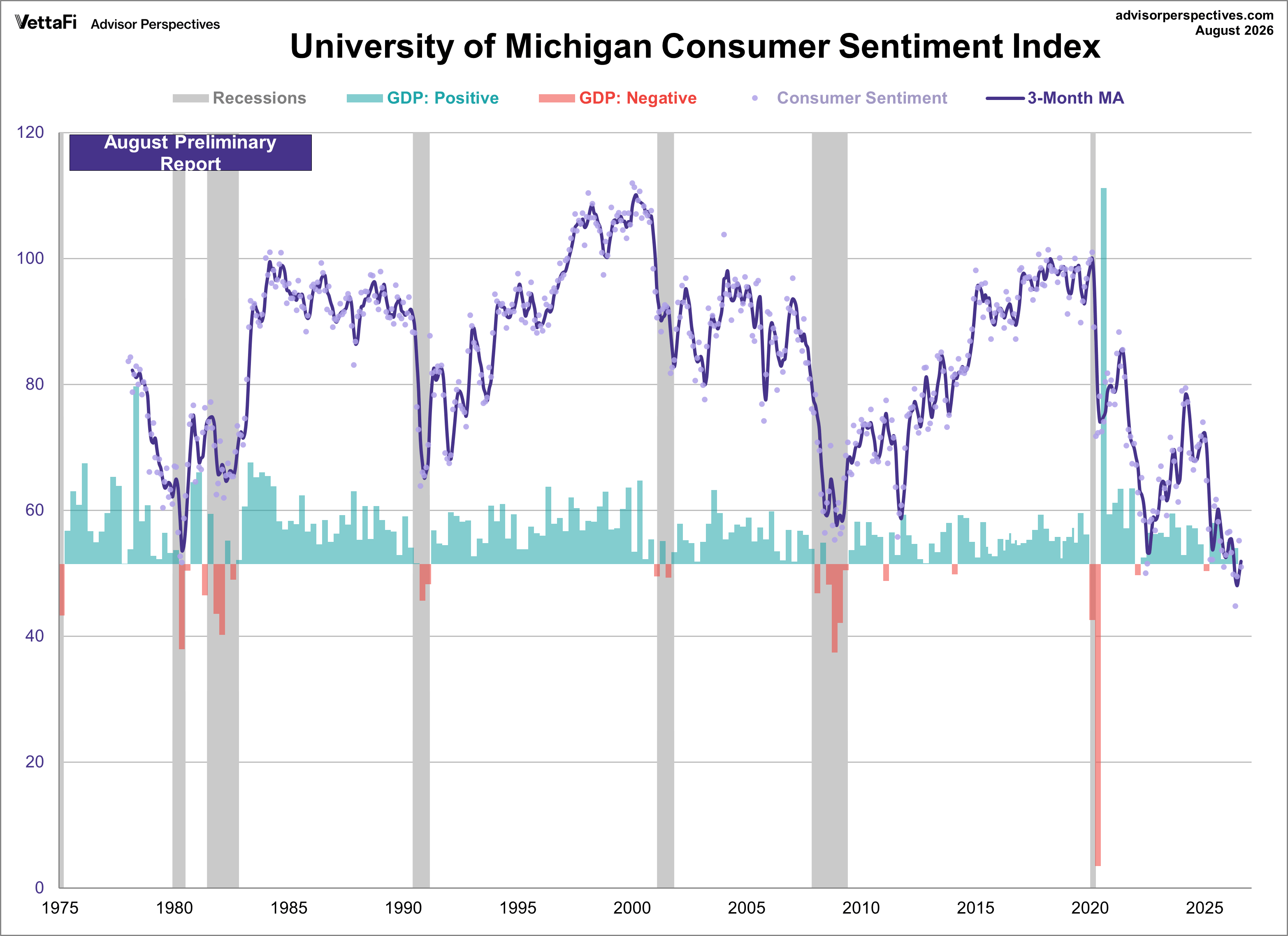
To visualize the volatility and its impact on the broader economy, the following chart includes a three-month moving average and real GDP. Historically, prolonged periods where the moving average remains at these depressed levels have closely correlated with negative GDP growth (the red bars below).
The Political and Presidential Lens of Consumer Sentiment
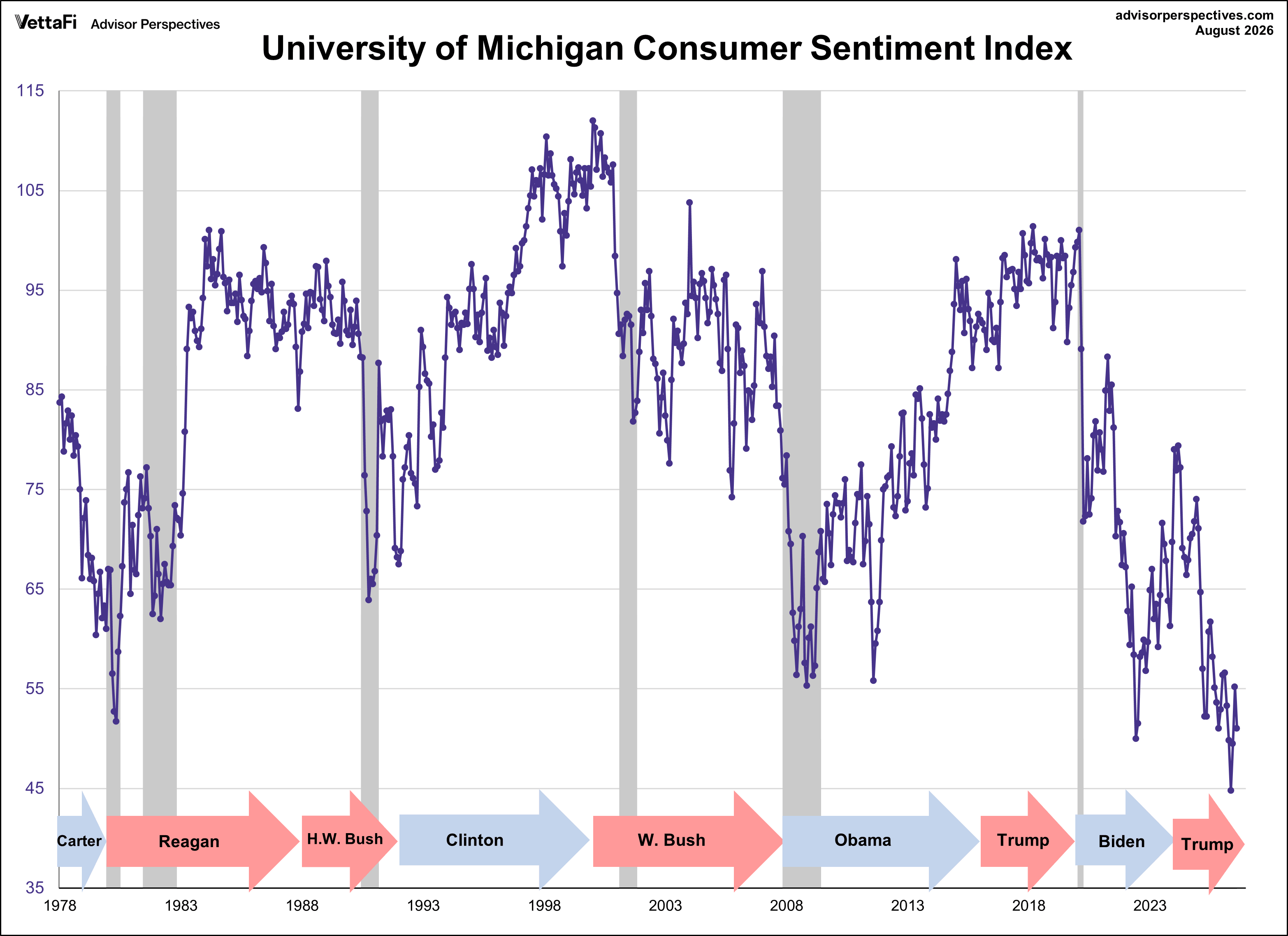
Each month, the survey results highlight sentiment within each political party. Sentiment is often viewed through a partisan lens, but the data shows that sentiment has fluctuated both positively and negatively under both Republican and Democratic administrations. As the chart below illustrates, the current "plunge" is a rare moment of bipartisan agreement, with declines seen across the political spectrum as energy costs hit every household.
University of Michigan Consumer Sentiment Index: Components
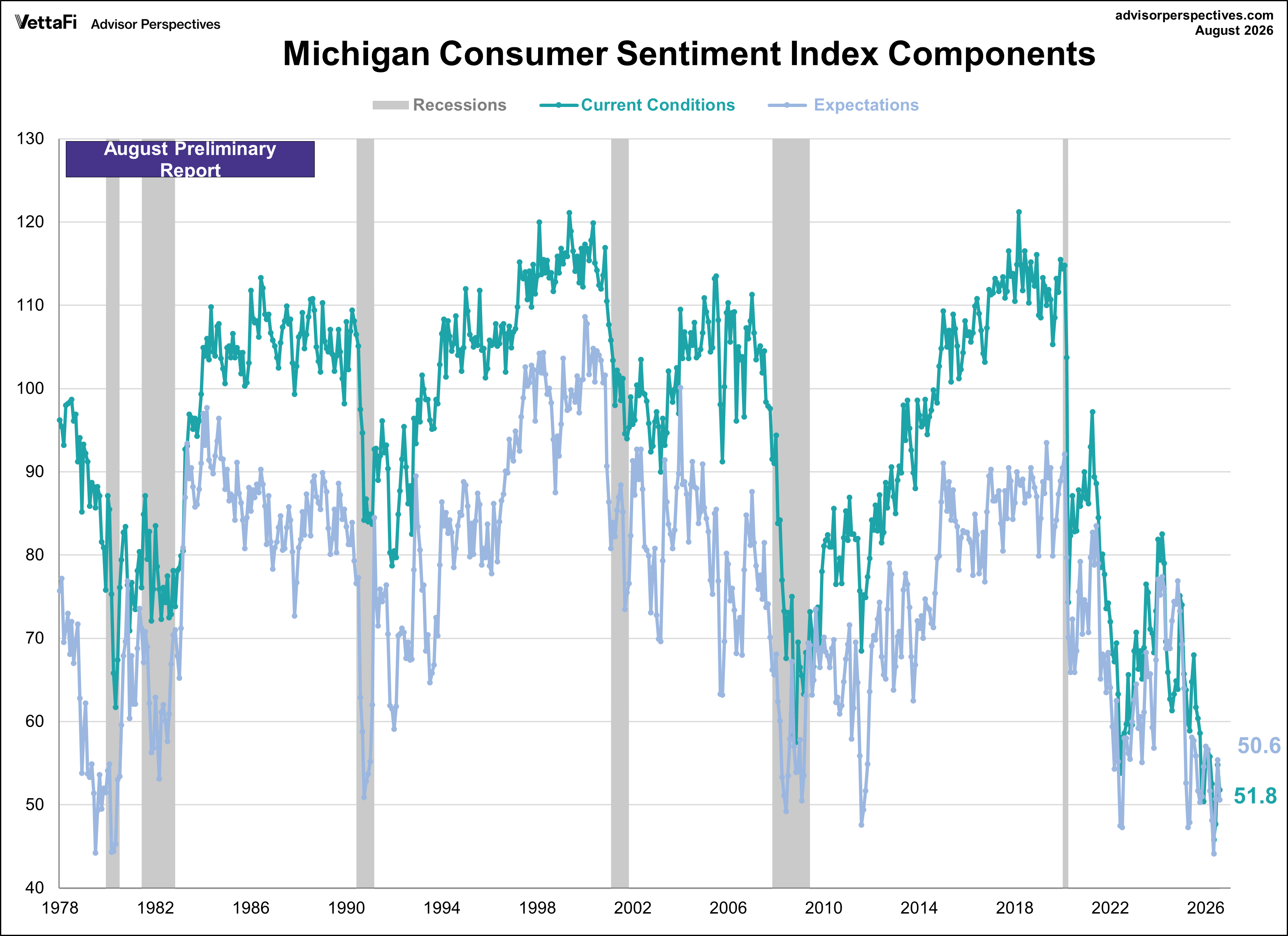
The Michigan Consumer Sentiment Index consists of two sub-indexes: the Current Economic Conditions Index (CECI) and the Consumer Expectations Index (CEI). The CECI reflects consumers' views of their current financial situation and the overall economy, while the CEI gauges their outlook for the future.
Current Economic Conditions Index (CECI)
The Current Economic Conditions Index fell to 51.8. This represents a 5.5% decrease from the previous month and a 16.0% drop from a year ago. The latest reading was lower than the forecast of 55.0.
Consumer Expectations Index (CEI)
The Consumer Expectations Index fell to 50.6. This represents a 8.7% decrease from the previous month and a 9.5% drop from one year ago. The latest reading was lower than the forecast of 55.2.
University of Michigan Consumer Sentiment Index: Inflation Expectations
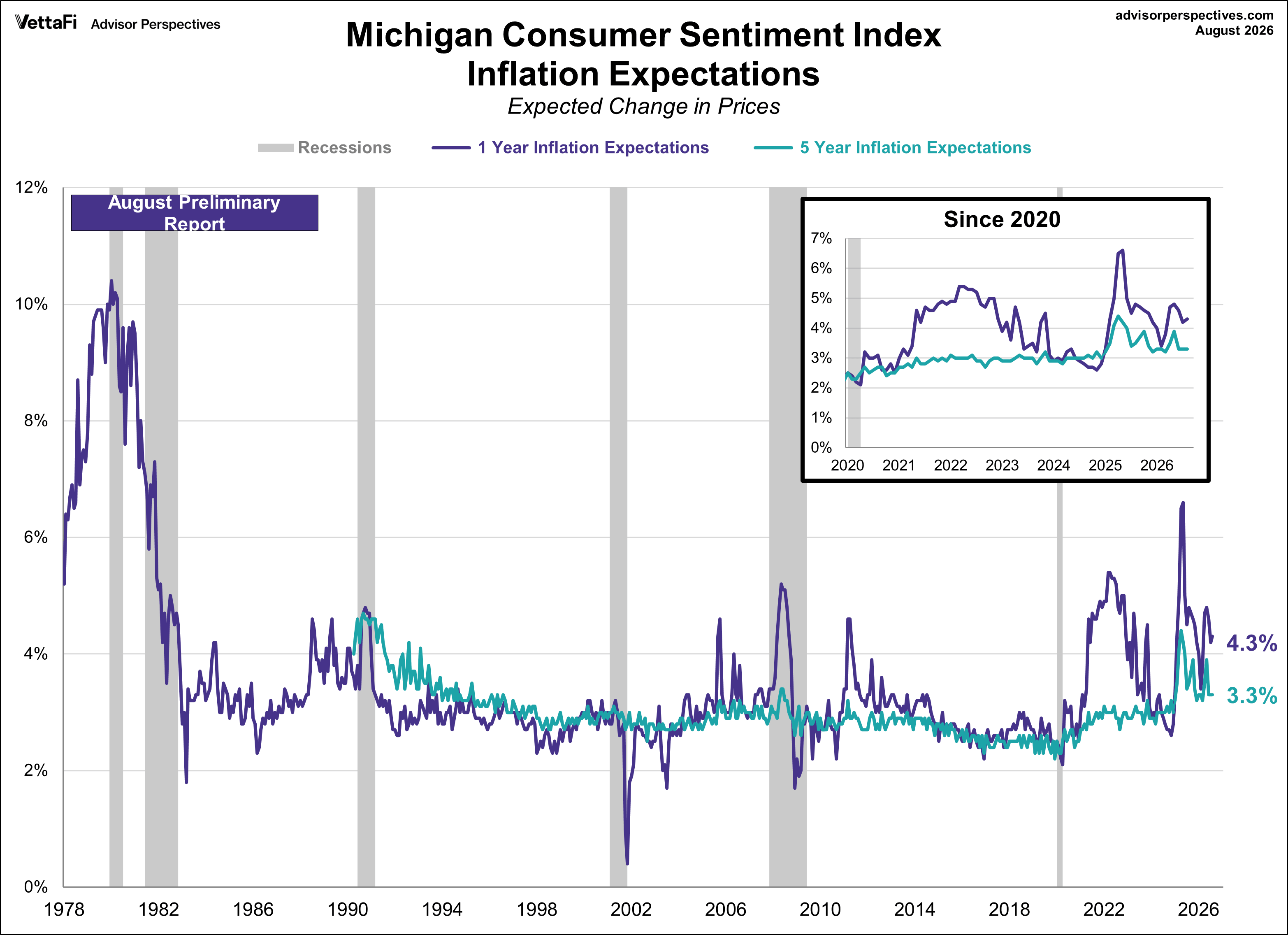
Year-ahead inflation expectations ticked up from 4.2% in July to 4.3% this month. The current reading substantially exceeds the 3.4% seen in February before the Iran conflict began, along with all 2024 readings. Long-run inflation expectations held steady at 3.3% for the third consecutive month, remaining a bit higher than its 2024 range of 2.8% to 3.2%.
The next update to this report will be published on August 30th.
Other Sentiment Indicators
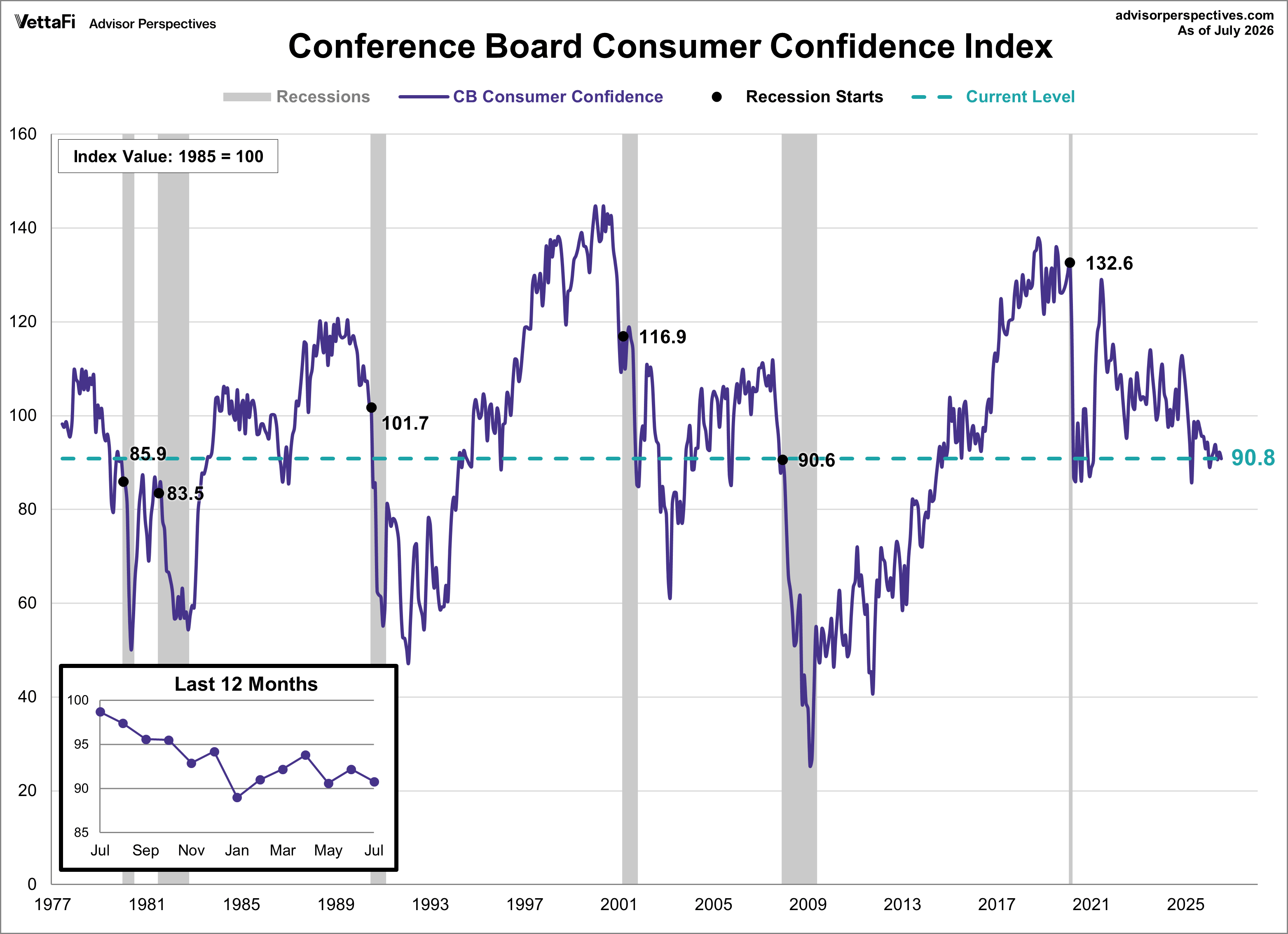
For an additional perspective on consumer attitudes, see the most recent Conference Board's Consumer Confidence Index. Both indexes gauge consumer attitudes toward the current and future strength of the economy. However, the Consumer Confidence Index is more influenced by employment and labor market conditions while the Michigan Sentiment Index is more focused on household finances and the impact of inflation.
The Conference Board index is the more volatile of the two, but the broad pattern and general trends have been remarkably similar to the Michigan index.
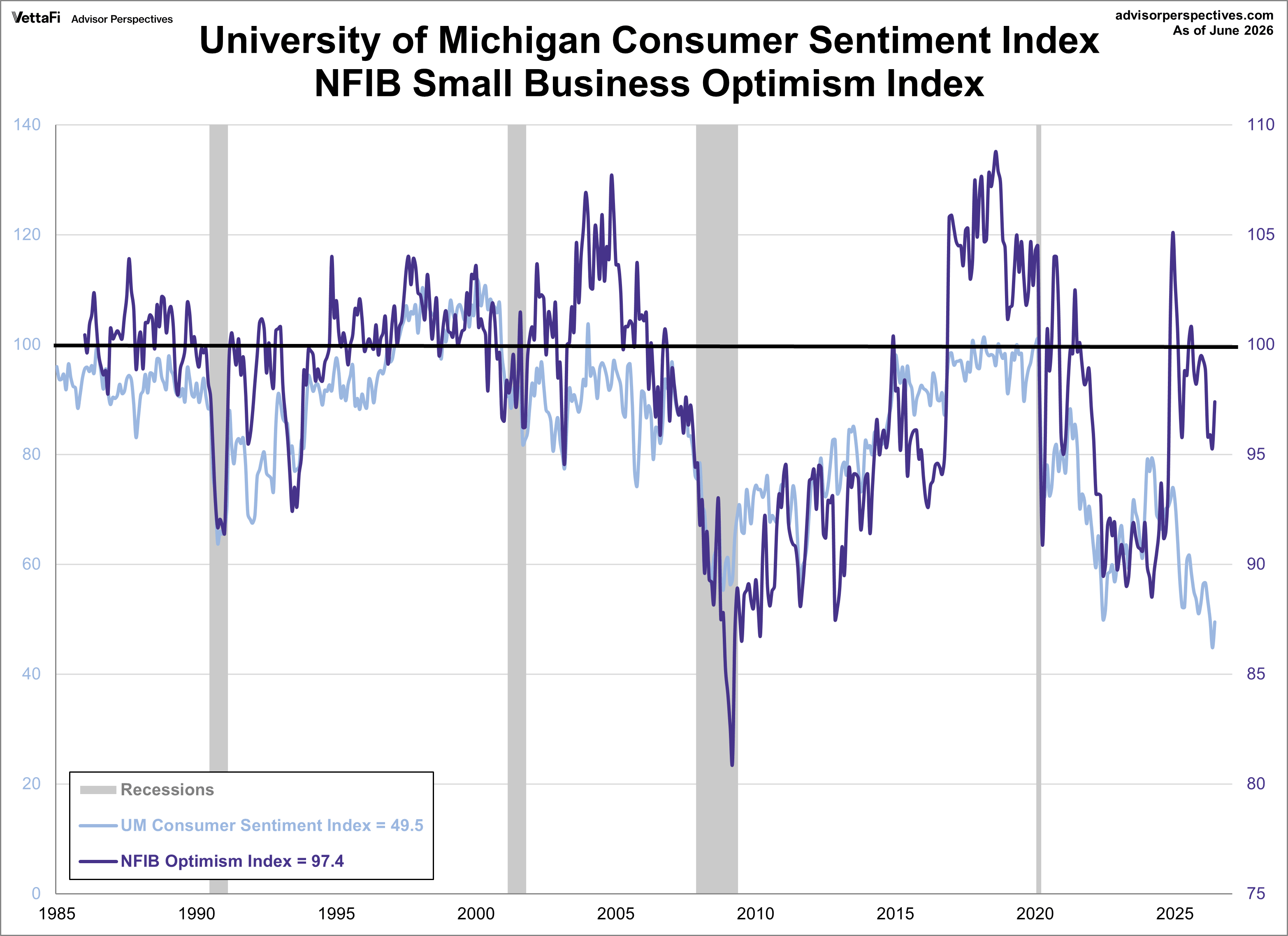
And finally, the prevailing mood of the Michigan survey is also similar to the mood of small business owners, as captured by the NFIB business optimism Index (monthly update here).
ETFs associated with sentiment include: Consumer Discretionary Select Sector SPDR Fund (XLY).
Read more updates by Jen Nash