This is part two of a three-part series of articles reviewing stand-alone income (SALB) guarantees. Part one of this series is available here.
Unlike traditional guaranteed lifetime withdrawal benefit riders on variable annuities (VA/GLWBs), the future payments from stand-alone income riders (SALBs) are tied to 10-year Treasury rates. That’s bad news for retirees, who may find their future benefits compromised if interest rates remain at historically low levels – regardless of how the stock market performs.
Part 2 in this series on income guarantee riders considers the point when a client locks in an income guarantee after a 10-year deferral period, picking up where Part 1 left off. (Part 1, linked above for those who missed it, focused on the deferral period.)
RetireOne’s SALB offers many attractive features relative to a VA/GLWB: it can be applied to stand-alone portfolios of mutual funds and ETFs, its costs can be reduced by choosing index funds, and the rider fee is charged on the remaining contract value rather than the typically larger benefit base.
Bob Veres, in his publication Inside Information (link, requires subscription), posed the fundamental question with respect to SALBs: What market scenarios does their guarantee hedge against, and how likely are those scenarios to occur?
To answer Veres’ question, we’ll explore more deeply the link between pre-retirement wealth accumulation – which is driven by equity-market performance – and interest rates at the retirement date, which will govern SALB payments post-retirement. As we’ll see, recent retirees can’t catch a break. Relative to historical outcomes, wealth accumulations from 10-year deferral periods ending currently are low, as are interest rates.
Ideally, wealth accumulations should relate inversely to interest rates. The most helpful income guarantee would provide downside protection, in the form of higher payout rates, against declines in the stock market – which for most investors will translate to disappointing accumulations of wealth.
Unfortunately the historical record does not show an inverse relationship between equity returns and interest rates. This means payout rates that are linked to current Treasury yields, as in the case of RetireOne’s SALB, are an unattractive feature for an income guarantee rider.
The key assumptions that drive performance
For anyone interested, part 1 of this series offered a complete run-down of the background and features for VA/GLWBs and SALBs, and I will not go into the same level of detail here. Very briefly, VA/GLWBs are designed to provide owners with downside protection, upside potential, and the opportunity to have remaining assets returned. These riders guarantee an income for life at a fixed withdrawal percentage of the initial assets. As long as the investor does not exceed the allowed withdrawal amounts, guaranteed withdrawals never decrease (in nominal terms, as opposed to inflation-adjusted or “real” terms) even if the account balance falls to zero. If the contract value of the underlying account increases enough in value (after accounting for any withdrawals and fees), a step-up feature will kick in to provide permanently higher withdrawal amounts.
Because these guarantees are not adjusted for inflation, however, the real value of future benefits will decline over time as cost of living increases.
In part 1, I explained my methodology for comparing the performance of different strategies, including the SALB rider, using historical simulations of 10-year deferral periods for retirement dates between 1936 and 2011. More specifically, I compared the account value for unguaranteed mutual fund strategies to the contract values and benefit bases for VA/GLWBs and RetireOne. This comparison showed how well, historically, these guarantees would have protected the benefit base.
In the previous article, we used as hypothetical investors a couple who makes an investment of $100 at age 55. We then calculated the portfolio wealth and benefit base, in real terms, 10 years later, when the couple is 65. Here, in part 2, my goal is to determine the guaranteed initial income that both the VA/GLWB and RetireOne can support for this couple – put another way, it’s the initial retirement payout that we’re focused on.
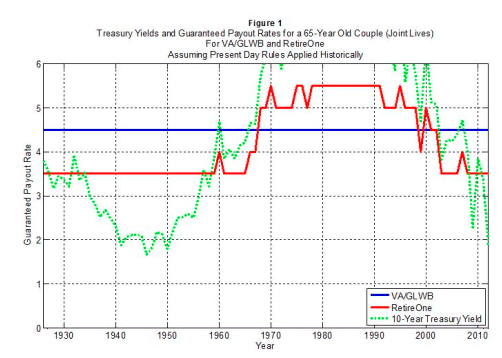
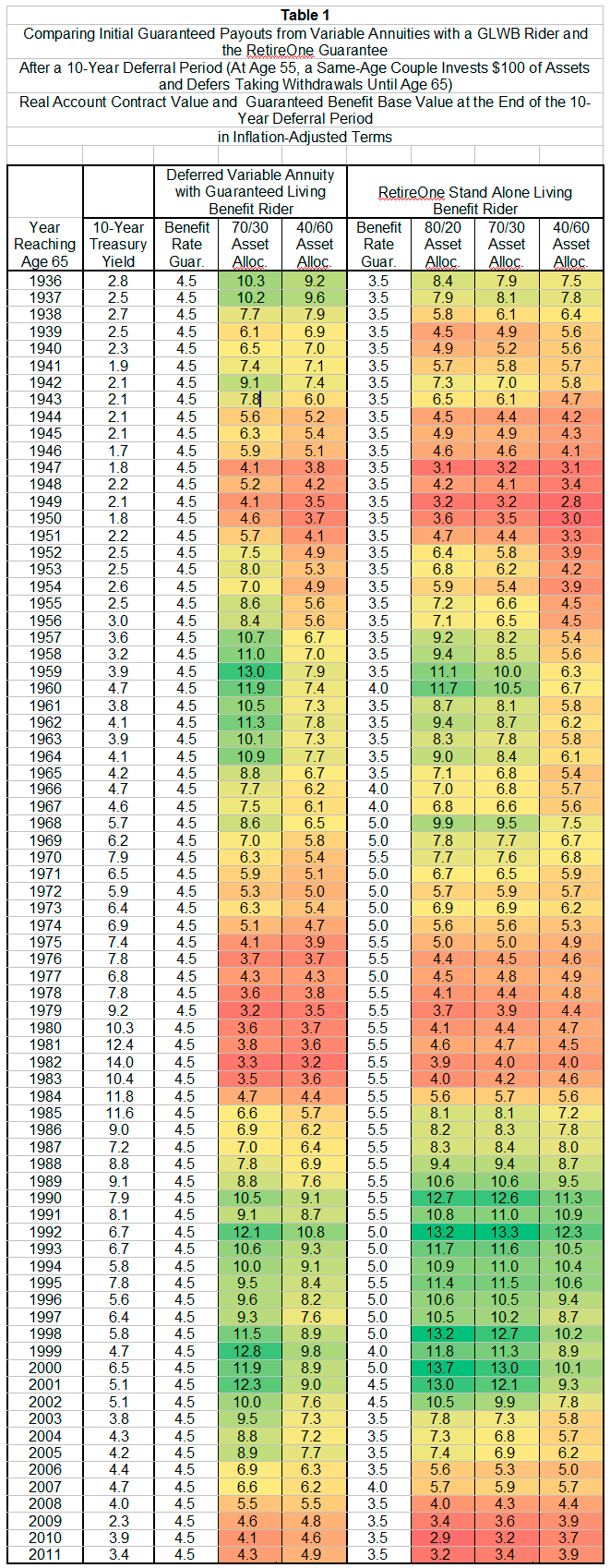
For the VA/GLWB, the payout does not vary – it’s always 4.5% for this couple. The RetireOne payout rate depends on the yield for a 10-year Treasury bond on the last business day before that first payout is taken, with a floor of 3.5% (when the Treasury yield is less than 4.5%) and a ceiling of 5.5% (when the Treasury yield is above 7%). Assuming that today’s payout rules would have applied historically, Figure 1, below, shows the payout rates supported by each guarantee over time.

With Treasury yields currently at historic lows, payout rates for RetireOne will have little chance to rise above 3.5% in the foreseeable future, unless there is a dramatic upswing in interest rates.
(The source for the treasury yields on which the SALB payouts are based is Global Financial Data. For full details of the initial payouts that different asset allocations support, see Table 1, an appendix at the end of this article.)
The relationship between wealth accumulations and interest rates
As I said, it would be helpful if those with lower wealth accumulation enjoyed higher payout rates, and vice versa. Since annuity payouts are tied integrally to interest rates, there would be a smoothing effect for guaranteed income if interest rates were high when wealth accumulations were low, and if interest rates were low when wealth accumulations were high.
This is a matter of more than just academic interest when it comes to comparing RetireOne to the VA/GLWB, given that RetireOne’s payout rate varies with interest rates and the VA/GLWB’s doesn’t. Whether that is an advantage or a disadvantage with regard to downside spending protections depends on how interest rates relate to wealth accumulations.
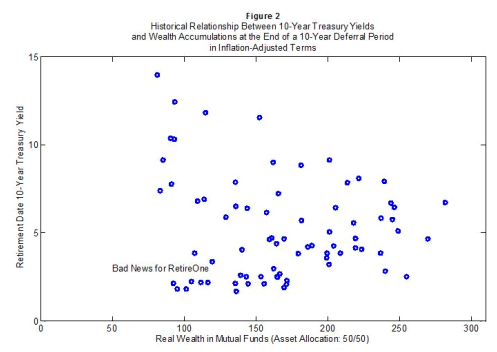
As it turns out, interest rates tend to correlate positively to wealth accumulations. Figure 2 plots the 10-year real wealth accumulation for a mutual fund portfolio with a 50/50 asset allocation against the 10-year Treasury yield at the end of those 10 years. A regression line fitted through the data would have a slightly negative slope, but that’s misleading – the relationship is likely only negative because the high inflation of the 1970s pushed bond yields higher at a time when real wealth accumulations stagnated.
Retirees, in any event, should be more concerned about inflation-adjusted (real) interest rates. Wealth accumulations, when plotted against different measures of real interest rates, reveal an underlying positive relationship between the variables that’s more pronounced than the slight negative relationship to nominal rates.
Since any wealth accumulations for RetireOne at a time when Treasury yields fell below 4.5% would produce a 3.5% payout rate, it’s worth examining Figure 2 to see when those lower-bound yields were most commonly in play. Unfortunately, as we can see, many of those outcomes cluster in the lower left hand region of the figure, where some of the lowest wealth accumulations can be found.
From a risk management perspective, having guaranteed payout rates tied to Treasury yields is a discouraging feature of the RetireOne guarantee, especially with interest rates currently at historic lows.
Comparing initial income with the VA/GLWB and RetireOne
Finally, let’s compare initial retirement income for a VA/GLWB to RetireOne, using a 70/30 asset allocation.
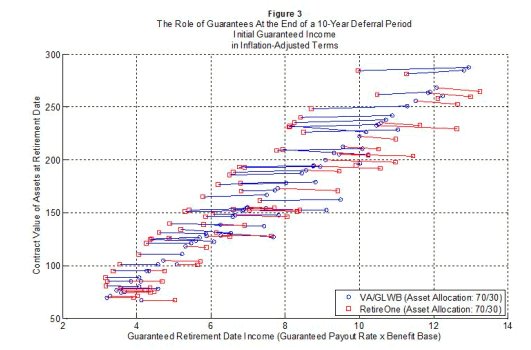
With the VA/GLWB in blue and RetireOne in red, Figure 3, below, plots the guaranteed income against the contract value of assets for both at each retirement date. (The retirement dates each fall at the conclusion of a 10-year deferral period, for rolling historical periods ending between 1936 and 2011.) As RetireOne payout rates vary between 3.5% and 5.5%, while the VA/GLWB payout rate is always 4.5%, it varies, depending on the retirement date, which product provides a higher initial income.
To think about what these guarantees are designed to insure against, consider, for example, that the typical investor expects his or her wealth to double in the last 10 years before their retirement. With a 4.5% payout rate, our hypothetical couple would expect a guaranteed income of $9 at age 65, based on their initial investment of $100 at age 55. Even if they only planned for their wealth to maintain its age-55 value, they would still expect $4.50 in guaranteed income.
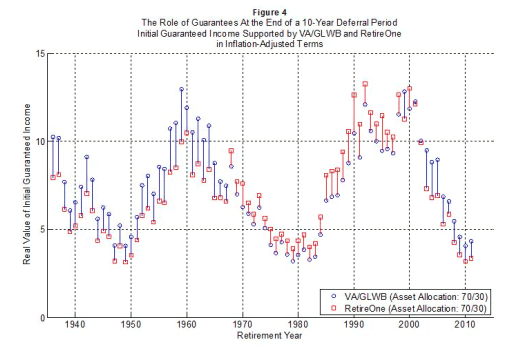
But, in inflation-adjusted terms, the guarantee rider does not always maintain even that minimal guarantee. Figure 4 shows that in 13 of the 76 rolling historical periods (17% of the time), the guaranteed income provided by the VA/GLWB with a 70/30 asset allocation did not maintain a real value of at least $4.50 in age 55 dollars. With its varying payout rates, this minimum real value was supported even less frequently by the RetireOne rider using the same asset allocation – it fell short in 16 of the 76 rolling periods (21%).
In short, neither of these guarantees provides the protection, in real terms, that both advisors and their clients expect.
Figure 4 presents the same data on initial income guarantees after 10 years of deferral, provided as a time series graph. Recall that in Figure 1, RetireOne provided a higher payout rate than the VA/GLWB between the late 1960s and early 2000s, while the VA/GLWB payout rate was higher before and after those dates – we see essentially the same distribution in Figure 4.
As it will likely be more conservative clients who consider these guarantees, we should focus on what happens in the bad-luck cases where guaranteed income is the lowest. Outcomes tended to be most severe in the late 1940s, the years before and after 1980, and in the past few years. During the higher inflation and high interest rates of the 1970s, RetireOne supported a greater income. But the period of the late 1940s most closely resembles the situation for today’s retirees. Wealth accumulations and interest rates were both low, giving the VA/GLWB had an edge in providing income, which it has also enjoyed in recent years.
The bottom line
We’ve now looked at the initial guaranteed income provided by these two riders after a 10-year deferral period. Though these guaranteed incomes may be lower than clients expect, that does not necessarily mean that the riders are a bad idea. In Part 3, I will examine the withdrawal phase in more detail to answer the key question investors face: How do these riders perform in comparison to drawdowns from an unguaranteed portfolio of mutual funds?
This analysis, however, shows that clients reaching retirement after a period of lower market returns will face an unpleasant second shock: Interest rates and annuity payouts will tend to be relatively low as well. When selecting a guarantee rider with payout rates based on underlying interest rates, such as RetireOne, use caution – especially when interest rates are as low as they are today.
Wade Pfau, Ph.D., CFA, is an associate professor of economics at the National Graduate Institute for Policy Studies (GRIPS) in Tokyo, Japan. He maintains a blog about retirement planning research at wpfau.blogspot.com
Notes: Data for stocks, bonds, and inflation is from Stocks, Bonds, Bills, and Inflation provided by Morningstar and Ibbotson Associates, in which the U.S. S&P 500 index represents the stock market and intermediate-term U.S. government bonds represent the bond market. Annual data is used, with annual rebalancing to the fixed asset allocation. Starting wealth at age 55 is $100. Amounts are expressed in real terms with a base year for when the couple turned age 55. Amounts are shown at the couple's 65 birthday (both members are assumed to be born on January 1st). The couple invests $100 on their 55th birthday and defers taking their first retirement withdrawal until their 65th birthday. Mutual funds have an annual expense ratio of 0.2% of remaining assets. The VA/GLWB is modeled after Vanguard's offering, with specifications including a joint withdrawal payout rate of 4.5% for the 65-year old couple, variable annuity fees of 0.59% of remaining assets, a guarantee rider of 0.95% of the benefit base, and an annual step-up feature. For the RetireOne product, the underlying mutual funds are assumed to have an annual fee of 0.2% of remaining assets. The rider amount is also calculated as a percentage of remaining assets and is 1% for the 40/60 allocation, 1.35% for the 70/30 allocation, and 1.75% for the 80/20 allocation. It also has an annual step-up feature. Note that during the deferral period, both the VA/GLWB and RetireOne offer quarterly step-ups, which could result in a higher benefit base than shown here in some instances. The RetireOne payout rate is connected to the yield for a 10-year Treasury Bond from the last business day before January 1 (data is from Global Financial Data), with a floor of 3.5% and a ceiling of 5.5% whenever the Treasury yield is outside of those bounds.
Read more articles by Wade Pfau