Investors increasingly want to align their financial goals with a commitment to improving the lives of others. Two recent projects showcase how municipal bond investors are making an impact.
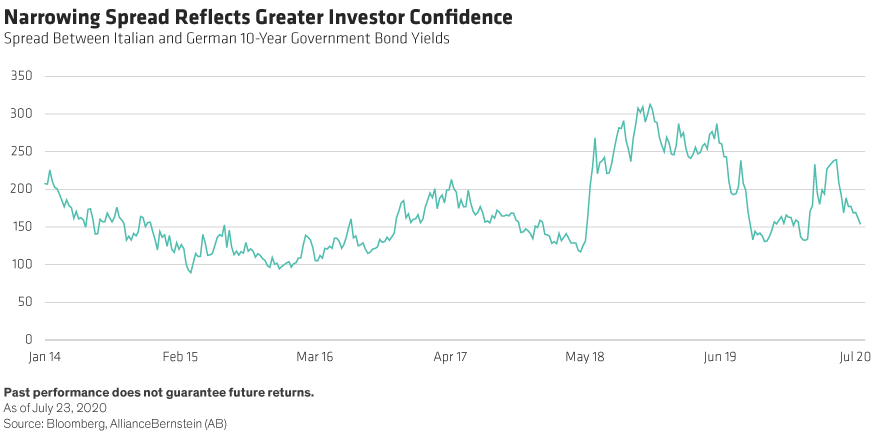
After four days of intense negotiations, EU leaders have reached agreement on a €750 billion recovery fund to help repair the economic damage from COVID-19. It took several concessions to EU creditor countries to break the deadlock. As expected, total grants in the deal have been reduced to €390 billion from an original €500 billion proposal.
Higher-income assets underperformed in the second-quarter rebound. But that also means there’s pent-up potential in income-generating assets that may begin to show in later stages of the recovery.
In emerging markets, some industries and countries are in better shape than others. And many businesses have the right qualities to benefit from structural changes now and long after local conditions improve.
In addition to its tragic human toll, COVID-19 triggered the sharpest recession in recent history, and efforts to control its spread have transformed the way we work, the way we shop and how we connect with others. We think these changes will last awhile—with implications for asset allocation.
The Fed’s recent stress tests raised concern about solvency risks to US banks. But as second-quarter earnings season begins, investors may find that some banks are much more resilient than expected.
Virtual meetings are inherently different from face-to-face encounters, largely because they eliminate many of the social obligations that deeply influence interpersonal behaviors. Experience with conducting virtual meetings in a variety of contexts has revealed that they are typically harder to manage than live meetings.
Low yields plus rising defaults seemingly leave little ground for bond investors seeking safety or income—or both. But for investors who remain flexible, those objectives aren’t as distant as many think.
Reaching a mutually beneficial Brexit deal has so far been beyond the reach of UK and European Union (EU) negotiators. Now that COVID-19 has struck, can they avoid a damaging split?
Global equities rebounded sharply in the second quarter. But new risks are looming as companies and countries count the costs of the pandemic.
Even with today’s low yields, credit barbell strategies can still meet their objectives of downside protection, upside participation and efficient income.
The five largest US growth stocks now comprise more than a third of the Russell 1000 Growth Index. Investors should be alert to the risks of high benchmark concentration.
One simple statistic can help high-yield investors gauge how their bonds may perform down the road.
Economic fallout from the coronavirus crisis was especially hard on real estate, mostly from misperceptions that the asset class is dominated by hotels, malls and office parks. But a look inside shows a diverse group of sectors that are more pandemic resilient than investors may think.
Companies are coping with diverse challenges through the coronavirus crisis. Investors who integrate environmental, social and governance (ESG) factors into their research can gain important insights on how businesses are adapting—and how future return potential might be affected.
Many investors are looking for emerging signs of a return to normalcy from the coronavirus crisis. While there are many indicators to choose from, we’ve assembled a group of signals, with the help of big data, that may point the way.
Value stocks have underperformed in the coronavirus crisis. Yet some higher-quality companies are now trading at valuations that underestimate their ability to withstand shorter-term stress—and their longer-term recovery potential.
The COVID-19 crisis poses a big challenge for employers to rationalize the benefits they offer to employees. With budgets stretched and every dollar scrutinized, tough choices loom on DC plan offerings, in addition to programs like financial wellness.
The new normal—working from home and curtailed travel—is painful for extroverts. Conducting virtual meetings using videoconferencing makes people seem less real, and extroverts crave the physical presence of others. While you may prefer to be face-to-face with your clients, this blog may convince you of the benefits of virtual meetings.
Municipal bonds—especially higher-quality issues—bounced back after a rough March. But not all munis have rallied. We see potential among overlooked mid-grade issues.
Target-date portfolios that use carefully chosen defensive equities are best equipped to protect from coronavirus market turmoil and volatility in general.
COVID-19 is triggering a new era of central banking. We believe this will play out just as powerfully in the euro area as elsewhere.
The COVID-19 pandemic has significantly impacted an advisor’s ability to prospect for new business. But with turbulent markets, clients may be willing to consider a new financial relationship. Recognize this opportunity and offer an immediate, problem-solving approach: the Financial Uncertainty Preparedness Checklist.
The Fed gave its updated economic outlook this week, but not the additional policy support markets were looking for. We think this was a misstep...but one we hope will be corrected if the outlook doesn’t improve.
Municipal bond defaults have been rare, making them a remarkably resilient investment over the years. The reasons range from the very services muni issuers provide to the fundamental characteristics of municipalities.
As the coronavirus crisis reinforces technology’s fundamental role in our lives, investors can find sources of risk reduction and growth potential in companies that have become digital utilities enabling global networks.
The term “new normal” now widely applies to everyone’s lives. One facet is attending virtual meetings. It’s our view that web-based conversations are here to stay because they are better than live interactions. Here is a list of 10 reasons why your clients prefer virtual meetings.
European banks’ additional Tier 1 securities should survive a short bout of the coronavirus. But even in a prolonged pandemic, the risk/reward trade-off might be better than perceived.
Emerging markets (EM) are at a crossroads. The impact of COVID-19 aggravates pre-existing challenges. But it also enables those EM economies that respond effectively to create better conditions for the future.
Chinese stocks have been resilient this year because of relatively modest earnings downgrades amid an early recovery from the virus-induced shock.
Today’s bond yields are extremely low, and some multi-asset investors may be struggling to rationalize exposure to interest-rate driven assets such as government bonds. But past experience suggests that they can still be effective diversifiers over the near term, even at low yield levels.
As the COVID-19 crisis and the challenge of the economic recovery process continue, it’s critical to understand how to care about our clients without caring too much. Don’t risk your own well-being and become unable to help those who need you.
Tensions between the US and China are flaring up again. With pressure mounting on Chinese stocks listed in the US, including those widely held in emerging-market portfolios, investors need to consider how to prepare for the mounting risks.
COVID-19 has supplied the catalyst for a secular change in the role of central banks. Providing governments with ammunition to fight the virus is now the overriding goal, and this means keeping bond yields pinned close to zero for the foreseeable future.
As fixed-income markets have started to recover following the massive selloff and liquidity crunch in March, credit risk-transfer securities (CRTs)―agency mortgage securities not guaranteed by Fannie Mae and Freddie Mac―have been slower to do so. Investors are wondering: Where do CRTs go from here?
Small-cap stocks were hit harder than large-caps in the coronavirus sell-off. But given the extreme market dislocations, select smaller companies with innovative advantages could offer investors a surprising source of diversification for the uncertain times ahead.
Economic fallout from the pandemic is devastating US retail. But companies that were already adapting well to seismic changes in the industry should prosper over time.
The Fed continues to dismiss the idea of negative US rates but the market keeps pricing them in. We don’t expect negative rates: in our view, the market is using them as a proxy for Fed measures that may be needed but aren’t yet identified.
Many human decisions are driven by impulses known as heuristics, such as the simple-and-familiar bias. When mental energy is depleted, as during a crisis, advisors may employ this bias to select investment solutions that are easy to explain (simple) and that they’ve used before (familiar).
China is further along the coronavirus curve than much of the rest of the world. What does its path to normal look like, and what are the big unknowns?
Asian businesses are gradually rebooting after governments quelled the initial wave of the pandemic. Conditions may be improving for regional value stocks that were beaten down before and during the pandemic.
As an advisor, you have protective instincts, so COVID-19 is likely to activate your emotions and push your thinking toward extremes. Your brain is probably searching the world for dangers and building a decidedly negative worldview. Psychologists call this catastrophizing: seeing the future in a negative light. This reduces your ability to sort available information.
The turmoil in the first quarter of 2020 reinforced the importance of rebalancing in target-date design. As we see it, a finely tuned, systematic approach can help keep emotions in check and risk under control—benefits that translate to many types of multi-asset solutions.
Healthcare stocks usually are defensive for a portfolio during market downturns. Given the extent of the pandemic’s impact, more questions are being asked about the sector’s resilience.
The onslaught of the coronavirus forced the Federal Reserve and lawmakers to take desperately needed measures. The US economy will eventually recover, but the effects of these drastic policy decisions will be felt for a long time.
As an unprecedented number of US companies suspend earnings guidance, equity investors should rethink the overly precise game of predicting short-term estimates.
Coronavirus-led economic uncertainty is forcing downgrades, defaults and fallen angels. Could this spell opportunity for credit investors?