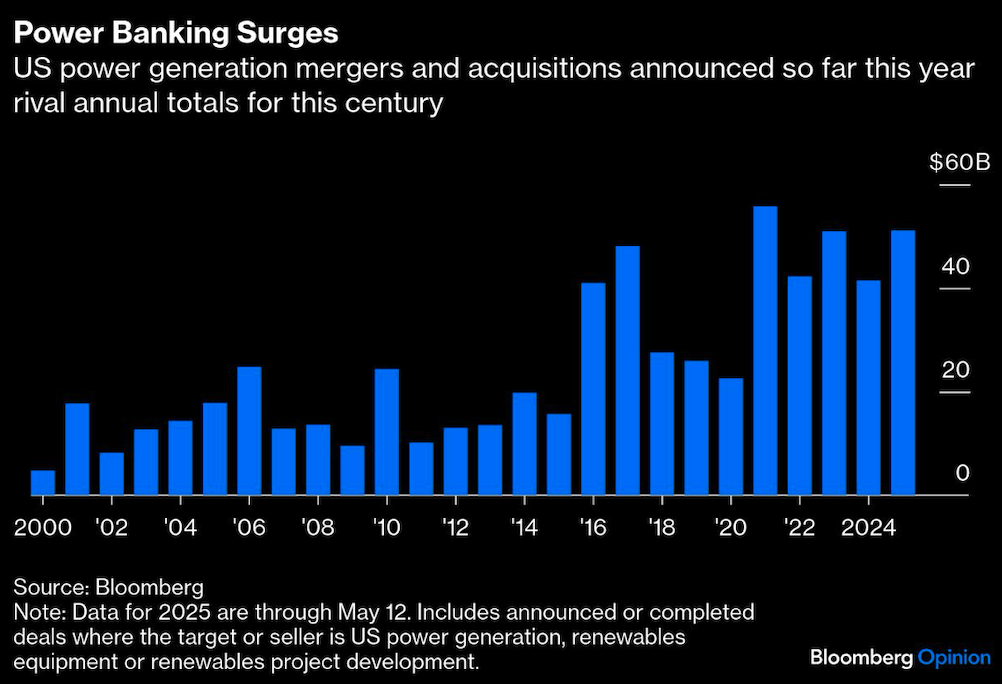
The artificial intelligence arms race has prompted a contest for America’s power plants. NRG Energy Inc.’s acquisition of a gas-fired fleet comes a few months after Constellation Energy Corp.’s even bigger deal for Calpine Corp. US power generation deals announced through mid-May add up to $51 billion, more than in any entire year this century save one.
NRG’s offers a $12 billion proof point that Big Tech’s datacenter boom, among other things, demands vast quantities of power. It also underscores a related point: History shows the US will struggle to build the plants required to generate that power.

It is not often that a company announces an acquisition worth roughly a third of its own enterprise value and investors cheer it on. That NRG’s stock popped by 26% on Monday partly reflects the company drawing a line under previous management’s missteps. An ill-received and ill-timed pivot toward retail power and services had left NRG short of generation just as demand for electricity takes off again after years of flatlining.1 The assets acquired from LS Power LLC correct this and also rebalances NRG’s Texas-centric business toward a bigger presence in the datacenter heartland, the PJM grid covering a swath of the Midwest and Mid-Atlantic states. Moreover, as Constellation did with Calpine, NRG is paying partly with a slug of its own stock, with LS Power’s pending 11% stake signaling a vote of confidence.
NRG estimates it is paying about half of what it would cost to build new power plants. The latter is a somewhat nebulous number but has definitely moved higher. John Ketchum, Chief Executive Officer of NextEra Energy Inc., a large utility operator, estimated recently that the cost of new gas-fired capacity has gone from less than $800 per kilowatt of capacity to $2,400 in the space of just a few years.
This reflects the collision of two industries operating on very different schedules. Big Tech sees itself as being in a race for dominance in AI — especially versus Chinese competitors — that demands massive investment in computing power even before the business models this will support have been fully figured out. But it relies for the energy needed on a power generation industry that hasn’t seen growth in demand for more than a decade and takes years to construct new plants and hook them up to America’s infamously bottlenecked power grid. This is why we have seen the likes of Microsoft Corp. and Meta Platforms Inc. paying up to get old nuclear plants revived or brand new gas-fired plants built as quickly as possible.
As regional power grids issue ever expanding estimates of how much load is coming onto the system, it raises the question of whether the sector can respond to the challenge. Looking at historical performance, the short answer is no.
That’s according to a recent analysis by Hugh Wynne and Eric Selmon at Sector and Sovereign Research LLC. By their calculation, projections imply US peak demand rising by 139 gigawatts through 2030 (power generation is sized to meet peak, rather than average, demand so that the lights don’t go out). While batteries can help meet peaks in demand, it is more likely that dispatchable capacity would be built, meaning gas-fired plants essentially. Factoring out existing planned additions to generating capacity over the next two years, this would mean needing 38.5 gigawatts of new dispatchable capacity every year from 2027 to 2030. That is about four times the average pace of the past decade.2
One way to read this is that those projections for higher electricity demand, predicated on an AI boom, simply won’t happen because the electricity needed won’t be there. The real constraints of the physical world will assert themselves over the dreams of the virtual one. This will surely form part of what happens over the next five years. But another implication is that datacenters will have to get smarter about how they consume energy, managing it to relieve stress on the grid— which seems reasonable given that we are talking about the supposed dawn of superintelligence, after all.
Besides traditional efficiency gains in new generations of chips and cooling systems, this can extend to the management of demand itself. A study of flexible demand by large power consumers, including datacenters, published in March by researchers at Duke University’s Nicholas Institute for Energy, Environment and Sustainability has garnered a lot of attention in the industry. It found that if such users could cut their consumption by about the equivalent of one day’s usage a year, that would effectively free up space for another 76 gigawatts of load, going a long way to meeting those high demand projections.
As it happens, NRG didn’t just acquire 12.9 gigawatts of generating capacity from LS. It also took on CPower, a virtual power plant platform with six gigawatts of capacity spread across 2,000 commercial and industrial clients. VPPs aggregate smaller, distributed generation and battery assets at multiple sites to operate as larger entities. They also integrate sophisticated demand management, to shift it up and down based on price signals. These can offer balancing services to the grid in return for payment. They epitomize the intersection of electric power with computing power. Taken as a whole, NRG’s deal both captures the enormous challenge of building enough power generation and looks ahead to what might be done differently to keep pace with demand.
1. NRG's pivot back toward generation follows a shake-up by Elliott Investment Management LP, the second by the activist at this company in the past decade. In a nice example of history rhyming, Monday's rally in NRG's stock was the best since July 12, 2017, which is when it announced the first strategic pivot at the behest of Elliott's earlier campaign.
2. "Updated load forecasts push demand growth beyond feasible capacity additions;" Hugh Wynne and Eric Selmon; Sector and Sovereign Research; April 28, 2025.
A message from Advisor Perspectives and VettaFi: To learn more about this and other topics, check out some of our webcasts.
Bloomberg News provided this article. For more articles like this please visit
bloomberg.com.
Read more articles by Liam Denning