The selloff in Japan’s long-dated bonds is drawing international investors, who expect the securities to rebound as global trade turmoil abates.
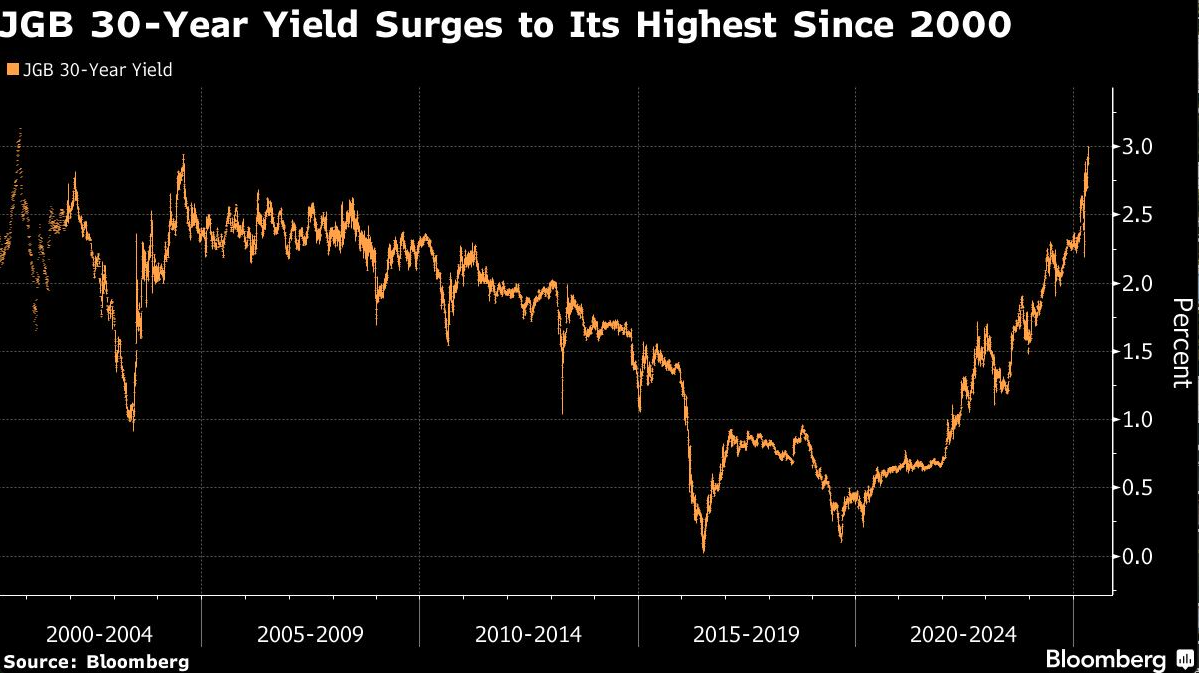
Japanese 30-year government borrowing costs approached 3% this week for the first time in almost 25 years, and there are fears of further rises as tariff-linked uncertainty sends investors toward shorter-dated bonds. Yet, some funds, including Vanguard and RBC BlueBay Asset Management, see the moves as a green light to buy more of the super-long securities.
They point to the likelihood of a tariff detente with the US, allowing the Bank of Japan to resume its interest-rate hikes. That should spark flight out of shorter-dated Japanese government bonds (JGB), bringing relief to longer maturities, they say.
“It’s hard to see how 3% makes sense here,” said Ales Koutny, head of international rates at Vanguard, which has $1.8 trillion in actively managed funds. “We still plan to keep adding JGBs in the long end if the 30-year yield comes back towards 3%”

That view appears to be shared by others in the market. A sale of 30—year debt on Tuesday drew solid demand as the higher yields attracted buyers. Yields fell after the auction, then bounced back Thursday to 2.98%.
That’s about 75 basis points above the lows hit in early-April, and more than the 65 basis-point move seen in 30-year Treasuries. One reason is reduced buying from big Japanese insurers and pension funds that typically dominate the long-bond market, as well as the central bank’s continued tapering of bond-buying across the yield curve. There are also concerns the Trump administration will pressure Japan to up defense spending, lifting longer-dated yields.
While money markets have pared bets on rate hikes for this year, Koutny reckons easing trade tensions add to the case for tighter policy. He expects the BOJ to move over the summer, even as swaps price less than a 15% chance of a quarter-point increase by July.
“We think the curve will flatten,” he said. “Two-year to 10-year maturities will sell off and the long end has found its new clearing level of 2.5% to 3%.”
To exercise that curve-flattening bet, he’s been buying more 30-year debt in recent weeks, while holding an underweight position on 7-year to 10-year securities.
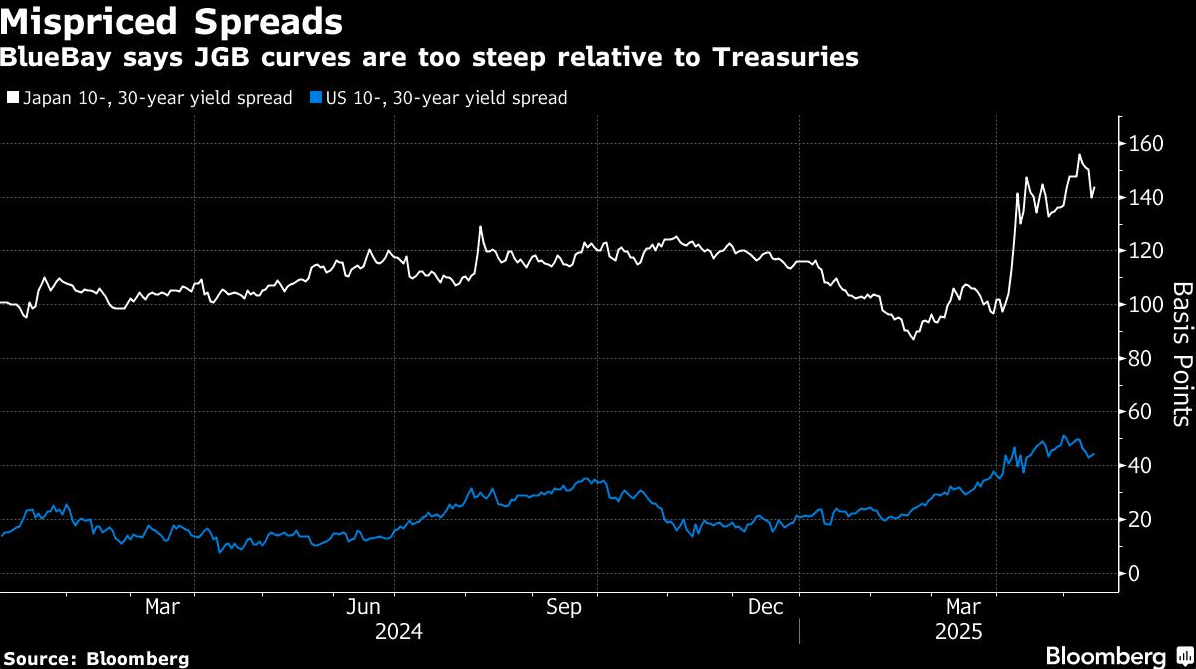
Meanwhile, Mark Dowding, chief investment officer at BlueBay, has also added to his long position in 30-year Japanese debt. He scooped up more of the securities late last week, highlighting what he says is a mismatch in the spread between the 10-year and 30-year Japanese yields, compared with US Treasuries.
That gap in Japanese yields stands now at about 145 basis points, nearly triple that of the US spread. Dowding says a fair spread for Japan is probably around 75 basis points, with the current level “a real mispricing.”
A key question for the market now is whether Japanese institutions will return to super-long bonds. The current turmoil could induce them to steer clear, according to Masayuki Nakajima, senior strategist at Mizuho EMEA, who says it “can’t be excluded” that 30-year yields surge past 3%.
Adding to 30-year bonds at this point is like “catching a falling knife,” he said.
Dowding, on the other hand, expects that as trade war jitters recede, big-money Japanese investors will return, especially as they need to deploy fresh funds allocated at the start of Japan’s financial year in April.
“Once that volatility does come down, I think the spread will slowly creep back,” he said, referring to the 10-year/30-year yield mismatch.
Dowding’s latest moves add to an overweight position adopted last month, when he jettisoned a long-standing bet against Japanese bonds. However, he is buying the long-dated bonds on a “duration-neutral” basis, offsetting the overweight with a short position in 10-year securities and two-year swaps.
A message from Advisor Perspectives and VettaFi: To learn more about this and other topics, check out some of our webcasts.
Bloomberg News provided this article. For more articles like this please visit
bloomberg.com.
Read more articles by Naomi Tajitsu