Investors dumped US stocks Wednesday afternoon following a disappointing Treasury auction that sent bond yields surging past levels seen during April’s market rout.
The S&P 500 Index slid 1.6%, while the technology-heavy Nasdaq 100 Index declined 1.3%. US equities had been holding up earlier in the session on the strength of Big Tech, despite fresh signs American consumers have started curbing some purchases. The rise in Treasury yields following the troubling 20-year auction added to the angst, as the 30-year rate soared above 5%. The Cboe Volatility Index, or VIX, also crossed 20.
“The 30-year T-Bond yield is within 10 basis points of hitting its highest level since 2007,” said Michael O’Rourke, chief market strategist at JonesTrading. “If the world’s safest assets are acting this poorly, then equities are due for a correction.”
Unprofitable companies, which tend to have the most debt, got smoked, with shares of profitless technology firms in free fall and a Goldman Sachs Group Inc. basket of the most-shorted stocks tumbling 4.1%. Wall Street pros said Treaury yields are reaching levels where it’s difficult for the recent stock market rally to hold.
“The move in the 10-year yield meaningfully above 4.5% is something that confirms a key change in long-term yields,” said Matt Maley at Miller + Tabak. The moves across the bond market “make it much tougher to justify today’s very high valuation levels, so, it’s something that will likely create some renewed headwinds for stocks.”
Google- parent Alphabet Inc. was the big outlier, climbing 2.9% in the wake an artificial intelligence event hosted by the company. Piper Sandler & Co. analysts said the firm left Apple’s showcase “impressed,” applauding Google’s new AI features. Shares jumped as much as 5% midday, but retreated in the afternoon.
Republicans led by House Speaker Mike Johnson reached an agreement to increase the state and local tax deduction as part of President Donald Trump’s economic bill, fanning already pronounced concerns about fiscal deficits and mounting debt.
On the earnings front, a slew of major retailers reported mixed financial results. Target cut its sales forecast following a sharp pullback in spending and a hit from tariffs, boycotts and consumer confidence. Meanwhile, Lowe’s Cos. climbed after beating Wall Street estimates as shoppers maintained home spending in the face of economic uncertainty.

The European Union was expected to share a revised trade proposal with the US, as it aims to inject momentum in talks with President Donald Trump’s administration, though the development did little to lift Wall Street spirits.
The rally in US stocks had been tiring out out after a nearly 20% surge since last month, though some Wall Street prognosticators are optimistic the advance can continue into the second half of the year.
Morgan Stanley cross-asset strategists led by Serena Tang turned overweight on US stocks and Treasuries, citing an improving corporate earnings outlook and a weaker dollar. The team also said equities will benefit from expected Federal Reserve interest-rate cuts and lower odds of a recession.
San Francisco Fed President Mary Daly and Cleveland Fed President Beth Hammack continued a trend among policymakers of stressing that the US central bank can be patient and assess upcoming data before adjusting policy as the economy navigates heightened uncertainty from Trump’s tariff fights.
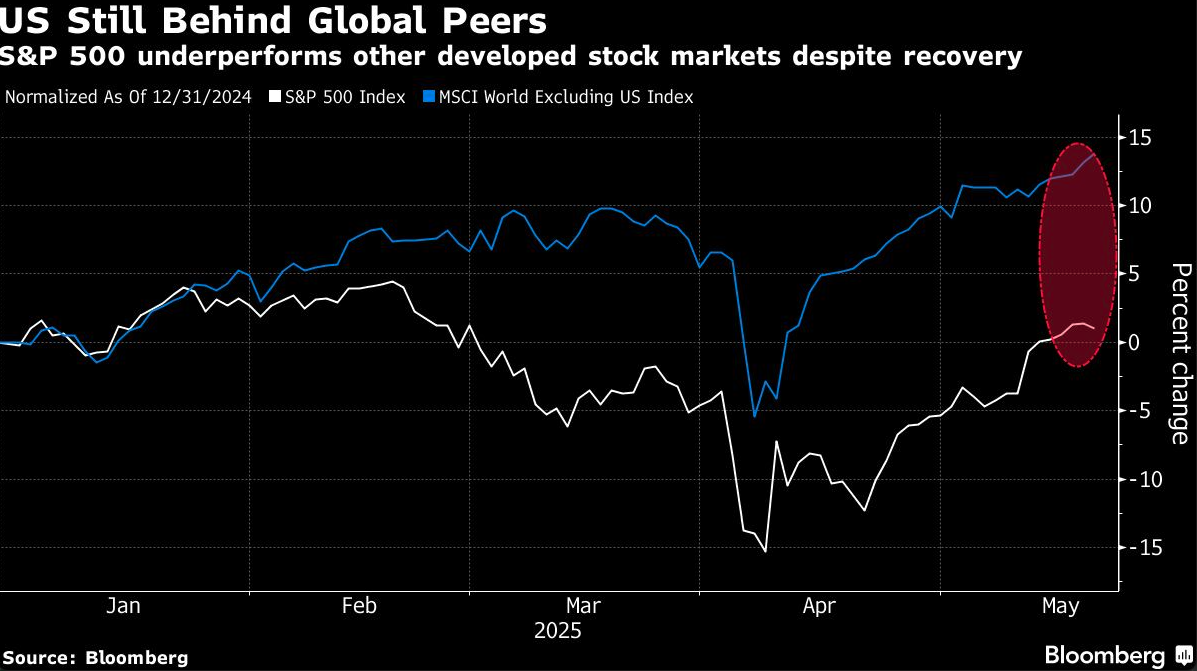
Despite a big comeback, US stocks are still laggards in global equity markets this year. For them to sustain the rally and reclaim their usual spot at the top of the pack, Corporate America’s profit engine needs to rev back up, analysts at Bloomberg Intelligence say.
US earnings growth surpassed that of other developed markets by 13% for the 12-month period through December, but that edge has since narrowed to 9% and could decline further as companies struggle to navigate the toll of tariffs on their bottom lines, according to BI’s Nathaniel Welnhofer. So far this year, the S&P 500 has underperformed the MSCI World Index excluding the US by roughly 13 percentage points.
In individual movers, UnitedHealth Group Inc.’s shares tumbled after the Guardian reported that the insurer secretly paid nursing homes to reduce hospital transfers for ailing residents. Meanwhile, Boeing Co. has told customers that it’s approaching a key production target that would signal manufacturing of its all-important 737 jet is back on track.
A message from Advisor Perspectives and VettaFi: To learn more about this and other topics, check out some of our webcasts.
Bloomberg News provided this article. For more articles like this please visit
bloomberg.com.
Read more articles by Alexandra Semenova