If you’re fighting an antitrust lawsuit that might end up breaking your company into pieces, one defense is to argue that those pieces would wither away if separated from the mother ship, thus creating a worse outcome for the consumer.
That’s what Google has been doing in the face of Department of Justice calls for it to sell Chrome, its market-leading web browser, as part of the remedies for its monopolistic behaviors involving its search business. The company wrote on its blog in May:
DOJ’s proposal to break off Chrome — which billions of people use for free — would break it and result in a “shadow of the current Chrome,” according to Chrome leader Parisa Tabriz. She added that the browser would likely become “insecure and obsolete.”
This defense was complicated somewhat on Tuesday when it emerged that Perplexity, an artificial-intelligence company, had made an “audacious” (Bloomberg), “longshot” (Wall Street Journal) and “mischievous” (me) bid to take Chrome off Google’s hands for $34.5 billion. Perplexity doesn’t have $34.5 billion — the company was valued at $18 billion at the time of its last funding round — but said it would pull the money together from a coalition of investors who are already on board with the plan.
The deal would realistically be possible only if the court does indeed force the Alphabet Inc. unit to sell Chrome, which, according to most analysts I’ve spoken to, would be an extreme measure. But it’s certainly not an impossibility. Indeed, it might have become slightly more possible thanks to Perplexity’s bid and what might come next. But before I get into that, let’s humor this for a second and talk about why buying Chrome would make sense for Perplexity.
The web browser, as I was discussing earlier this week, has become a critical early battleground for shaping new habits in AI. Perplexity realizes this and recently introduced its own browser, Comet, which places its own AI assistant front and center: If you type a query into the address bar, Comet will, instead of searching Google, turn to its AI instead. (After almost a month of using it, I’m not at all sold that this is an improvement, but that’s for another column.)
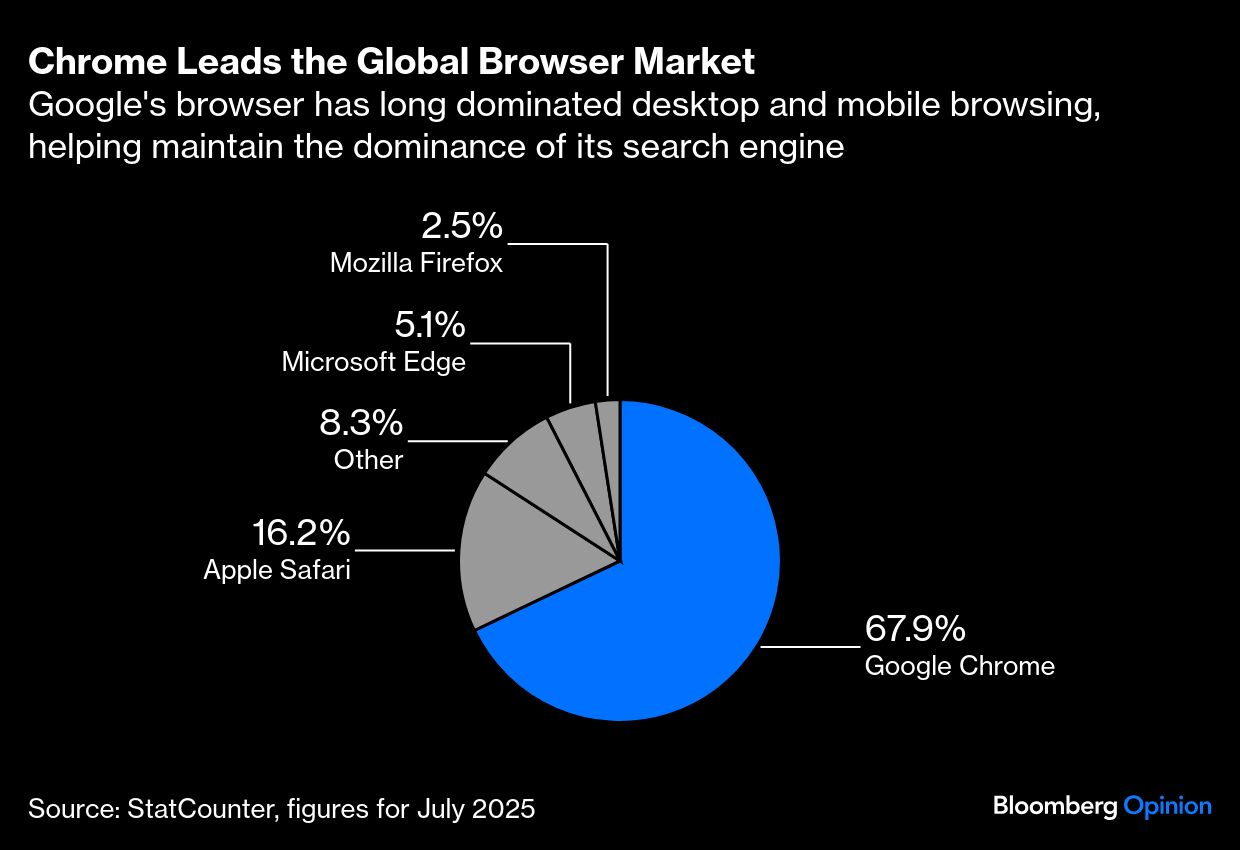
At scale, this shift in behavior — from search engine to AI — would be profound. The problem is that Comet, which is being used by only a handful of users in an early access program, has a minuscule market share compared with Chrome’s 70% of desktop browser use globally and 67% on mobile. Following loose estimates of about 3.5 billion users of Chrome, napkin math suggests Perplexity would be paying about $10 per user. The goal then, of course, would be to convert as many of them as possible to users of its $20-a-month “Pro” AI plan.

As AI business models go, it’s actually not bad. Unlike its biggest competitors, Perplexity lacks a shop window for its AI, an existing highly used product where users can discover the functionality of AI without having to consciously go looking for it. Buying Chrome certainly makes a lot more sense than Perplexity’s previous headline-grabbing M&A move, which was a merger bid for TikTok.
Still, the lack of movement in Alphabet’s share price on Tuesday suggests investors have brushed off the possibility. For starters, some analysts think the valuation is way off. The offer “vastly undervalues the asset, and should not be taken seriously,” according to Baird. A better number, its analysts said, would be more like $100 billion — though it’s hard to say how the dynamics of a deal would play out if Google had no choice but to sell Chrome. Previous valuations put it somewhere between $30 billion and $50 billion, a figure that seems a little conservative if the browser is indeed pivotal to building AI market share.
Regardless, what this bid truly represents is a cunning plan to get in the ear of Judge Amit Mehta as he considers the appropriate antitrust remedies for Google’s prior bad behavior. By making this move, Perplexity is skewering Google’s defense that spinning out Chrome would be fatal to not just Chrome but to Chromium, the open-source project that forms the backbone of most top web browsers, including Google’s direct competitors. It can now be sincerely argued that there’s a bona fide offer from a company capable of not only taking Chrome out of Google’s hands but developing it further — keeping it from becoming “insecure and obsolete,” as the company warned. What’s more, it seems likely other AI companies will throw their names into the running. OpenAI’s head of ChatGPT testified during the trial that the company would be interested in buying Chrome, “as would many other parties.”
How much the judge takes any of this into account when making his ruling is another thing. He probably shouldn’t: The rationale to force a sale of Chrome would be to prevent Alphabet from creating a new AI monopoly with the same tactics it used to dominate the world of search. Fine, but Judge Mehta has other tools at his disposal to achieve that more fairly. After all, the only reason an AI company would be interested in buying Chrome, at a cost that’s double its existing value, would be to use the browser for those same anticompetitive ends.
A message from Advisor Perspectives and VettaFi: To learn more about this and other topics, check out some of our webcasts.
Bloomberg News provided this article. For more articles like this please visit
bloomberg.com.
Read more articles by Dave Lee