If I told you Argentina is the world’s hottest new market for copper, you might be likely either to scratch your head or just laugh.
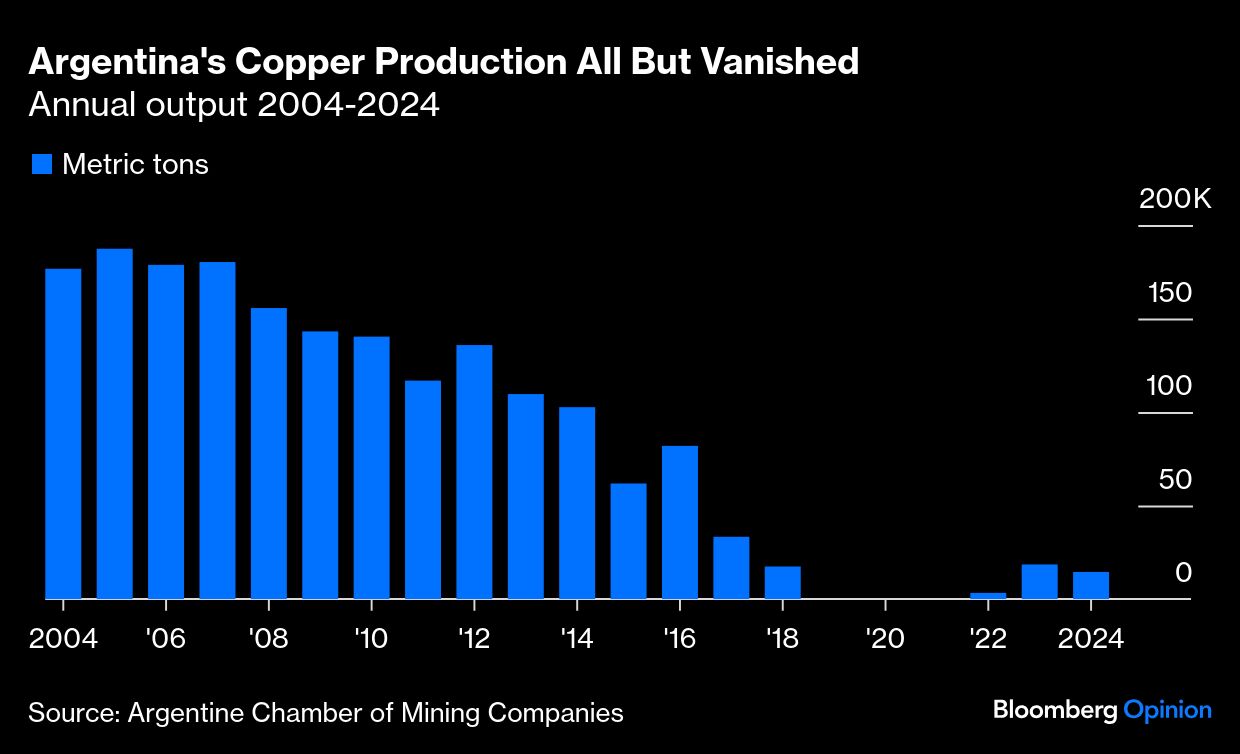
This is, after all, a country better known for volatility and policy U-turns than the kind of political and financial long-term stability that mega-mining projects require. Argentina’s last major copper mine shut in 2018. Today, production is virtually nil. Despite vast reserves — particularly across the Andes mountains alongside Chile and Bolivia — much of Argentina’s mineral wealth remains untapped thanks to decades of hostile business conditions and economic chaos.

That’s why the synchronized visit of executives from Rio Tinto Plc. and Glencore Plc. to Buenos Aires last week was so symbolic. On Aug. 20, just hours apart, the top brass of these two mining giants met with Javier Milei, the Libertarian president vowing to break Argentina’s cycle of economic failures. They are making bold bets: Rio Tinto is pushing ahead with a $2.5 billion lithium project, while Glencore is weighing two large copper developments that together would require $13.5 billion in investments.
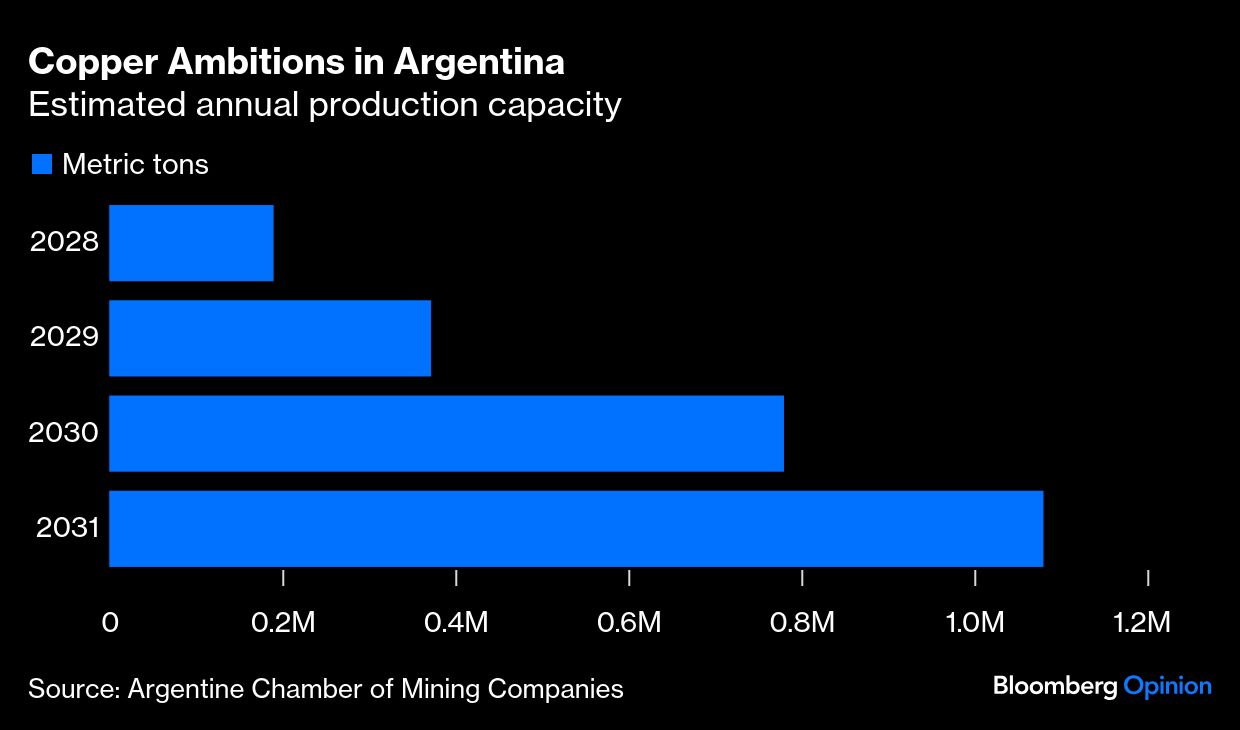
Big Mining now sees the South American nation as a new great frontier just as the world braces for a severe copper shortage in the second half of this decade thanks to the significance of the red metal in the energy transition. Six world-class copper projects are on the drawing board, backed by the likes of BHP Group Ltd. and First Quantum Minerals Ltd., expected to start producing between 2028 and 2031. If they all come through, Argentina could produce more than one million metric tons of copper per year, vaulting into the ranking of top global suppliers.
The key words here are: if they come through. Argentina has seen mining booms fizzle, with ambitious projects going nowhere due to abrupt policy shifts and currency crisis. To seize this golden opportunity, Milei’s government needs to overcome its recent setbacks (including a bubbling bribery scandal) and consolidate the economic recovery. Moreover, legislators and provincial leaders, particularly from an opposition more focused on partisan gains than national welfare, must match Milei’s commitment.
For their part, companies, meanwhile, must maintain strong dialogue with local communities and meet strict environmental standards — if they don’t want a repeat of First Quantum’s nightmare in Panama, where nationwide protests forced the closure of its giant copper mine in 2023.
I saw these pitfalls firsthand: In 2006, while living in London, I witnessed the excitement of Rio Tinto officials unveiling a massive potash project in Mendoza, the Argentine province famous for its wines. The project, Rio Colorado, looked like a game-changer: proximity to Brazil, a fertilizer-hungry giant, great geology and strong business interest. Vale SA bought it in 2009, pledging $6 billion for development — by far the largest investment in the country at the time. Yet after sinking in more than $2 billion and completing almost half the project, the Rio de Janeiro-based company abandoned it in 2013, frustrated by inflation, capital controls and absurd demands from multiple authorities. Nearly two decades later, Rio Colorado remains a chimera — and Brazil still imports much of its potash from Russia.
This is hardly an isolated case: Roberto Cacciola, an industry veteran who heads the country’s mining chamber, has seen plenty of failed attempts to tap Argentina’s largest mining deposits. Still, he thinks this time could be different. The Milei government has created a new legal framework, known by its Spanish acronym RIGI, offering guarantees, tax incentives and regulatory benefits for large capital investments. The country also shares a growing consensus that in certain industries — energy, agriculture, technology and, of course, mining — national policies should focus on boosting exports regardless of who’s in office. Above all, at a time when new deposits are scarce and harder to develop, Argentina’s geology makes it an irresistible destination.
“The conditions are in place for this boom to move forward, but we must avoid the electrocardiogram that has traditionally been the Argentine economy,” Cacciola told me from Buenos Aires. “None of this will happen overnight. We have already been disappointed several times.”
The numbers point to forward movement. Last year, Argentina exported minerals worth $4.65 billion led by gold shipments, almost 44% more than the $3.24 billion registered in 2021. Lithium production is set to quadruple compared with the same year. The government also inked a deal with the outgoing Biden administration to strengthen supply chains for critical minerals, adding geopolitical clout to its ambitions.
But these huge copper projects represent the ultimate test. If Argentina manages to pull them off, it will signal not only that the mining boom is real, but that the country itself has truly broken new ground.
A message from Advisor Perspectives and VettaFi: To learn more about this and other topics, check out some of our webcasts.
Bloomberg News provided this article. For more articles like this please visit
bloomberg.com.
Read more articles by Juan Pablo Spinetto