After FedEx Corp. and Amazon.com Inc. went through a noisy divorce in 2019, it was a bit jarring to hear Brie Carere, FedEx’s chief customer officer, welcome back volume from the e-commerce giant with such open arms.
United Parcel Service Inc., FedEx’s larger rival, is going in the opposite direction with Amazon, announcing at the beginning of the year that it was accelerating its “glide down relationship” to shed about $5 billion of business with the company that’s not very profitable.
The new Amazon volume is only part of a self-help push by FedEx to boost annual revenue by as much as 6% in a soft package market, Carere said in a conference call last week. Best Buy Co., the electronics retailer, just named FedEx as its primary national carrier, she said.
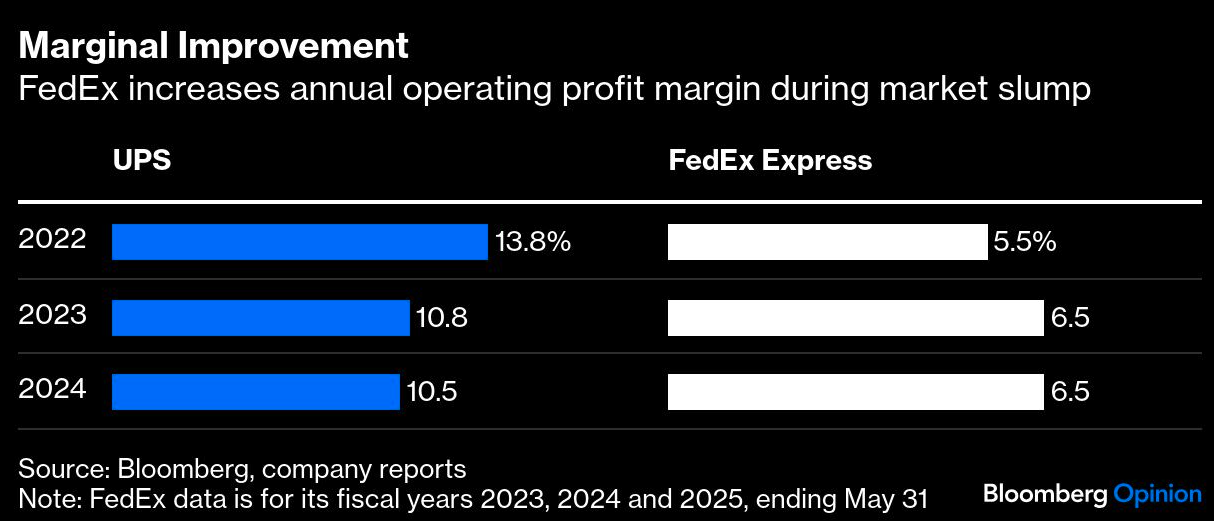
FedEx is winning market share and expanding margins. This is the fruit of the transformation plan introduced by Raj Subramaniam in June 2022 soon after the company’s founder, Fred Smith, installed him as chief executive officer. The full impact of this strategy is muddied by the post-pandemic downturn for package delivery and now the shake-up of the market from tariffs and the demise of the de minimis exemption, which had allowed packages with a value of $800 or less to enter the US duty free. Until the noise from the tariffs changes subsides, it will be difficult to tell how profitable this new business is.

Both UPS and FedEx are cutting costs to cope with the soft market, but the efforts are unequal. UPS, which has historically operated more efficiently because of its expensive unionized workforce, doesn’t have as much fat to cut to cope with higher costs. The workforce became much more expensive after a five-year labor contract was reached in 2023 and the Teamsters won concessions on costly items such as adding air conditioning to new delivery vehicles.
FedEx, on the other hand, isn’t just doing another vaporous round of cost-cutting that won’t stick. Subramaniam is taking bold steps to overhaul the company’s structure to take advantage of its less expensive and more flexible workforce. The courier is also leaning in on services, such as handling large packages and Sunday deliveries, that UPS has shied from.
Subramaniam is combining the company’s two distinct delivery networks that arose when FedEx grew at a breakneck pace. He’s rationalizing the aircraft fleet and farming out lower-yield packages to third-party air freighters. The short-haul trucking unit, which has grown into the largest US less-than-truck load carrier, is being spun out into a separate company.
The transformation has yielded $4 billion of permanent cost cuts so far. The network combination, which promises another $2 billion of cost reduction and efficiencies, is just getting started. FedEx said last week that 18% of US daily package volume is running through the new network design.
The end goal of Subramaniam’s plan is to match or beat UPS on efficiency, which would give FedEx a structural advantage from its lower cost labor force. A driver for a contractor that hauls packages for FedEx can earn half of what an experienced UPS driver makes and even less when adding the Cadillac health and pension benefits that UPS offers. A unionized workforce has its own efficiencies, including low turnover and increased safety because of well-trained, experienced drivers. By using contractors, FedEx loses direct control over drivers and vehicle maintenance.
The market power of FedEx’s new cost structure isn’t clear yet amid a soft market and tariff turmoil. The company had been increasing earnings in the last few quarters even as revenue had been declining, which is a good sign. The company has been promising that all the cost reductions will flow to earnings once revenue begins to increase. The tariff changes, though, are creating a $1 billion headwind on top of a $160 million drag from a US Postal Service air freight contract it lost last year to UPS.
The bull case for FedEx is that structurally lower costs and a service advantage from its flexible workforce will boost market share and profit margins. While FedEx embraced large packages, UPS discouraged them because the bulky, odd-shaped items can gum up sorting centers. There’s also pushback from unionized drivers over carting around 150-pound parcels by themselves. UPS would rather hand off those large packages to Roadie, the point-to-point gig delivery startup that UPS bought in 2021. The new Amazon business focuses on those large items that fetch higher delivery prices, FedEx said.
FedEx touts its delivery speed, which it says tops UPS’, and the courier offers direct Sunday delivery. UPS has relied on the US Postal Service for Sunday service, which was set back by UPS’ recent pullback from handing ground packages to the Postal Service for final delivery. FedEx also doesn’t face the risk of a possible system-wide shutdown that UPS does when it reenters contract negotiations with the Teamsters in less than three years.
In 2019, FedEx tussled with Amazon over the price for hauling packages by air. That led Amazon to cancel its FedEx contract for ground packages. FedEx says it now has the cost structure and the service to take on Amazon business while boosting both revenue and profit margin. This will be clear, or not, when the tariff turmoil subsides.
A message from Advisor Perspectives and VettaFi: Discover something new! Click here to register for our upcoming webcasts.
Bloomberg News provided this article. For more articles like this please visit
bloomberg.com.
Read more articles by Thomas Black