Investors expect the Federal Reserve to cut its policy rate on Oct. 29, and once more by the end of the year. Right now, amid enormous uncertainty about where the economy is headed, the case for cutting is weak. The Fed would be wiser to pause.
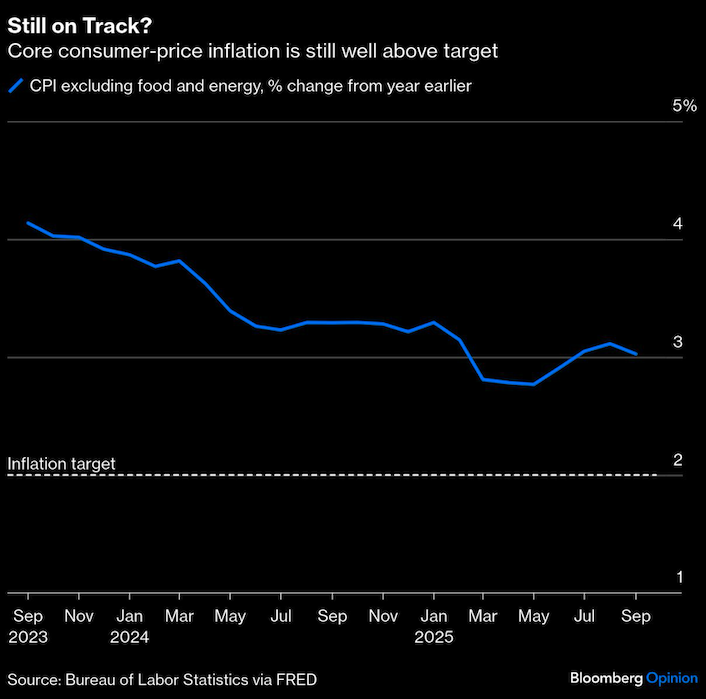
Core consumer-price inflation edged lower in September — but at 3%, where it’s lingered for the past year, it remains well above the central bank’s target. True, as Fed officials have stressed, the labor market has cooled — yet unemployment, at 4.3% in August, is still in line with the bank’s mandate of “maximum employment.” Looking at those two numbers, Lorie Logan, president of the Federal Reserve Bank of Dallas, was right to say earlier this month that “we’re further away on the inflation side of those objectives.”
Other Fed officials, including Chair Jerome Powell, have argued that the balance of risks has shifted. Looking forward, they say, the employment goal is now in greater jeopardy than the inflation target. Perhaps, but it’s far from obvious.
Recent downward revisions to earlier employment numbers were unusually big, which put paid to the idea that the labor market was still running hot. Further cooling has lately taken the form of slower hiring alongside slower firings. Uncertainty over tariffs has probably reduced the demand for labor, but the crackdown on illegal immigration has reduced the supply. This unusual “low-hire, low-fire” pattern helps explain why the unemployment rate has held fairly steady. It sends no clear message on interest rates.
The inflation outlook is equally murky. Tariffs have so far been passed through to consumers more slowly than many expected, perhaps because companies are waiting to see what happens next. If so, there’ll be more tariff-driven inflation to come. That could push wages up, making higher-than-targeted inflation stickier.
Adding to the Fed’s problems, the government shutdown has delayed or canceled many scheduled statistical releases. Understanding the state of the economy would be difficult enough with the data flowing as usual. Without it, the job is next to impossible.
Given all these uncertainties, why are investors so confident that there’ll be another interest rate cut next week, with yet another to follow in December? The answer is partly that Powell and his colleagues have led them to expect it. The Fed’s last summary of economic projections penciled in a federal funds rate of 3.6% for the end of the year, meaning another 50 basis points of cuts. And most recent commentary from Fed officials has emphasized the new “balance of risks” rationale (giving more weight to jobs than prices), which Powell used to justify the September cut.
Trouble is, the resulting market-based predictions tend to be partly self-fulfilling, because the central bank hesitates to surprise investors without good reason. In effect, the burden of proof moves: Instead of having to justify a lower policy rate, the Fed would have to explain why it decided not to cut. Perversely, missing data and heightened uncertainty over tariffs and labor-market trends then become reasons to keep going rather than arguing, as they should, for caution.
The expected cut of 25 basis points is no big deal in itself. And Powell and his colleagues may well turn out to be correct about the balance of risks, in which case persisting with a rate reduction will prove to have been the right decision. But for now, as far as anybody knows, the economy is growing, unemployment is low and inflation is higher than it should be. Why not wait and see?
A message from Advisor Perspectives and VettaFi: Interested in learning more about how bond ETFs can help diversify your portfolio? Click here to read more.
Bloomberg News provided this article. For more articles like this please visit
bloomberg.com.