Treasuries ticked higher in early US trading, stalling a global bond selloff that had sent yields to multiyear highs, as investors saw signs that the US and Iran were making progress toward a deal.
Yields on US bonds dipped as much as three basis points Monday after Iran’s semi-official Tasnim reported that Washington proposed a temporary waiver on Iran oil sanctions until the final agreement, citing a source close to the negotiation team.
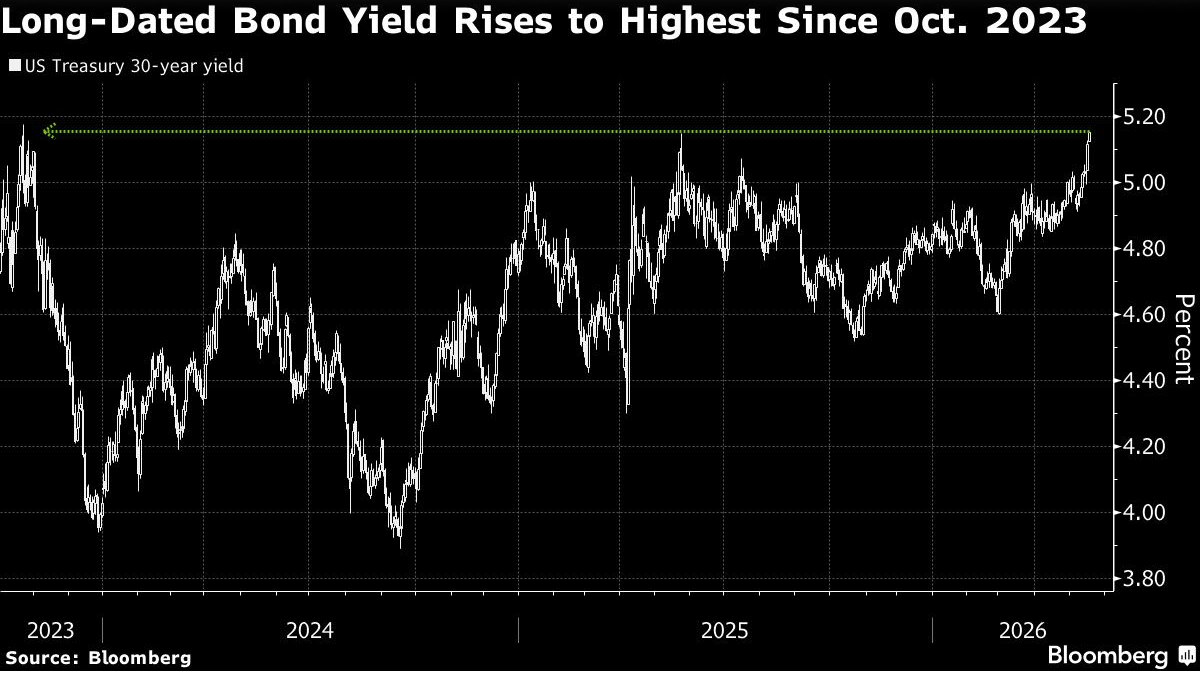
The move brought some relief to a market that has been buffeted by worries over the economic fallout of a war-driven surge in prices, with yields on longer-dated bonds spiking in Japan, the UK and the US. On Monday, the rate on 30-year Treasuries remained near 5.12% after touching its highest since 2023 earlier in the session.
There is “no anchor above 5%,” said Guneet Dhingra, head of US rates strategy at BNP Paribas, who is recommending clients target a 5.25% to 5.5% trading range in the 30-year note. “Holders of long-end Treasuries are increasingly more price-sensitive than before.”

The concern driving the recent selloff is that a surge in energy prices emanating from the closure of the Straight of Hormuz will force central banks — including the Federal Reserve — to keep interest rates elevated. Add in worries over US deficits and signs that the economy remains resilient, and the result is that investors have been seeking greater compensation to own longer-dated Treasuries.
“As we see yields creep higher, it’s very much a reflection of this protracted conflict and time is not on our side as it relates to this, clearly,” Amanda Agati, PNC Asset Management Group’s chief investment officer said on Bloomberg Radio.
For policymakers, hotter inflation will make it harder for the central bank to lower interest rates and add pressure on incoming Fed Chair Kevin Warsh. Whereas traders were betting on two quarter-point cuts this year before the war, interest-rate swaps now point to a hike in March 2027 as a virtual certainty to combat inflation pressures.
Ed Yardeni, president and chief investment strategist at Yardeni Research, said the Fed needs to drop its easing bias at its June meeting, adding that it is “no longer” appropriate in the current market environment. Later in the week, the Fed is due to release its April meeting minutes, which will give investors clues about the central bank’s thinking.
What Bloomberg Strategists say...
“The global trend for higher real yields is certainly a kick in the shins for those (including many still on the FOMC!) who think that the long-run equilibrium policy interest rate hasn’t really changed in the past few years. That’s going to make for an interesting few months, to say the least.”
— Cameron Crise, Macro Strategist, Markets Live
Yields, meantime, have risen around a half-point or more from where they stood at the end of February. The two-year rose as high as 4.09% in early Asian trading, marking a level unseen since February 2025. It was hovering near 4.06% as of 9:30 a.m. New York time. The 10-year, at 4.59%, was near the highest in about a year. Thirty-year yields, meantime, were approaching their highest since 2007 in intraday trading.
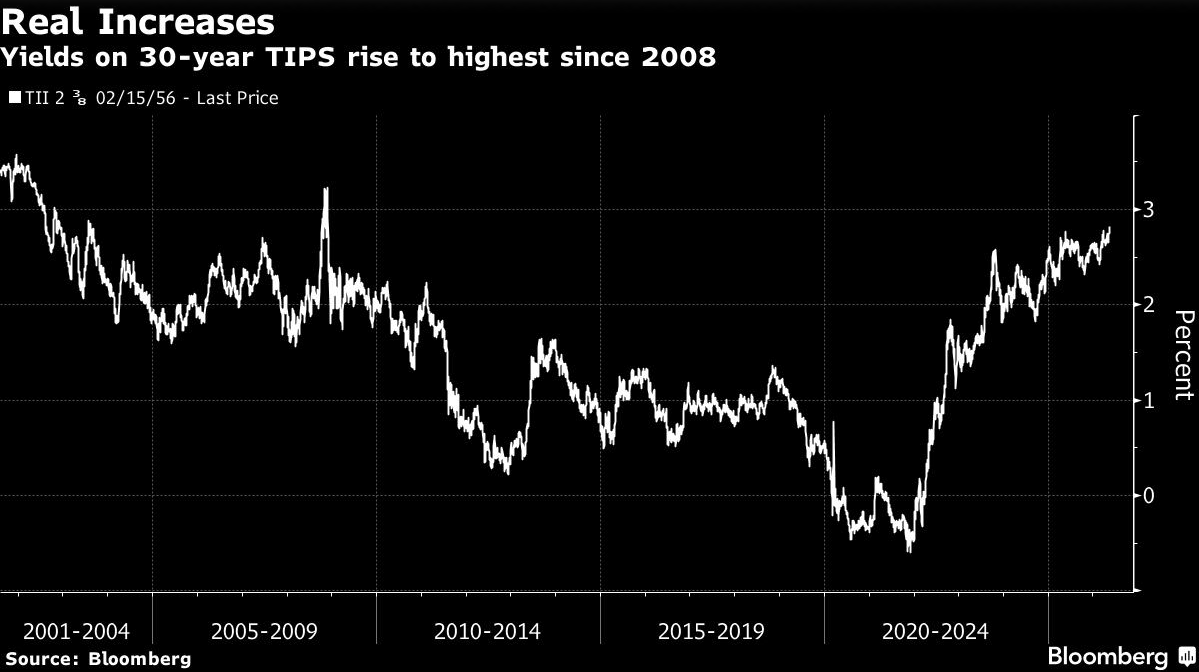
Yields on 30-year Treasury Inflation Protected Securities rose to 2.81% Monday, the highest since 2008. The TIPS yields have increased about 40 basis points since the Iran conflict started in late February, contributing to most of the jump of the 30-year nominal yields during the period.
“In order for rates to come off of the highs and return to previous ranges, we think that a catalyst, specifically a catalyst that drives oil prices lower, is needed to bring rates back into the ranges they were trading at the last couple of months,” said Molly Brooks, US interest-rate strategist at TD Securities. “Any news that can pressure oil prices lower should lead to rallies in rates, but a more certain end to negotiations would lead to the market being able to sustain the move.”
The ructions have also gatecrashed talks being held this week in Paris by Group of Seven finance chiefs. European Central Bank chief Christine Lagarde, questioned on the bond selloff as she arrived at the G-7, said that “it’s always my job” to think about such things.
Japanese government bonds notched the biggest losses, with the 30-year yield surging to its highest since the maturity was first sold in 1999. In Europe, 30-year German yields hovered near 3.67%, while worries about the fiscal implications of a leadership challenge to Prime Minister Keir Starmer remain top of investors’ minds in the UK.
A message from Advisor Perspectives and VettaFi: Discover something new! Click here to register for our upcoming webcasts.
Bloomberg News provided this article. For more articles like this please visit
bloomberg.com.
Read more articles by Greg Ritchie, Georgia Hall