A seemingly endless appetite for buying US stock dips has propelled Vanguard Group’s S&P 500-tracking ETF past $1 trillion in assets, making it the first fund of its kind to reach a milestone once thought unimaginable for the ETF industry.
A $1.7 billion inflow in the latest session for which figures are available brought assets in the Vanguard S&P 500 ETF (ticker VOO) above $1 trillion, data compiled by Bloomberg show. As such, VOO — already the largest ETF in the world — now ranks as the first and only ETF to cross $1 trillion, a threshold reached by just a handful of open-ended funds worldwide.
Its ascent has been fueled by a remarkably durable buy-the-dip mentality that has kept cash flowing into US equities through wars, tariff scares and growth concerns alike. And the inflows come ahead of what’s expected to be a wave of mega-IPOs this year, including for SpaceX, suggesting a pile of passive cash is on standby to buy into the offerings.
It’s a watershed moment not just for Vanguard, but for the ETF industry as a whole, which birthed its first funds in relative obscurity in the early 1990s. Over the past three decades, the low fees and tax-efficiency of ETFs have made the structure a hit with big and small investors alike, while the wrapper’s liquidity and derivatives ecosystem have knit ETFs into the central nervous system of Wall Street.
“This milestone is just the latest sign that ETFs are all grown up,” said Ben Johnson, head of client solutions at Morningstar Inc. “What was once a fringe category has become the default investment wrapper for millions of investors around the world.”

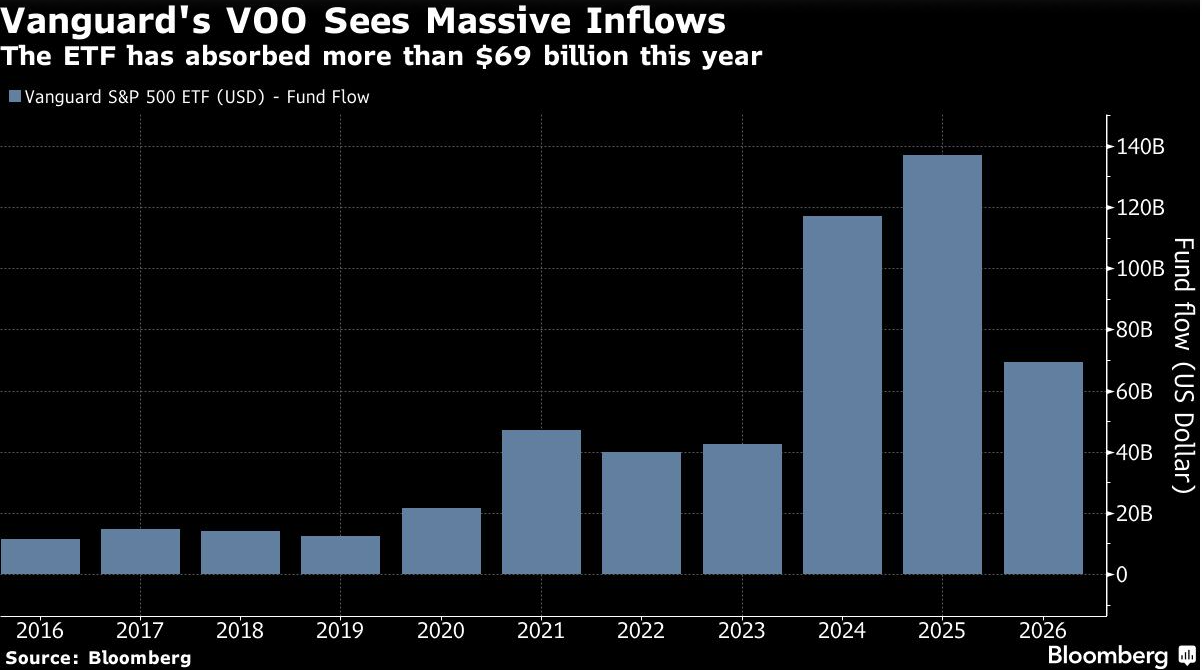
While US equities shuddered at the outbreak of the Iran war, a seemingly relentless climb higher in the S&P 500 has funneled a wall of buy-and-hold money into the likes of VOO. The ETF has absorbed more than $69 billion so far in 2026 — the most of any other ETF — as the benchmark has soared 11% year to date on the heels of multiple all-time highs.
VOO’s 2026 cash haul follows two straight years of more than $100 billion annual inflows, data compiled by Bloomberg show. Since its 2010 inception, VOO has managed to take in money every year, helping it to eclipse the $787 billion State Street SPDR S&P 500 ETF (SPY) as the world’s largest ETF early last year.
“As the US market has been just insanely resilient, most long-term investors are using VOO as the easy button now, not SPY,” said Dave Nadig, president and director of research at ETF.com.
VOO’s march to $1 trillion also marks an interesting chapter for Vanguard itself, notes Morningstar’s Johnson. Vanguard was founded more than 50 years ago by the late Jack Bogle, who was famously skeptical of ETFs. Fast forward to 2026, and Vanguard is on the cusp of surpassing BlackRock Inc. for the title of world’s largest ETF issuer.
It’s been a largely symbiotic relationship between Vanguard and the ETF industry, in the eyes of Bloomberg Intelligence senior ETF analyst Eric Balchunas. Vanguard’s low-cost mentality sparked an industry wide race-to-the-bottom on fees, which popularized ETFs among cost-conscious investors. On the flip side, entering ETFs helped to further distribute Vanguard products among the brokerage platforms, Balchunas said.
“Vanguard has been very good to ETFs and ETFs have been very good to Vanguard,” said Balchunas, the author of The Bogle Effect. “Those two entities created a lot of synergies.”
A message from Advisor Perspectives and VettaFi: Discover something new! Click here to register for our upcoming webcasts.
Bloomberg News provided this article. For more articles like this please visit
bloomberg.com.
Read more articles by Katie Greifeld