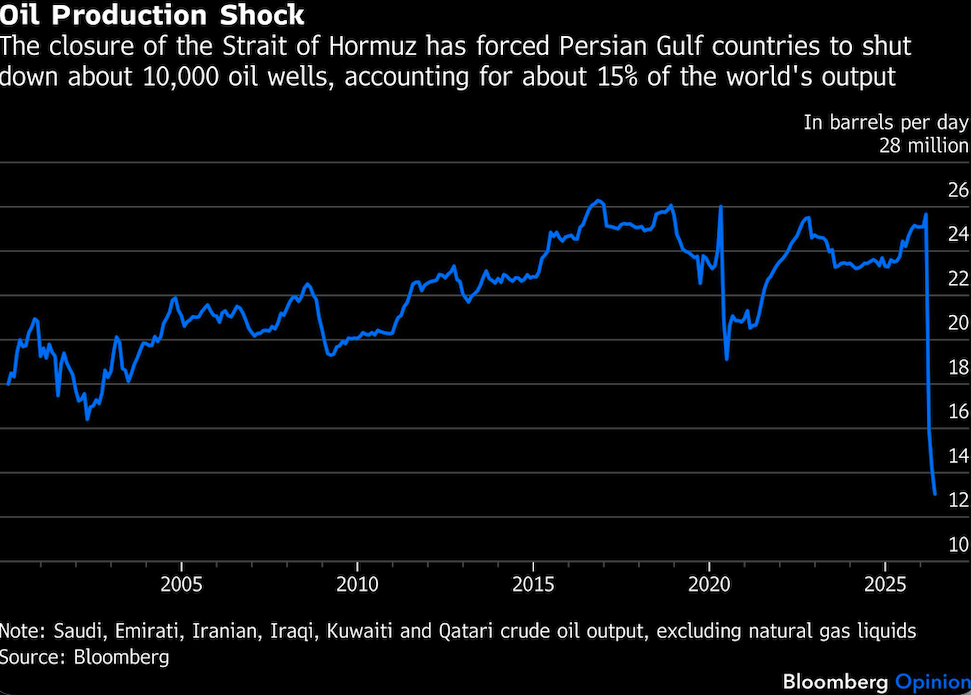
When the day comes, the reopening of the Strait of Hormuz will be an extraordinary event: restarting about 10,000 oil wells, pumping roughly 15% of the world’s production, that had been shut down for a hundred days and counting. Nothing even remotely close has been attempted — ever. The oil industry doesn’t have a playbook for it; it will learn by doing.
Unsurprisingly, the commodity market is deeply divided about how long it would take. Oil bears believe it could be done in days and weeks, while the bulls talk about six to eight months, perhaps even a year. The most pessimistic say many wells won’t restart at all.
My industry soundings are far more upbeat: When it happens, it would start as a trickle, but very quickly — in just a handful of weeks, if not days — transform into an oil flood. I’m on the side of the bears, as you may have guessed.
Admittedly, resuming shipping in the strait would require a diplomatic deal between the US and Iran that has so far proven elusive. But allow me to speculate on the day after Tehran and Washington sign a memorandum of understanding that, in practical terms, allows tanker traffic on the waterway to return to prewar levels within, say, 30 days.
I’m sidestepping key questions: Would Iran charge tolls or fees? Would oil tankers use the Iranian shipping lanes or the Omani ones? But the starting point is somber. The closure of Hormuz has forced Saudi Arabia, Iraq, Iran, the United Arab Emirates, Kuwait, Qatar and Bahrain to curtail output by 45%, from a pre-war level of roughly 32 million barrels a day to about 17.5 million last month, according to the International Energy Agency.1
Before oil can re-start, the first job is to get tankers past the Hormuz bottleneck into the Persian Gulf. Often, I hear the reopening would be a two-phase operation: First, tankers already laden would depart, and only then could ships on ballast go beyond the strait to load. That’s nonsense: It would happen simultaneously. Greek shipowners have already pre-positioned multiple empty supertankers within only three to five days of navigation from Hormuz for the job.
War insurance wouldn’t be a problem: It’s available, at reasonable prices, from multiple companies. What would be needed is confidence the US-Iran deal is holding. Call it proof of concept. The most adventurous shipowners will go first – think the likes of Evangelos Marinakis and George Procopiou – paving the way for other, more conservative, owners to follow.
If the diplomatic accord holds, it will take time to organize the dozens of tankers needed to carry the oil when the flow fully resumes — but that won’t take as long as conventional wisdom assumes. True, some tankers are in the wrong position, having diverted to do other business, say, shipping crude from the US Gulf of Mexico to Japan. But plenty of tonnage is available.
Frontline Plc, one of the world’s top supertanker owners, reckons that 55 large tankers are empty near the Persian Gulf, waiting for the strait to reopen. That equals 110 million barrels of capacity. The vessels are “contracted to industrial players like refiners and oil majors,” Chief Executive Officer Lars Barstad told investors recently. Rather than put the tankers to work elsewhere, making as much as $100,000 a day, those companies have preferred to incur an opportunity cost, keeping the ships idle but near Hormuz. “For these guys to not have vessels available should the strait open can be an extremely costly affair,” he said. “For them, this is logistics; it's not necessarily profit.”
If the transportation gets resolved quickly, as I expect, then it’s all down to the flow of crude. So far, the infrastructure that needs to be restarted — the 10,000 or so wells, gas-and-oil processing centers, pipelines, storage tanks and ports — has emerged from the war largely unscratched. And where damage occurred, it has been largely repaired during the ceasefire.
The lack of significant damage contrasts with other Middle Eastern conflicts. When Kuwait was liberated from Saddam Hussein in 1991, its oil wells were on fire, for example. The closure this time has also been controlled. Unlike, say, the oil strike in Venezuela in 2002-2003, when wells closed by disgruntled employees in a matter of minutes were damaged, Saudi Arabia and its neighbors had time to shutter wells in an orderly fashion. Moreover, the oilfields haven’t been battlegrounds, as they were during the 2011 Libyan civil war, thus allowing maintenance to continue.
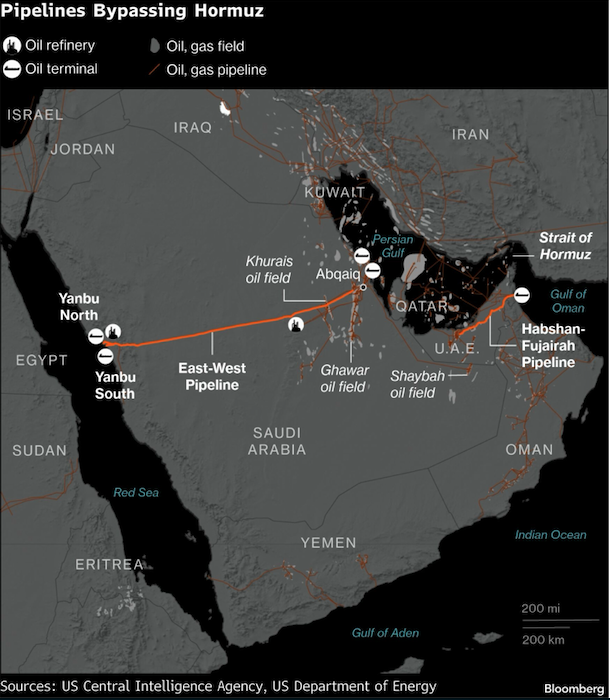
Nowhere in the region has output fallen to zero, because of the need to meet domestic oil demand and, in the cases of Saudi Arabia and the UAE, the use of pipelines bypassing Hormuz. Thus, petroleum engineers have kept some output running continuously, purposely selecting the wells most likely to have problems when reopening if they’d been out of service. In other cases, they’ve rotated the shutdowns, keeping some wells closed for a couple of weeks, then reopening them while shutting down others in an effort to never have an individual well out of business for more than a few weeks. They have choked down flows to reduce output to a trickle, but still keeping a few barrels coming out. By doing so, they try to avoid problems down the road, like clogging or loss of pressure.
Zoom out, and it’s clear the Middle Eastern oil industry hasn’t shut down cold; it’s been kept warm, a senior executive from the region tells me, waiting for peace. When the day comes, I expect about 50% of the region’s total production capacity could come back online in a matter of days; within a few weeks, about 75% would flow again; and full capacity would be possible within a few months. I don’t anticipate any long-term losses.
Importantly, Persian Gulf output wasn’t at capacity before the war – so it doesn’t need to return to full capacity immediately. Because of OPEC+ quotas, several key countries pumped less than they are able to. Saudi Arabia, for example, can produce 12.5 million barrels a day, but was pumping only 10.4 million before the war – about 83% of capacity.
Since February, oil demand has fallen due to the impact of high prices, while production outside the Middle East has also increased, notably in places like Brazil, the US and Canada. Put both together, and it means that Persian Gulf oil production doesn’t even need to return to its pre-war level for global supply and demand to balance again.
Oil engineers are, above all, expert problem solvers. So while the restart process won’t be easy once traversing the strait is possible again, don’t mistake difficult for impossible. The reopening of Hormuz, when politics allows it, will surprise with its speed.
1. Including crude oil, condensates and natural gas liquids.
A message from Advisor Perspectives and VettaFi: Discover something new! Click here to register for our upcoming webcasts.
Bloomberg News provided this article. For more articles like this please visit
bloomberg.com.