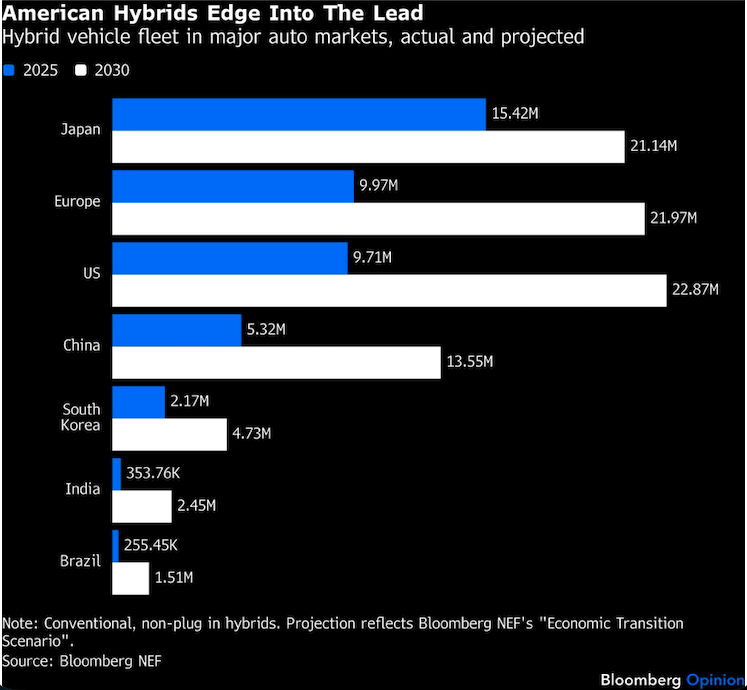
Americans like their electric vehicles to come with a side of gasoline. Sales of conventional hybrid vehicles, which combine internal combustion and electric drivetrains but don’t plug in to recharge, jumped by almost a fifth in the first half of 2026, year over year, while pure battery EVs slumped by a quarter. The most obvious catalysts were the Iran war’s impact on pump prices and the removal of EV subsidies, respectively.
A less obvious, but further reaching, cause is that most auto companies prefer making hybrids to EVs. After the deluge of multi-billion dollar write-downs on EV efforts, a boom in hybrid models is coming, setting the pattern for US vehicle electrification and cementing the divide with China over the rest of this decade.
Sales of EVs, including the type of hybrids that plug in to recharge, almost quintupled between 2020 and 2025. Tesla Inc. expanded sales massively on the back of cheap capital from its high stock price. Legacy automakers followed belatedly with investments and models of their own, hoping to garner some of Tesla’s EV mystique in their own share prices, even if they lacked scale and lost money on the vehicles themselves. Behind them, former President Joe Biden gave a hefty push in the form of subsidies for EV buyers and very tight fuel economy standards, necessitating rapid electrification.
The latter was critical because it was based on an important truth: Consumer demand is set to a large degree by what’s available. On that basis, the Biden administration hoped that if auto plants, and the associated investment in product development, were turned over to making EVs, then EVs would end up taking more market share by default. The only problem was that, Tesla aside, automakers generally lost money on the vehicles — most obviously at Ford Motor Co. — and garnered none of Musk’s valuation aura. Then, in 2025, Republicans knocked away both the subsidies and the fuel economy standards.
Detroit has retreated toward its most profitable segments, large trucks and SUVs, because those vehicles sell well in the US. But here, too, demand is not just a signal for supply but also a function of what automakers choose to supply. Kevin Tynan, director of research at the Presidio Group, an investment bank serving the automotive retailing sector, observes that the full-size pickups dominating suburban driveways are “not necessary” in strictly practical terms, “but this is what’s been marketed.”
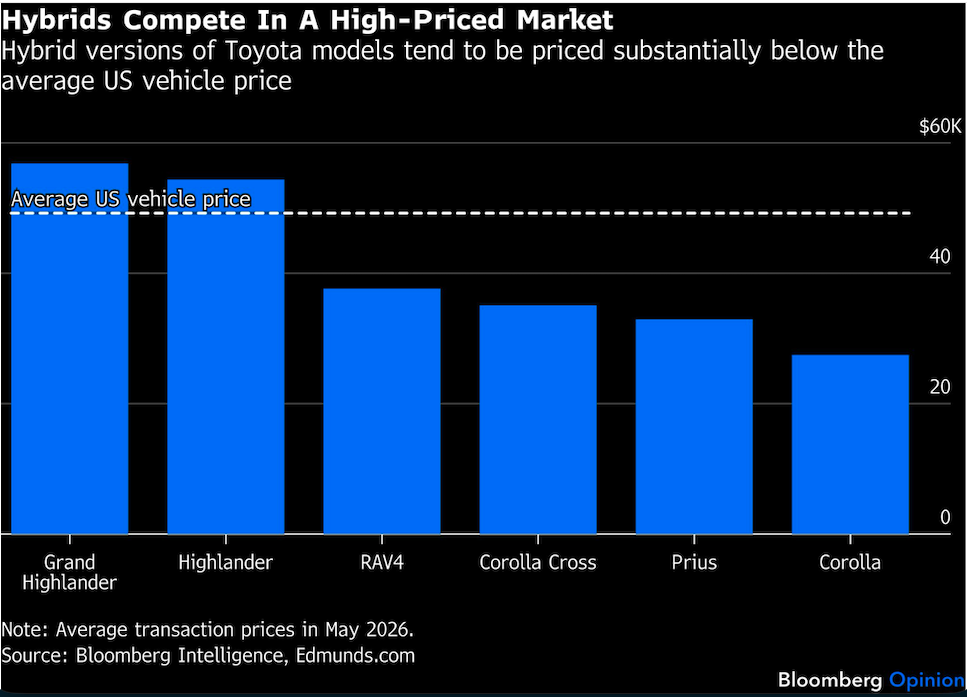
The same logic holds for hybrids. Hybrids are cheaper than EVs and aren’t necessarily loss-making for the manufacturers on day one. Hybrids are typically $1,500-$3,000 more expensive than conventional counterparts, a smaller premium than for plug-ins, with fuel savings typically paying back that premium within two to five years. Toyota Motor Corp.’s range of hybrids, including the trailblazing Prius, are mostly priced well below the average cost of a vehicle in the US, with only the Highlander and Grand Highlander hybrid SUVs coming in above the $50,000 level. Despite that, Toyota still earns better margins on its hybrids than the US average, according to an analysis by Tynan in 2024.