President Xi Jinping used the rise of China’s AI models to stake his claim on shaping the technology’s global rules, even as their growing power stirs security concerns in Washington and Beijing alike.
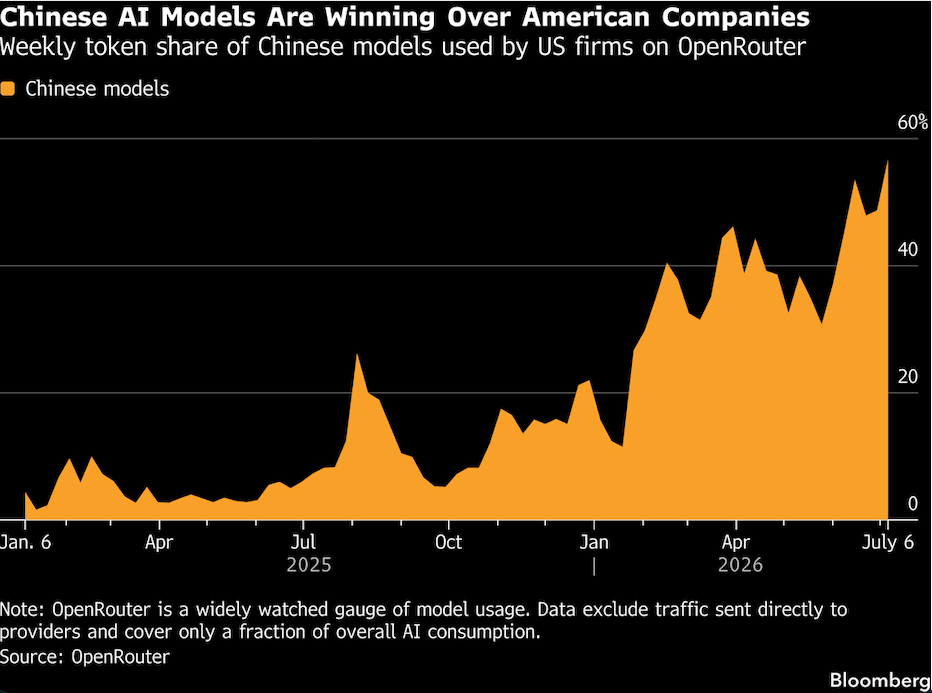
Emphasizing safety and equality, Xi made a sweeping call for international cooperation in his debut at the World AI Conference in Shanghai on Friday, an event that previously attracted Elon Musk and Jack Ma. He addressed scores of tech and government leaders as Chinese models win over companies worldwide, with their share of US firms’ AI usage nearing record 60% on the popular marketplace OpenRouter.
“We must carry out extensive international cooperation and help Global South countries in capacity building to bridge the AI and digital divides,” he said, calling for efforts to avoid creating “historical injustice in AI.”
His remarks echoed a drumbeat of state media articles framing China’s openness as the antidote to a world of walls. The Communist Party’s flagship mouthpiece People’s Daily earlier this week warned against an “AI Iron Curtain,” contrasting an “oil mindset” that hoards data and computing power with a “water” approach that treats AI as a public good for all, without naming any country.
Beijing is now looking to jostle with the US — the leading AI power — for influence through a new group of nearly 30 countries called the World AI Cooperation Organization. Xi used his keynote to champion the bloc, proposed last year and established Thursday, pledging to align global AI rules and technical standards “to make this frontier technology better benefit humanity.”
The organization would hand China a platform to sway global rule- and standard-setting for AI, an ambition researchers at home have been candid about.
“China is not only the world’s largest open-source application market but also a major source of contributions; however, its voice in international rule-making does not yet match its strength,” said Gu Lingyu, an AI researcher at Peking University.
“By effectively telling the story of China’s open-source practices, we can enhance our capacity to shape global open-source governance,” Gu said at a roundtable published by an official journal of the Supreme People’s Court.
Behind the public-good rhetoric, however, Beijing faces the same dilemma as Washington: How to square mass adoption with national security as models grow more capable.
Just hours before Xi spoke, Chinese AI startup Moonshot announced its new Kimi K3 model, which the company said rivals the strongest systems from OpenAI and Anthropic PBC. The release sent AI and semiconductor stocks sharply lower as investors drew parallels with last year’s “DeepSeek moment.”
Chinese officials recently discussed with companies including Alibaba Group Holding Ltd. — developer of the popular Qwen models – how to mitigate the security risks posed by their increasingly powerful models, people familiar with the matter said. The talks are early, with no enforcement planned, but restricting foreign access to top models was among the options raised, the people said.
Reuters previously reported that Beijing was weighing curbs on overseas access. Alibaba and the Commerce Ministry didn’t respond to requests for comment.
In his speech, Xi highlighted the need to contain safety risks posed by the rapidly advancing technology and ensure that AI is “controllable,” while warning against overstretching the concept of national security.
That caution mirrors Washington’s. The US briefly barred foreign access to Anthropic’s Mythos and Fable models last month on national security grounds, as systems of that class can exploit well-hidden software flaws, at times without human supervision.
“Chinese models may get Mythos-level cyber capabilities within the next few months,” said Saif Khan, a distinguished technology fellow at the Institute for Progress. “This is a real security risk that many parts of the Chinese government will be concerned about.”
The scrutiny from both governments leaves companies building on openly available models squeezed, with a clampdown from either capital threatening to fracture global research networks and a rising class of startups.
Flo Crivello, founder of AI assistant startup Lindy AI, said a Chinese cutoff “would have a pretty major impact.” His company moved from Anthropic’s models to DeepSeek last month, and is now saving 90% on inference, the cost of running AI.
“This would essentially undo these savings until the open-source scene catches up in the US,” he said. However, he doesn’t see losing access as “the end of the world,” predicting it would take three to six months for companies such as Alphabet Inc.’s Google and Meta Platforms Inc. to release open-weight models that match China’s offerings.
Corporate America’s embrace of Chinese AI is itself drawing fire. In April, lawmakers opened probes into Airbnb Inc. and Cursor developer Anysphere Inc. over their use of Chinese models. Airbnb Chief Executive Officer Brian Chesky defended the choice of using Qwen for its customer service chatbot, saying no user data is sent to foreign entities.
American AI firms and the White House have also accused China of improperly extracting capabilities from US frontier models, an accusation Beijing denies. Palantir Technologies Inc. Chief Technology Officer Shyam Sankar this week called Chinese open models an economic threat, accusing them of stealing American intellectual property
None of that is likely to shake Beijing’s strategy, which has turned openness into its main competitive edge.
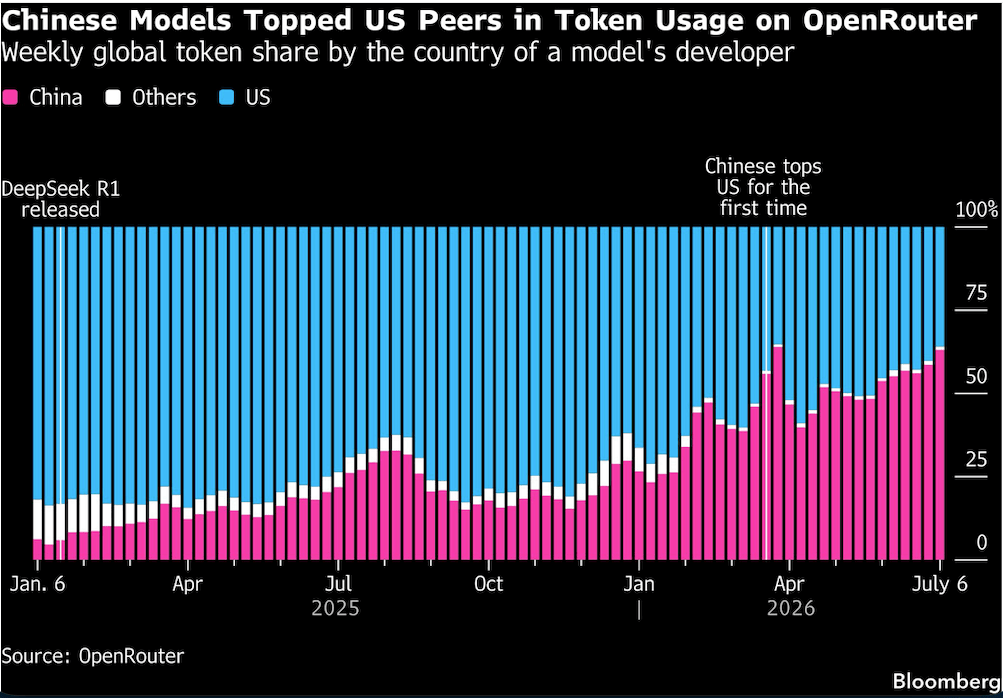
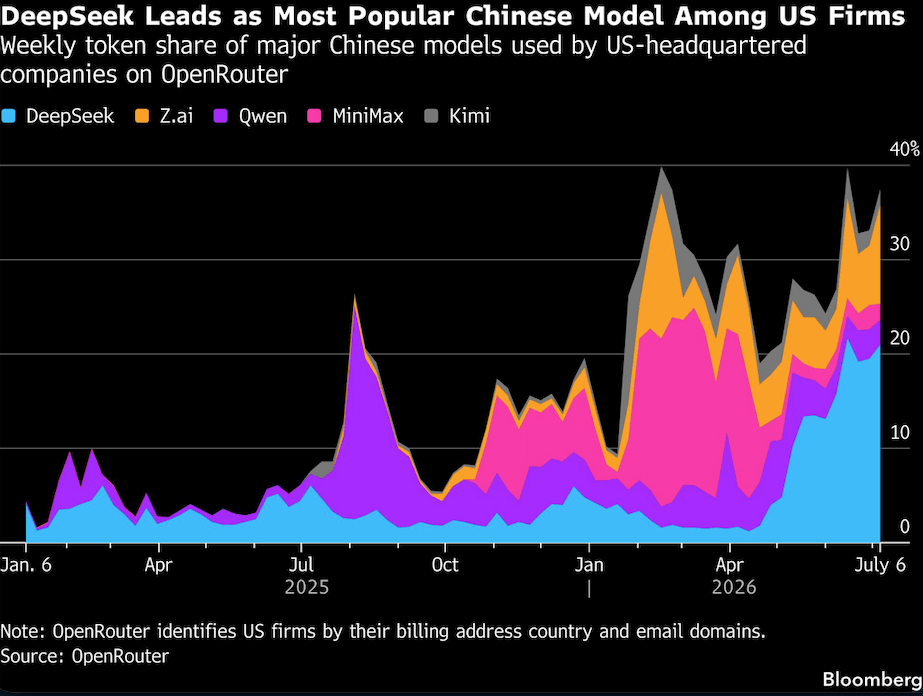
Chinese offerings overtook American rivals in OpenRouter’s US token traffic for the first time earlier this year and reached 63% in the first week of July, with DeepSeek emerging as the most popular choice among American firms in recent months.
The measure doesn’t capture direct use of models provided by Anthropic or OpenAI. But it shows how far the open-weight approach — models anyone can download and run free of charge — has carried Chinese developers, up from less than 10% of US firms’ usage a year ago on that platform.
“Open source AI has been such an important part of China’s AI strategy,” said Kristy Loke, a fellow at MATS Research who studies China’s AI governance. “It’s an important part of China’s domestic diffusion strategy, but also crucially the catch-up strategy, where everyone is building on top of each other.”
Rather than abandon that edge, Loke expects regulators to fine-tune oversight, such as by reserving the toughest curbs for frontier companies.
China’s industry leaders are also making the case for openness. Zhipu founder Tang Jie wrote in an internal memo seen by Bloomberg News that frontier AI should remain broadly accessible rather than controlled by a few, while stressing that safety is now “the fundamental prerequisite” for any technology powerful enough to alter civilization.
The confidence, meanwhile, is spilling into public view. In a recent exchange on X, Elon Musk predicted that China would be able to rival Anthropic’s top-tier Fable 5 “probably Q1.”