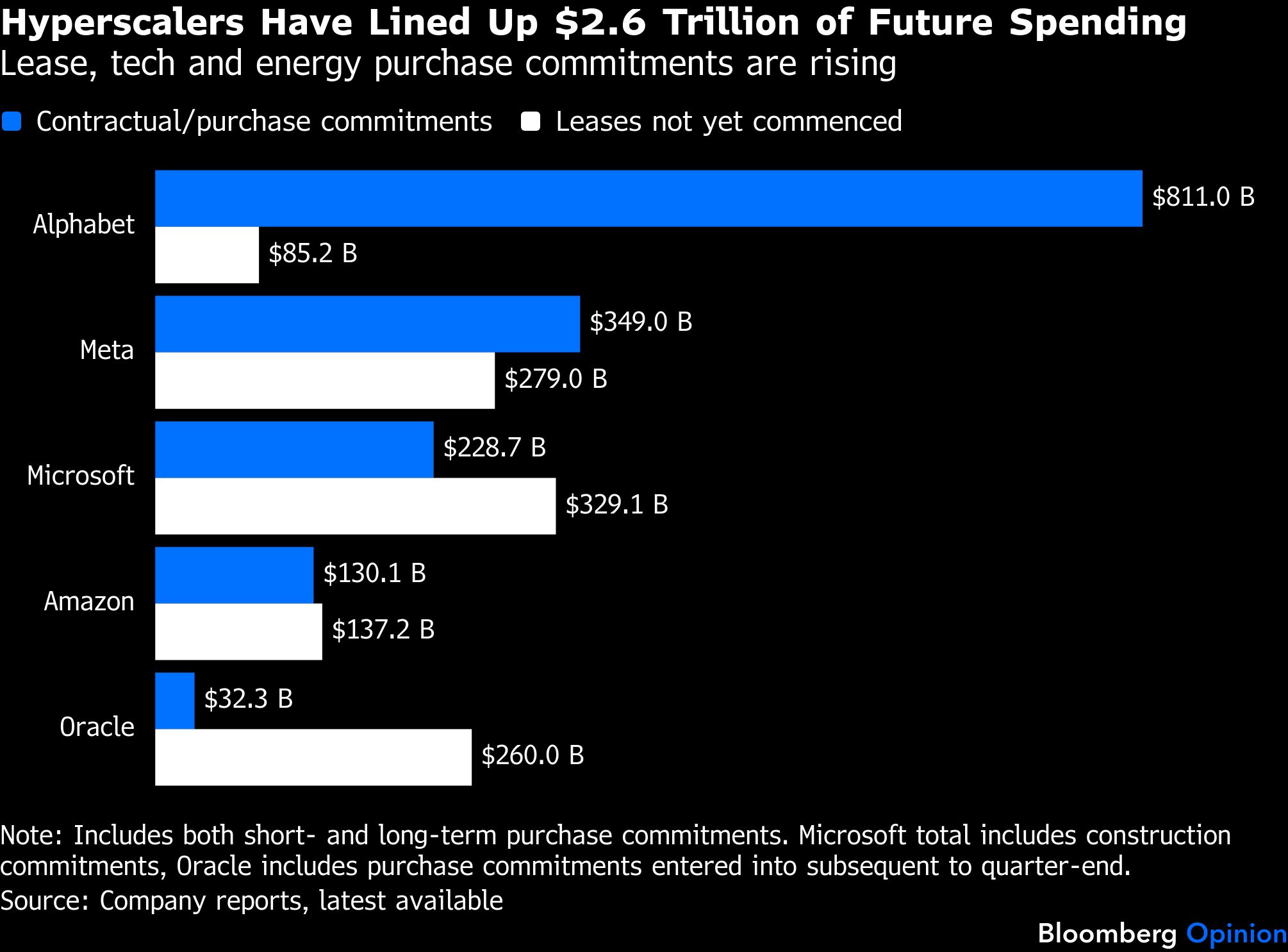
For anyone worried about the gargantuan costs of developing artificial-intelligence infrastructure, it was comforting to think that Big Tech firms could just turn off the spending taps if demand for chatbots and coding tools didn’t pan out. That’s starting to look like wishful thinking.
The hyperscalers that operate data centers, and chipmakers such as Nvidia Corp., are having to sign hugely expensive long-term contracts to secure computer memory as well as to rent and power the vast buildings that house AI kit. Some are using their heft to provide financial backstops in case less well-capitalized customers can’t pay their bills.
I calculate that the spending commitments of the main hyperscalers now total more than $2.5 trillion (as captured in the chart below). That’s just for leases that have yet to commence, plus the equipment and services they have promised to purchase, although not all of it is AI-related.
Alas, these future obligations aren’t included on balance sheets so they’re not as easy to track, though there are limited disclosures in accounting footnotes. Given their size and duration, they deserve more sunlight.

This is the consequence of the giants of Silicon Valley and Seattle, among the world’s most valuable companies, abandoning their “capital light” roots to try to profit from superintelligence by supplying its computational muscle. That’s unleashed an arms race for data-center capacity and components and given chip and equipment suppliers tremendous pricing power.
If all goes well, these financial commitments will position the largest tech firms to fully exploit the booming demand for AI tools. When they sell capacity in their data centers to AI service providers such as OpenAI and Anthropic PBC, these customer contracts typically last several years, meaning their spending pledges are backed by expected revenue.
And yet, they’d still have to keep forking out money even if Anthropic’s Claude chatbot or OpenAI’s equivalent succumb to competition from cheaper, open-source AI models. That’s not impossible.
Although most hyperscalers and US chip firms still have very solid balance sheets, the sheer scale of their spending obligations has begun to weigh on the price of insuring their debts against default. General market volatility linked to the troubles of hedge fund Situational Awareness will have played a part in that as well, in fairness.
“These future financial commitments are large and material to the companies and to the economy,” Todd Castagno, head of global valuation, accounting and tax at Morgan Stanley’s research division, tells me. “That’s what the market has been trying to digest in the past couple of weeks. What is the return on invested capital?”
The good news is that hyperscalers are at least trying to protect themselves against the risk of overbuilding by not purchasing too many computer chips in advance (when that’s an option), such as Nvidia’s graphics processing units. These are usually by far the priciest items in a data center.
If appetite for AI computing power weakens, such purchases can be slowed, Microsoft Corp.’s Chief Financial Officer Amy Hood said this week. Amazon.com Inc. echoed the same point: “If the demand isn’t there, we won’t spend the capital,” its boss Andy Jassy told investors. Shareholders cheered signs that both companies’ enormous data-center investments appear to be paying off.
However, memory chips are a different story. Suppliers are spoilt for choice in whom they sell to, and they’re insisting on multi-year financial commitments from customers as they try to shield themselves against any eventual AI downturn. US memory firm Micron Technology Inc. has snagged agreements lasting roughly five years that in aggregate cover at least $100 billion of future revenue. As of April, storage specialist Sandisk Corp. had extracted at least $42 billion of spending commitments from just three unnamed clients.
South Korea’s memory titans are also locking down clients, with Samsung Electronics Co. indicating that it might allocate up to 70% of its capacity to customers with long-term contracts. These are typically secured by deposits or financial guarantees, making it punitive to try to wriggle out of them.
There are unconfirmed indications of these sorts of deals showing up in customers’ financial filings, too. Meta Platforms Inc.’s latest earnings report showed almost $11 billion of the cash it holds in money-market funds is now restricted from general corporate use because of requirements connected to “multi-year infrastructure purchase agreements.” Those restrictions will end once the underlying obligations are met between 2028 and 2030.
At the end of June Meta had almost $350 billion of non-cancellable short- and long-term contractual commitments, more than double the amount it reported at the close of 2025. This relates mostly to securing cloud-computing capacity from third parties, as well as servers and network infrastructure, data centers and consumer hardware products.
Oracle Corp., meanwhile, has signed $19 billion of unconditional purchase commitments for “cloud infrastructure assets” with a five-year term, according to its annual report. Neither Oracle nor Meta specifically highlighted memory as the reason for the spending pledges, so these examples could relate to something else. An Oracle spokesperson declined to comment and Meta didn’t respond to a request for clarification.
And these numbers are pocket change compared with Alphabet Inc.’s latest earning report, which disclosed $707 billion of contractual commitments with remaining terms exceeding one year. That’s about $475 billion more than reported in the prior quarter.
The Google owner’s financial filings say the obligations relate to “long-term supply agreements to secure future production capacity for technical infrastructure and inventory components,” as well as energy for data centers and content licensing. It expects to fulfil the bulk of these commitments through 2030. Alphabet declined to comment on whether memory chips were part of this. I assume they were, along with pledges related to making its proprietary AI-processing chips.
Unlike long-term lease commitments, ratings companies usually don’t include equipment-purchase obligations in their debt calculations. That’s fair. After all, these items haven’t been delivered yet, so there’s no corresponding revenue.
Nevertheless, investors cannot ignore the likelihood that being on the hook like this will eventually impact a company’s cash flow and could hamper any response to slowing demand. Given the monumental size of these commitments, Big Tech really should disclose more about what it’s signing up for.
A message from Advisor Perspectives and VettaFi: Discover something new! Click here to register for our upcoming webcasts.
Bloomberg News provided this article. For more articles like this please visit
bloomberg.com.
Read more articles by Chris Bryant