SpaceX’s first earnings release following its record initial public offering is one of the most anticipated reports of the summer for traders on Wall Street and beyond. Whether it’ll give investors a reason to buy the sinking stock is another matter.
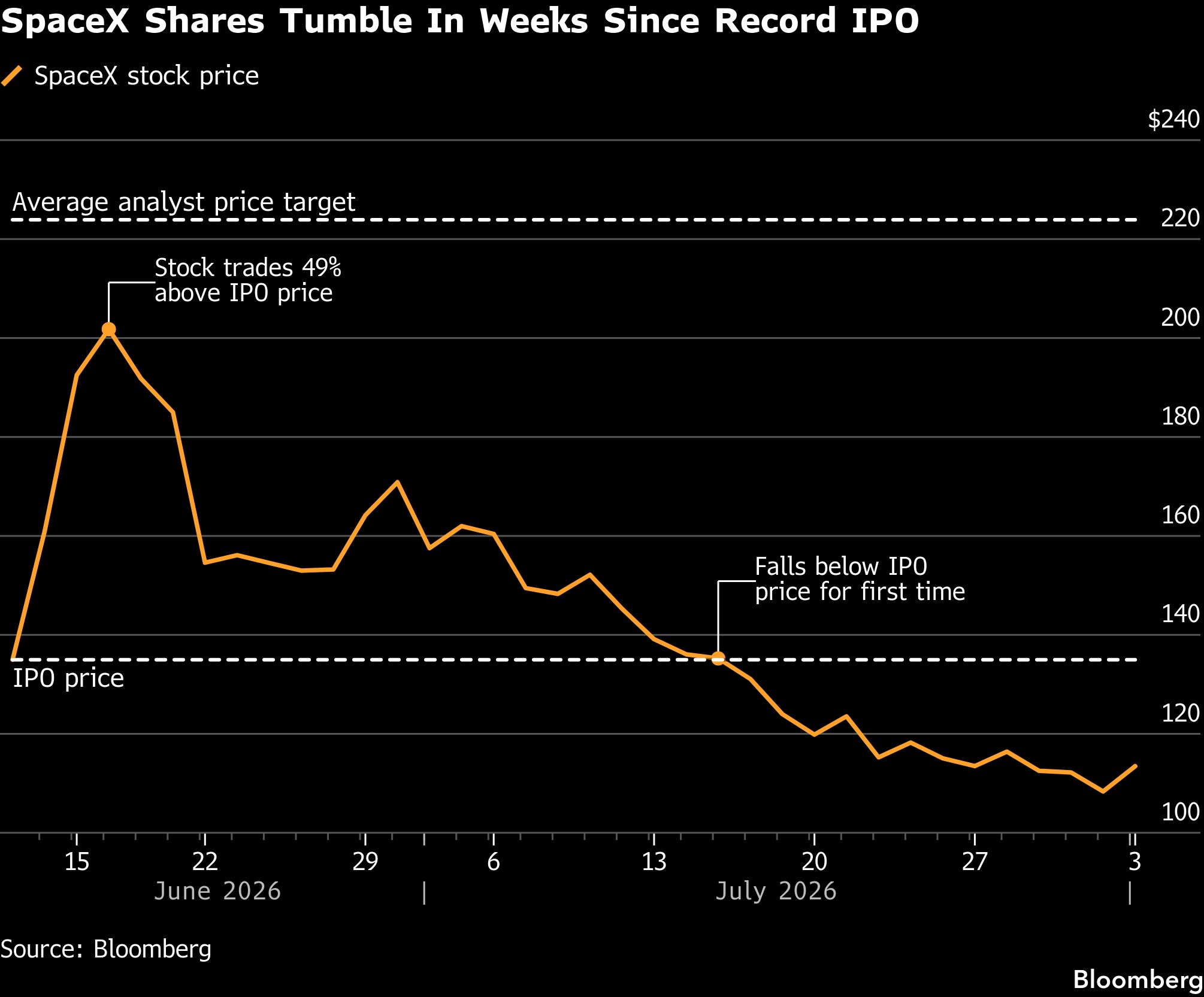
Elon Musk’s satellite, space and artificial intelligence company went public at $135 in June, and the shares have been on a roller coaster ride ever since, shooting up to $225 in the first days of trading and then plunging below the offering price. They closed Monday at $114.53, down 15% from the IPO and 49% from their high on June 16, erasing more than $1 trillion in market value from that peak.
See more: Can SpaceX Fire on All Cylinders?
SpaceX shares did rise 5.7% on Monday after tumbling 37% in July, and they’re up again early in Tuesday’s session, climbing 3.2% to roughly $118.

Earnings will give investors a chance to reassess the stock and the expectations for a bright future that have made analysts almost universally bullish on the company. The problem is SpaceX isn’t profitable and has a very speculative business at this point, so the results may end up raising more questions than they answer. With the shares still trading at a sky-high valuation despite the selloff, it will be difficult to entice new buyers.
“There is so much that’s in the future of the SpaceX story, so much that hasn’t been done yet, or ever, so there’s nothing to make you comfortable,” said Drew Cupps, portfolio manager and head of the 5Perspectives Growth Team investment group at Polen Capital, which owns a small position in the company. “There’s not a lot of here and now. There’s no, look at last year to justify what you should pay now.”
Wall Street expects SpaceX to report a loss of 24 cents per share in the second quarter on $6.8 billion of revenue. The results have been somewhat of a moving target, however, because so little information about the business is available. Analysts have widened their estimates for the company’s loss by 18% in the past month.
“I have very little confidence in those estimates,” said Jim Lebenthal, chief market strategist at Cerity Partners. “I don’t mean this obnoxiously, but I think they’re mostly licking their fingers and sticking it in the wind.”
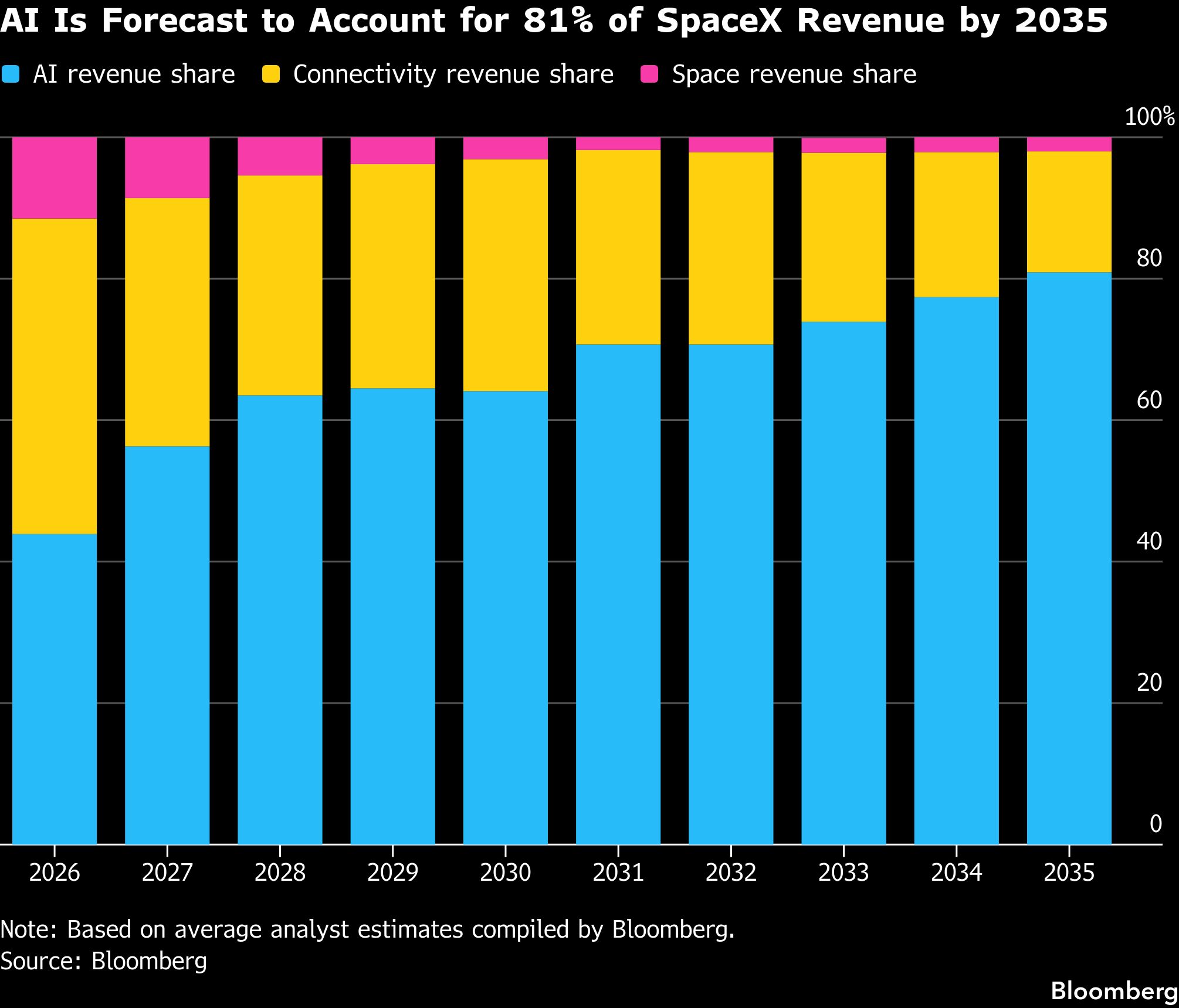
What investors and analysts will primarily be looking for is management’s comments on the company’s progress with AI, Starlink and its rocket launch business.
“We don’t have concrete earnings power that would be analogous to other parts of the market, but we do have a visionary set of massively capable assets that are in some cases unrivaled over all others,” said Polen Capital’s Cupps.
Still, analysts are widely bullish on the stock’s longer term prospects. Of the 39 analysts tracked by Bloomberg who cover the company, 30 have buy ratings. And few have backtracked on their extravagant predictions from when SpaceX went public.
Raymond James analyst Brian Gesuale is sticking with his call for the shares to reach $800 within the next 12 months on exponential revenue growth. Adam Jonas at Morgan Stanley recently reiterated his $300 price target and said that shares trading at $100 values the company’s AI business at zero, making this an attractive entry point for investors.
Bernstein’s Douglas Harned is urging investors to ignore the specifics of the earnings report alltogether and focus instead on the company’s confidence in the future.
“We believe the quarterly results should not matter,” Harned wrote in a note to clients on Friday. “What will be important is the level of confidence projected by management regarding the company’s growth path. Investors should look beyond short term stock movements as we view the case for a multi-trillion dollar valuation is about ‘if’ not ‘when’, for orbital data center plans.”
SpaceX’s results come on the heels of a strong run of earnings reports from big AI spenders, including Alphabet Inc., Microsoft Corp. and Amazon.com Inc. Investors are particularly rewarding companies that are showing clear payoffs from their capital expenditures. For example, shares of Amazon and Microsoft surged following the companies’ results.
With a market capitalization of roughly $1.5 trillion, SpaceX rivals the size of many megacap tech firms and is bigger than Musk’s other company, Tesla Inc. But its financials aren’t close, at least not yet, meaning investors may apply additional scrutiny to its spending plans. Analysts expect the company to report capital expenditures of $18.5 billion in the quarter and $45.5 billion for 2026.
The primary issue facing SpaceX shares is their extreme market valuation. The stock trades at about 448 times earnings estimated over the next 12 months, the highest multiple of any member of the Nasdaq 100 Index, and 26 times estimated sales, which is among the 10 highest ratios in the technology-heavy benchmark.
That helps explain why the short interest in SpaceX, which measures bearish bets against the stock, jumped to 34% of the company’s float, or the number shares available to trade in the market, from about 18% a month ago, according to data from S3 Partners. There are already more short bets against SpaceX than there are against Tesla.
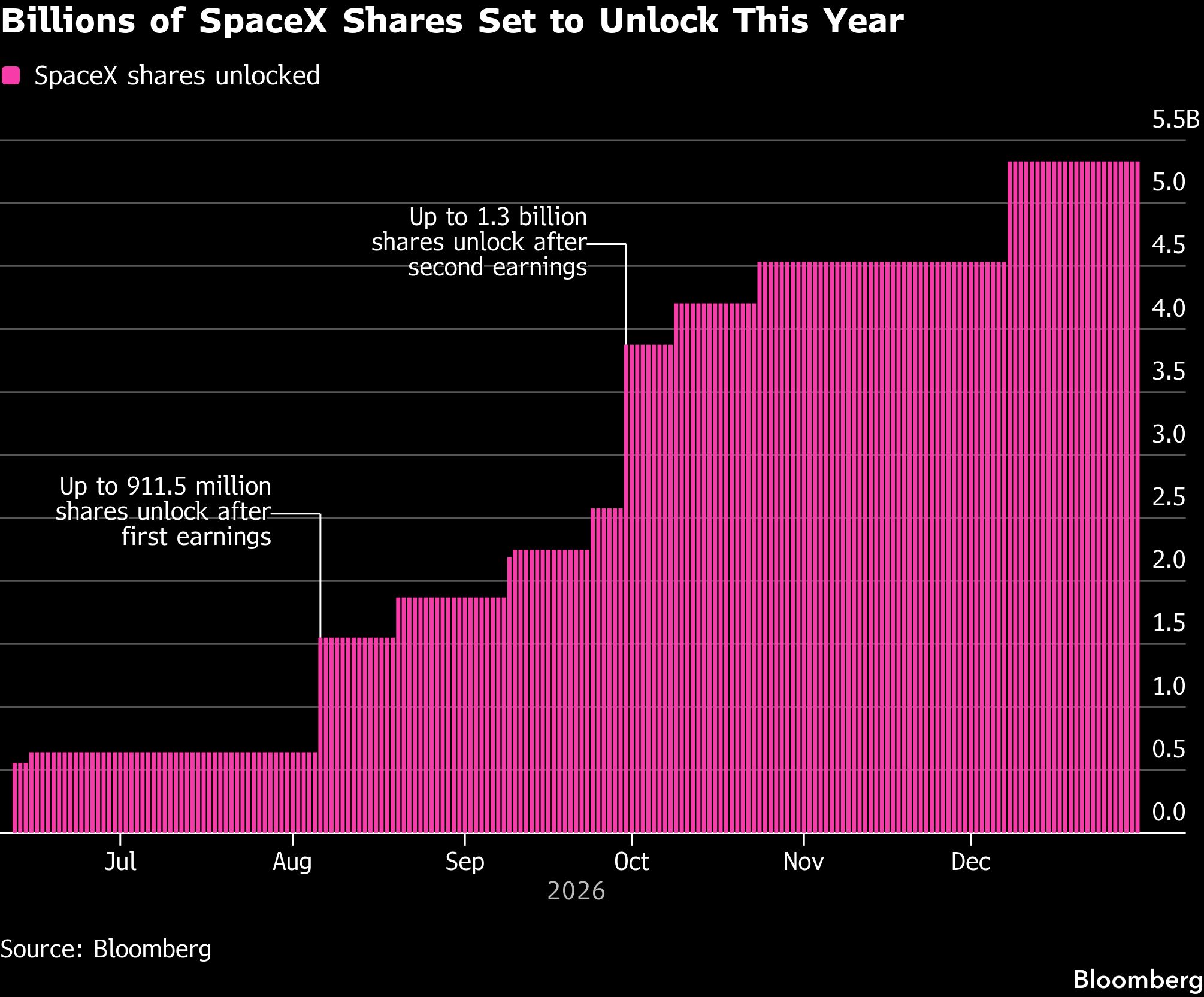
To make matters even more challenging for the stock, a flood of fresh SpaceX shares also is about to hit the market, as the first of many lockups that ban early investors from selling expires two days after the earnings report.
As many as 911.5 million SpaceX shares worth more than $100 billion will be released on Aug. 6. And that’s just the start as billions of additional shares will be eligible for trading before the end of the year. All of which will weigh on the stock price simply based on the market’s supply and demand function.
“It’s a total mess,” said Ken Mahoney, chief executive officer of Mahoney Asset Management.
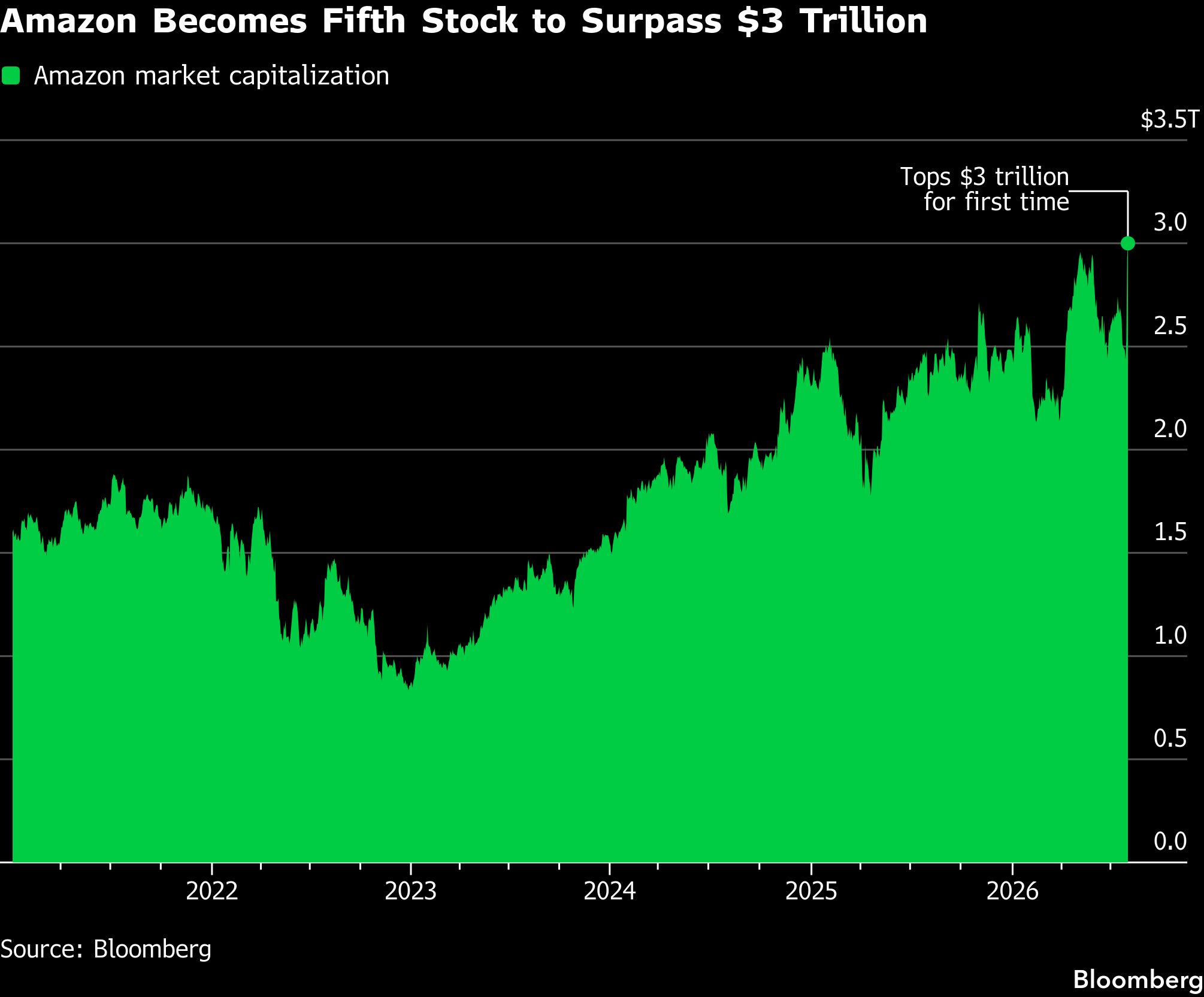
Tech Chart of the Day
Amazon.com Inc. surpassed $3 trillion in market value for the first time, becoming only the fifth company to ever reach the milestone.
A message from Advisor Perspectives and VettaFi: Discover something new! Click here to register for our upcoming webcasts.
Bloomberg News provided this article. For more articles like this please visit
bloomberg.com.
Read more articles by Carmen Reinicke, Ryan Vlastelica