A growing number of investors from the US to South Korea are using leveraged exchange-traded funds for long-term investing, a far cry from the day trading they were designed for.
In the US, Research Affiliates founder Rob Arnott spends part of his time betting against both bullish and bearish leveraged ETFs at once, seeking to profit from the quirks of their daily rebalancing rather than the direction of the market. In South Korea, the epicenter of the leveraged-ETF trend, former dentist Song Wonjun says the products helped him retire at 44 after turning them into the centerpiece of a long-term investing strategy he now teaches to hundreds of thousands of online followers.
The products have become something they weren’t built to be. Meant to magnify one-day returns, they are now being used as wealth-building plans, social-media movements and niche arbitrage trades.
South Korea’s recent AI-fueled market ructions, which roiled leveraged chip funds along with the country’s biggest technology stocks led by SK Hynix and Samsung Electronics Co., has put the ETFs back in the spotlight.
“This is some high-powered weaponry that could be used to help people’s portfolios, but also could really impair people’s portfolios,” said Christian Magoon, chief executive officer of Amplify ETFs.
The moment is striking because it comes even as money has flowed out of leveraged ETFs this year — though not before years of steady issuance expanded the universe of strategies available to sophisticated traders. A wave of launches starting in 2024 pushed global leveraged ETF assets above $200 billion for the first time, according to data compiled by Bloomberg Intelligence. New single-stock products, country funds and sector ETFs have given traders many opportunities to experiment.
Unlike conventional ETFs, which are typically used as long-term allocation tools, leveraged ETFs are designed for short-term trades that amplify an index’s daily moves. As they’ve grown more popular, they’re becoming more defined by the increasingly eye-catching ways investors are putting them to work.
That renewed attention is being fueled by exactly the kind of markets leveraged ETFs thrive in. Violent swings in artificial-intelligence stocks, semiconductor shares and other momentum trades have driven investors back toward products designed to amplify daily returns. They have also revived interest in strategies that attempt to profit not from where markets go, but from how the funds themselves behave.
‘Double Short’
One of the best-known practitioners is Arnott, a pioneer of so-called smart-beta investing. Alongside his institutional work, Arnott runs what he calls a $1 million “toy portfolio” using his own money that’s devoted largely to an unusual strategy known as the “double short.”
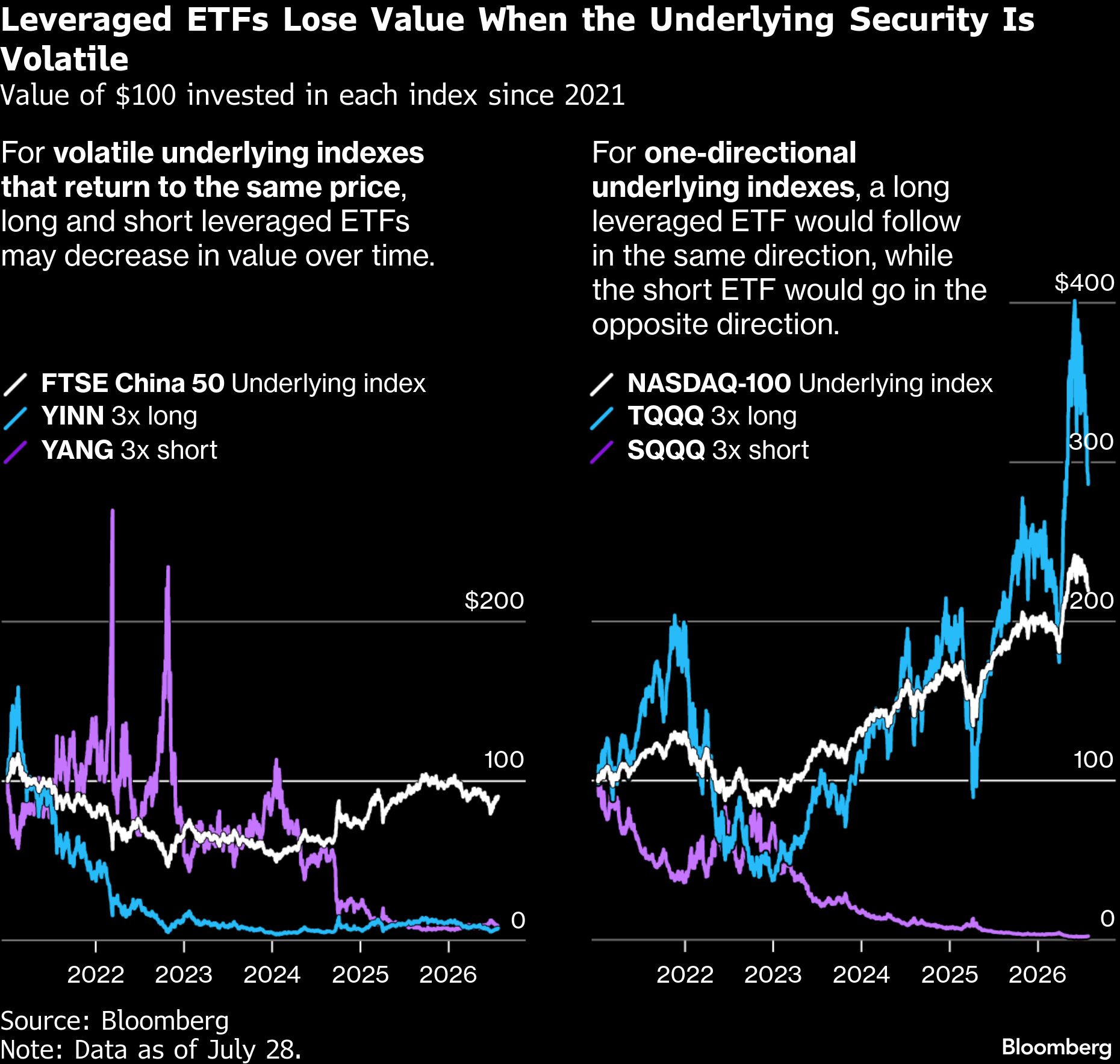
Instead of betting stocks will rise or fall, Arnott simultaneously shorts both the bullish and bearish versions of several leveraged ETF pairs. The trade attempts to capture a byproduct of the funds’ daily reset mechanism. When markets whip back and forth without a clear trend, the constant rebalancing required to maintain leverage can gradually erode returns on both sides. Traders willing to pay the borrowing costs try to harvest that erosion by betting against both funds simultaneously.
“It’s like watching grass grow,” Arnott said. “But it’s a fun little thing.”
To be sure, Arnott is a sophisticated investor, and the strategy is hardly foolproof. It works best in choppy, range-bound markets rather than sustained rallies or selloffs. Borrowing costs can overwhelm returns, timing matters, and positions often need to be actively managed.
“The products are designed to hold daily,” said Jose Carlos Gonzales, chief executive officer of Leverage Shares, whose products include leveraged ETFs tied to single stocks including SK Hynix (SKHX) and Elon Musk’s SpaceX (SPCH). “If you hold the product for a long period of time, the daily reset plays against you.”
Costs associated with Arnott’s strategy have become more pronounced as the trade has drawn attention. In one China-focused pair he uses, the cost of borrowing the bearish fund had climbed to nearly 29% a year, making it much harder for the strategy’s gains to outweigh its expenses, he said. As a result, he has pared back on it recently, while remaining invested in case borrowing costs come down.
These intricacies aren’t keeping the experimentation from moving beyond academia and quant shops to the retail scene — particularly in South Korea.
‘Infinite Buying’
When Song Wonjun first encountered leveraged ETFs during the pandemic, the advice was simple: stay away. The products were risky, complicated and intended for short-term trading.
Song, then a dentist in Seoul searching for ways to accelerate his savings, decided to investigate anyway.
“Laofus,” as he’s known online, eventually concluded that the warnings were overly simplistic. Rather than treating leveraged ETFs as trading vehicles, he says he developed strategies designed to accumulate positions over months and years through buying and rebalancing.
Four years later, Song says he made enough to retire from dentistry. It’s a pitch that attracts hundreds of thousands of followers to his daily 6 a.m. online courses for updates on strategies he calls “Infinite Buying” and “Value Rebalancing,” largely centered on funds such as TQQQ and SOXL.
“I didn’t know these products were designed for daily trading,” Song said. “You can comfortably apply swing trading strategies or invest for the long term.”
South Korean investors have become one of the largest foreign buyer bases of US-listed leveraged ETFs, pouring billions into products tied to semiconductors, AI and tech stocks — a movement that’s also taken hold in their home market.
Brokerage apps prominently display rankings of the day’s hottest leveraged funds, while online communities dissect strategies around products once considered highly specialized.
The enthusiasm has helped reshape markets — and magnify their risks. On Monday, an AI-driven selloff sent the Kospi tumbling more than 5%, with shares of Samsung and SK Hynix sliding nearly 9% each. That followed a surge of about 27% and 30%, respectively, in the previous session, itself a rebound from a massive a AI-driven selloff in the last days of July. A measure of the Kospi’s 30-day volatility surged to a record on Monday.
Extreme movements like that are precisely why experts say these products should never become retirement plans. For investors like Song, it’s part of the attraction.
“Without leverage,” Song said, “one cannot change a normal life.”