Richard Driehaus, the late Chicago money manager who helped popularize momentum investing, took exception to the mantra of buy low, sell high. “I believe that far more money is made buying high and selling at even higher prices,” he told Jack Schwager in his book The New Market Wizards. Driehaus, who died in 2021, has been vindicated over and over in recent decades, which is worth remembering after the S&P 500 Index broke out to its latest all-time high.
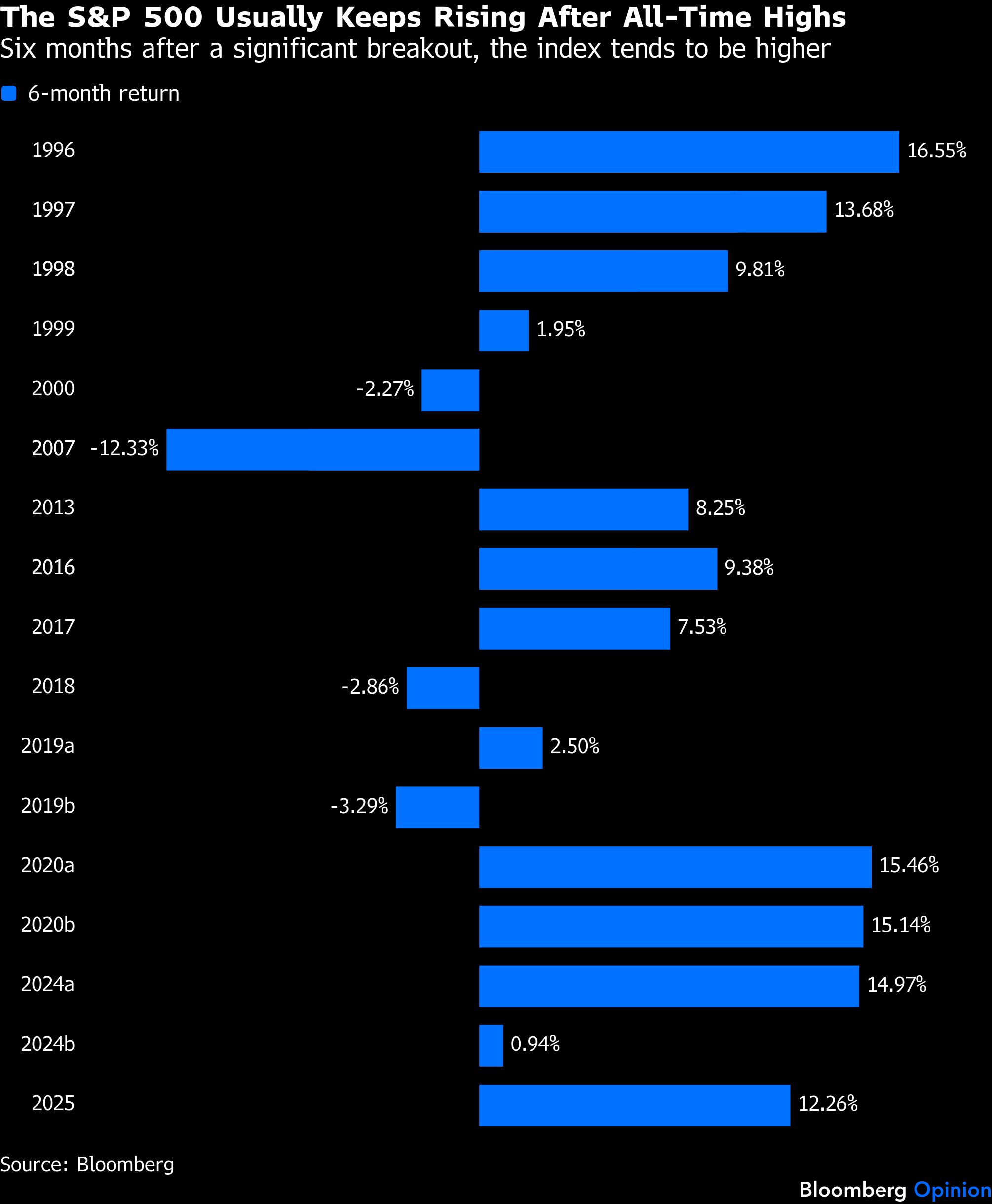
The new record came after a two-month gap (43 trading days to be exact), as investors grew optimistic about peace talks with Iran and the prospect of lower crude oil prices if the Strait of Hormuz opens. This type of breakout, after a drought of more than 40 days, has happened on 22 other occasions in the past 30 years. The S&P 500 was higher six months and 12 months later in more than 70% of those episodes.
Nothing’s a sure thing, but this sure feels like a Driehaus kind of market.
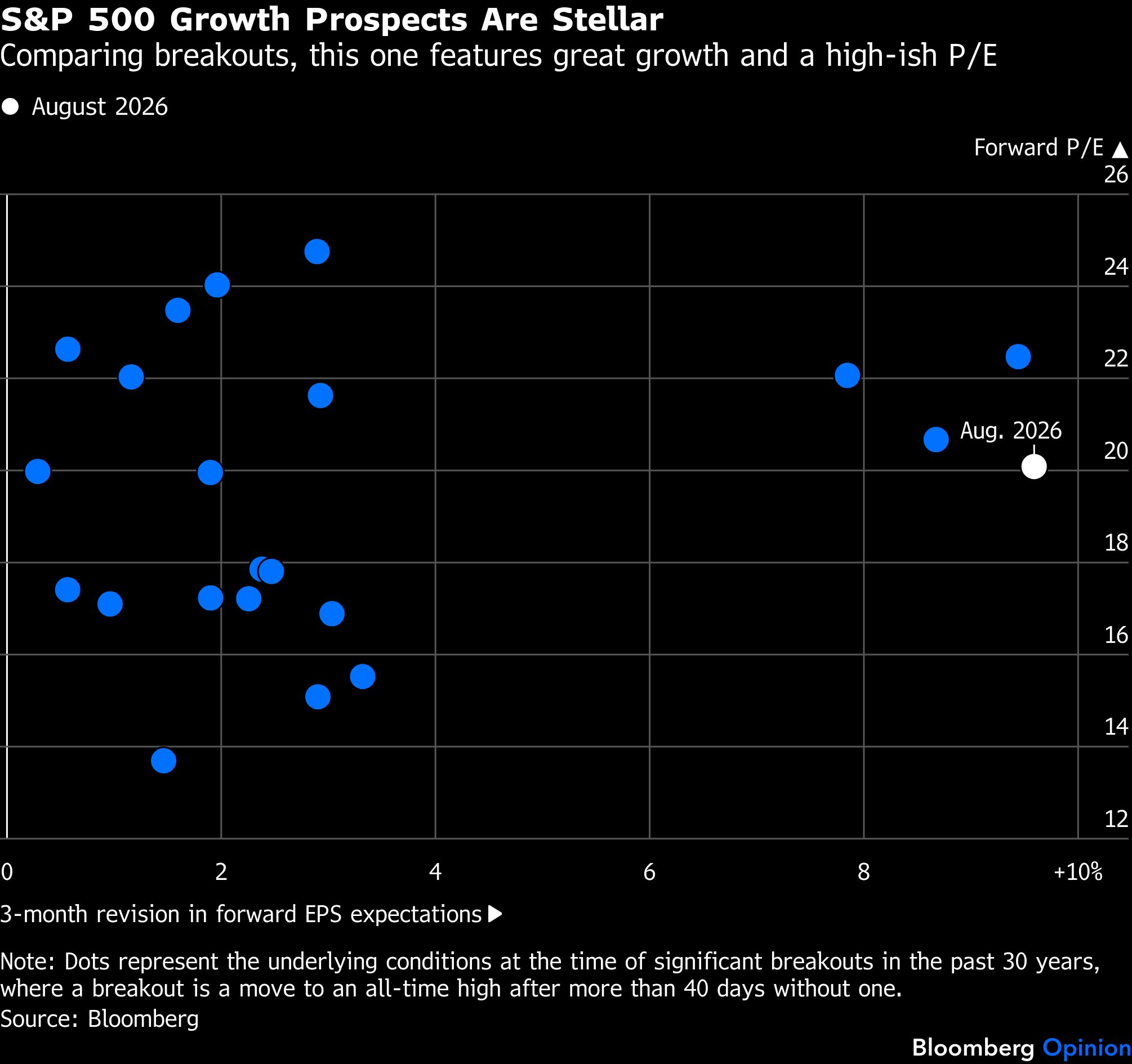
Tuesday’s breakout looks uniquely promising on one front: the earnings trajectory, powered by the artificial intelligence boom and resilient US consumption. Not only are second-quarter earnings on pace to grow by an extraordinary 29%, but analysts are also revising up their earnings-per-share estimates for the next 12 months at a stunning clip. Never before in my 30-year sample has there been a breakout at a time when EPS estimates were up 9% from the previous three months.
But that’s all priced in at these valuations, right? Yes and no. Even as earnings estimates have soared, a constellation of factors has conspired to drag forward price-earnings ratios lower throughout much of 2026. There’s been the Iran war, monetary policy concerns and general jitters about the ability of AI companies to transform eye-watering investments into profits. Forward price-earnings multiples are still on the high side of history, but they’re now lower than they’ve been during three-quarters of the breakouts we’ve experienced in the past five years. If you liked stocks at 23 times earnings in late 2025, presumably you love them now!
The risks are essentially twofold. First, even if the Iran-war shock really does resolve itself neatly, the one constant in Donald Trump’s presidencies is that another shock is always just around the corner. In Trump’s 18 months back in office, he has manifested two large selloffs of 19% and 9% — the Liberation Day tariffs and then Iran. That’s no easy task in a market with fundamentals this strong. The last time a significant breakout really fizzled was in 2018, when Trump 1.0 was roiling markets with his geopolitical antics.
The second risk is that the earnings momentum for hyperscalers including Alphabet Inc. and Meta Platforms Inc. starts to cool. In that view, the decline in forward P/E ratios is a warning signal that Wall Street analysts are yet to heed. That’s plausible, but investors can still stomach a slowdown in earnings growth from 29% to 20% much easier than they’d process an outright decline in profits.
On that note, it’s worth ending with another one of Driehaus’s aphorisms, also from Schwager’s famous book of market wisdom: Don’t try to time the market. The point isn’t that this breakout is a slam dunk buying opportunity — just that most all-time highs tend to beget subsequent ones, and the historical odds are against those who try to get clever and cash out at “the top.”
When the market retook all-time highs just two months after the haphazard rollout of “Liberation Day” tariffs last year, the unresolved policy risks made buying the rally seem foolhardy. In retrospect, it looked prescient. As Driehaus said: “The moral is that the penalty for being out of the market on the wrong days is severe — and human nature being what it is, those are exactly the days that most people are likely to be out of the market.”